By Petty Pablo | Lead Social Analyst
Online fame doesn’t always look like red carpets and brand deals. Sometimes it looks like a 21-year-old thirst-trapping to throwback hits, a fan base old enough to have mortgages and grown kids, and a steady slide from “supportive community” into boundary-free obsession.
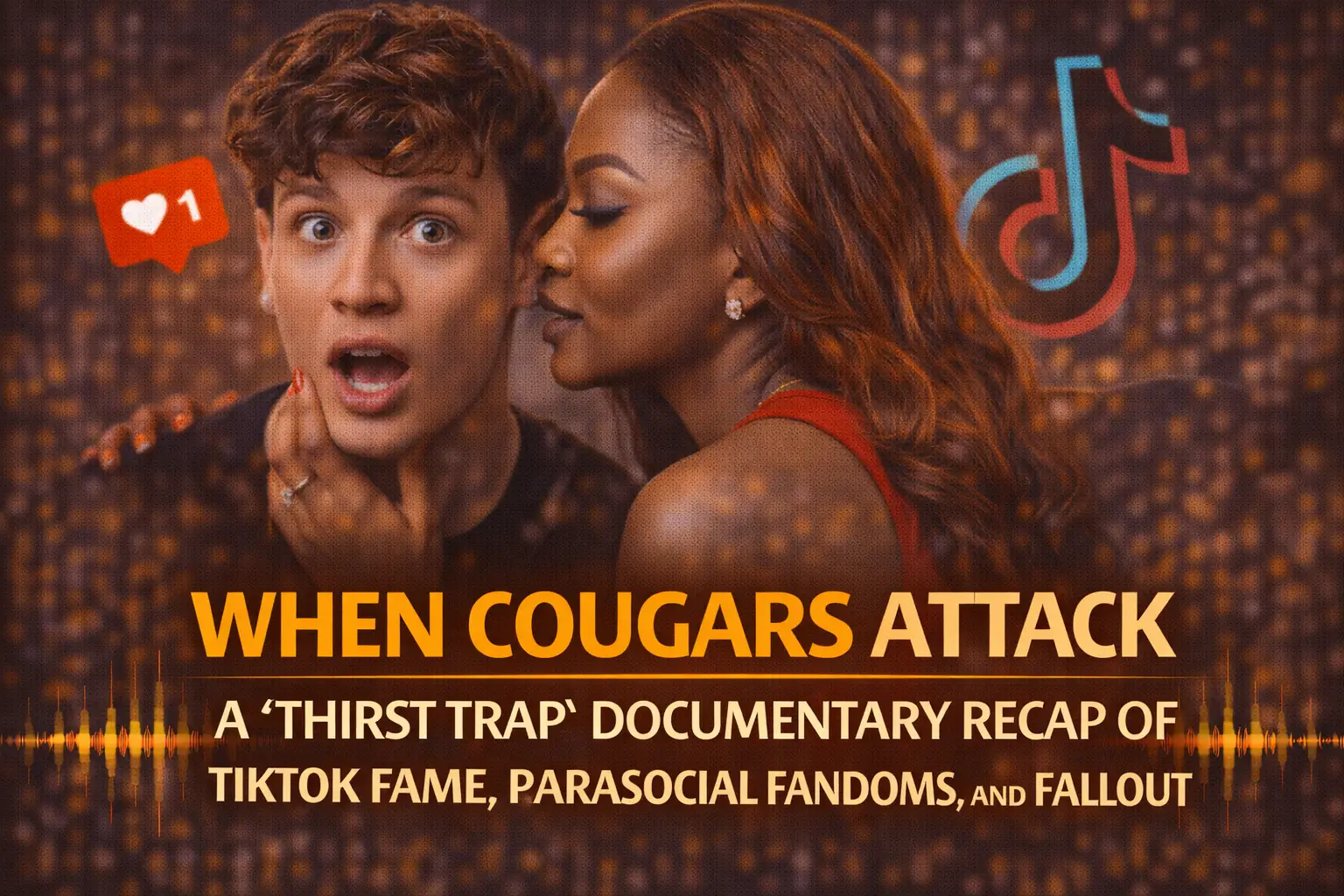
In Kennie J.D.’s video, she recaps the two-part docuseries Thirst Trap: The Fame. The Fantasy. The Fallout, centered on William White (known online as “Whitey18”) and the middle-aged fandom that, according to the documentary, began showing up in his real life. The result is messy in a way that’s hard to classify, because it’s not just one villain. It’s a pile-up of clout, loneliness, money, projection, and people making choices that don’t age well.
A quick New Year check-in, plus why this documentary is such a “doozy”
Kennie opens on a familiar vibe: it’s the New Year (even if the calendar’s already moved on a bit), she’s celebrating a birthday (31), and she’s not pretending the world is calm right now. Then she flags the obvious: this episode isn’t one of her usual pop culture series entries. Instead, she’s bringing viewers something she describes as “stupid enough” to be entertaining, until it isn’t.
The core framing is simple: a “thirst trap” creator gets popular during peak pandemic isolation, an older fan base rallies around him, and then the attention mutates into something much darker. Kennie’s recurring theme is that everyone involved has their own brand of dysfunction, just at different volumes. William can come off as cocky and transactional, yet still ends up positioned as a target. The fans can sound lonely and sincere, right up until the behavior turns invasive.
The documentary’s hook is the same hook that powers a lot of modern internet stories: parasocial closeness plus constant access. Add money to that, and the boundaries start to look optional.
Sponsor spotlight: Raycon, “new year, same bills,” and an airport reality check
Before getting into the documentary, Kennie does what creators have to do: pay the bills. She also shares a personal update about freezing her eggs, describing the process as physically and mentally taxing, and making it clear she’s not eager to repeat it.
Today’s sponsor is Raycon, with a focus on the Raycon Essential Open earbuds. Kennie highlights a specific appeal: they sit on the ear instead of going into the ear canal, so you can still hear what’s happening around you. In her example, that matters in an airport, where you want to catch gate announcements while still listening to something familiar and comforting.
Here’s the quick breakdown she emphasizes:
| Feature | What it means day-to-day |
|---|---|
| Open-ear design | You can hear your surroundings while you listen |
| Battery life | Up to 36 hours with the case, up to 8 hours on the buds |
| Lower cost | Priced below many premium audio brands |
The latest hyperfixation: press-on nails (and trying to be “responsible”)
In a quick detour that feels like a palate cleanser, Kennie shares a current obsession: press-on nails. She frames it like a sequel to her past Squishmallow fixation, except this version comes with “organization” and the ability to reuse sets.
The logic is relatable: a $30 reusable set can feel easier to justify than repeated salon visits, especially if you’re the kind of person who likes switching up looks often. It’s a brief moment of normal life before the documentary’s tone starts escalating.
How William White (Whitey18) got famous: pandemic TikTok, throwback songs, and thirst traps
The documentary’s early chapters, as described in Kennie’s recap, begin where a lot of internet fame stories begin: in 2020 and 2021, when boredom and loneliness were high, and scrolling became a routine.
William White, a young man in his early 20s (Kennie notes he’s not from the United States, and appears to be Canadian), starts posting TikToks under the name “Whitey18.” His content isn’t revolutionary on paper, because plenty of creators were lip-syncing at the time. The twist is the song choice. Instead of chasing whatever was trending that week, he lip-syncs to older hits, especially from the 1970s and 1980s.
According to Kennie’s description of the doc, that choice lands hard with an older audience. A big chunk of his fans are women roughly 45 to 65, who don’t just think he’s “cute.” The documentary presents many of them as openly, aggressively thirsty, using language and energy that reads less like casual celebrity-crush fun and more like fixation.
That’s where Kennie’s commentary sharpens. She draws a line between noticing an attractive adult and loudly building a public fantasy around someone young enough to be your kid. Even if William is legally an adult, the age gap is part of what makes the dynamic feel off, because the fandom isn’t subtle about why they’re there.
One reason the story accelerates fast is that William doesn’t just gain views, he gains spenders. Kennie highlights a key detail from the documentary: after fans pushed him to set up ways to receive money (like PayPal and TikTok gifting), he reportedly receives $60,000 in about 12 hours.
That’s where the relationship shifts. It’s no longer only “I like your content.” It becomes “I fund your life,” which can create a sense of ownership even in healthy fan communities. In this story, “healthy” is not the dominant flavor.
The documentary, as summarized by Kennie, also shows William moving into more mainstream visibility. He gets TV appearances, publicity as an “attractive TikToker,” and signs with a modeling agency. Kennie mentions him meeting Barry Manilow, which matters because the fandom’s obsession spikes around one particular lip-sync performance to “Mandy.”
Kennie also points out a humbling internet truth: someone can have millions of followers and still be totally unknown outside their bubble. Fame isn’t universal anymore. It’s segmented, audience-specific, and sometimes age-specific.
For a quick guide to the docuseries and where it’s available, see Decider’s “Thirst Trap” overview page.
“Mandy” and the rise of the fan groups, including the Grotto Girls
In the documentary’s telling (as Kennie recaps it), the “Mandy” lip-sync is treated like a canon event. Fans talk about it with the kind of reverence usually reserved for a pop star’s breakout single, except William is lip-syncing, not releasing music.
From there, fan activity becomes organized. Groups form on platforms like Facebook, and different sub-communities develop their own tone. Kennie singles out one group as especially important to the storyline: the Grotto Girls.
In her recap, the Grotto Girls are portrayed as high-engagement, high-investment supporters, including women with marketing and promotion experience. The group also leans heavily into William as a sex symbol, circulating shirtless photos and content focused on his body.
Kennie’s commentary here isn’t anti-sex or anti-desire. It’s about the collision of things that don’t mix well:
- intense sexualization
- a wide age gap
- a “mothering” tone that shows up in the same space as the thirst
- and a creator who benefits from the attention, but doesn’t enforce consistent boundaries
That mix produces a relationship that can look caring on the surface (gifts, support, encouragement), while quietly normalizing access that no stranger should have.
A major tension point in Kennie’s recap is how much of the access seems self-created. Fans send gifts (some practical, some pricey), and the line between “fan mail” and “real-life involvement” gets thin fast.
Kennie describes fans sending items to where William is staying, calling places he’s at while he’s live, and even trying to pay for meals. That leads to the obvious question: how do fans know where he is?
The documentary’s implied answer, as Kennie frames it: William often tells them. Maybe not always directly, but enough that the crowd can connect the dots. Kennie also notes that his mother appears in the documentary, and at first, she doesn’t see an issue with fans having an address for sending items. That early comfort quickly looks like a mistake once fans start showing up.
William attempts to set boundaries, but Kennie emphasizes the inconsistency. The pattern she describes looks like this:
He draws a line, fans push back, he retreats to keep them happy, then the cycle restarts.
That push-pull matters, because it teaches the audience a lesson: if you complain loud enough, you’ll get access again. Over time, the “ask” becomes bigger. The doc includes examples of group trips where multiple fans travel to places William might be, hoping to run into him.
Kennie’s reaction is basically, “This is beyond.” Not because fans can’t travel, but because traveling with the goal of “accidentally” finding a stranger is the kind of behavior people only excuse when they’ve stopped treating the creator like a real person.
The Disney Mama storyline: an alleged private encounter, then a public fandom meltdown
One of the documentary’s most talked-about plot points, in Kennie’s recap, involves a fan known as “Disney Mama.” During a trip connected to a charity event, William invites fans to attend if they buy tickets. The doc then depicts fans locating his hotel and gathering around the lobby.
According to Kennie’s summary, Disney Mama claims she had a private encounter with William. The documentary presents her describing him as the initiator, while also showing how complicated “consent plus fandom” can be when one person is a devoted supporter and the other is the object of that devotion.
Kennie doesn’t try to reduce it to a simple headline. Instead, she points out why the whole situation is hard to map:
- The fan is older and part of a community that has openly sexualized him.
- William has social power because he’s the celebrity figure in the room.
- The fan dynamic can create pressure, even when nobody uses force.
- The fandom’s reaction reveals what the outrage is really about.
Because when the story goes public, the fandom’s meltdown doesn’t read like concern for boundaries. In Kennie’s telling, it reads like jealousy, betrayal, and punishment. People who were doing similar behavior (tracking him, traveling to see him) suddenly frame Disney Mama as uniquely out of line, because she “got the fantasy.”
That’s a pattern Kennie keeps returning to: people will tolerate boundary-crossing until someone else crosses it first.
When the fandom turns into a fight: blocking, shaming, doxxing allegations, and retaliation
As the story progresses, Kennie describes a “war” phase, where William is frustrated with fans and starts blocking people aggressively during lives. A pop culture commentator in the documentary compares it to a messy breakup, where both sides feel entitled, unheard, and quick to escalate.
One fan featured in the documentary is Storm, who criticizes William’s family choices around what appears on his streams. Then the conflict spills outward. Kennie describes accusations being thrown around, personal attacks, and people trying to hurt each other offline (for example, contacting workplaces).
A particularly disturbing example in Kennie’s recap involves someone subscribing to Storm’s adult content platform and sending images to her adult child. Kennie treats this as a “what was the point?” moment, because it crosses from online arguing into targeted humiliation.
The important part, structurally, is that this phase isn’t about William’s content anymore. It becomes about control, status inside the fandom, and punishment. The creator is still the sun in the solar system, but the planets start crashing into each other.
The documentary’s “twist”: alleged explicit videos, a leak, and unanswered questions
Kennie flags a late-documentary turn that she clearly didn’t expect. According to her recap, the documentary introduces claims about explicit private videos circulating in fan spaces, including a set that allegedly involves a relative being present.
Kennie’s biggest frustration here is straightforward: the doc drops a shocking detail, then doesn’t answer the most basic questions viewers would have. Who had the content? How did fans get it? Why did it exist in the first place? Who spread it, and why?
In Kennie’s retelling, the documentary suggests the content was sold behind an anonymous account, then spread widely. The fallout reportedly includes job and relationship consequences for William, while the broader fan conflict keeps raging.
Even in a story already packed with strange behavior, this twist underscores the central problem: once private content enters a fandom ecosystem, it stops being “private” in any meaningful sense. It becomes currency.
For another take on the series framing and its bigger themes, here’s Decider’s “Stream It or Skip It” review of “Thirst Trap”.
Rehab, religion, and an open invitation that suggests the lesson still didn’t land
Near the end of Kennie’s recap, the documentary touches on William’s struggles with addiction and time in rehab (with limited detail). Kennie describes fans reacting in mixed ways, including supportive messages and, more alarmingly, guilt-inducing comments when he isn’t online.
That’s the parasocial trap at full strength: the creator becomes an emotional support object. When he disappears, some fans treat it like abandonment, not a human being taking care of himself.
The doc then shifts again into a “fresh start” narrative. William spends time with a very religious uncle, reconnects with faith, and travels to Greece for a baptism. Kennie’s reaction is immediate and practical: after everything that happened, why would you invite fans to this?
According to her recap, he does exactly that, extending an open invitation. So even after stalking allegations, location drama, and fandom implosion, the access remains.
At that point, Kennie ends where many viewers likely end: unsure what the “lesson” was supposed to be, because the behavior patterns don’t fully change.
Conclusion: what this story says about older fandom, loneliness, and the cost of being “too available”
Kennie’s closing argument isn’t that desire is bad or that older women shouldn’t feel wanted. It’s that unmet needs, isolation, and nostalgia can become combustible when they attach to a very young internet figure who encourages closeness, then resents it.
The documentary, through Kennie’s lens, is a cautionary tale with no clean hero. William benefits from attention and money, but also becomes a target. Fans build community, but also normalize invasive behavior. And the platform environment rewards intensity, right up until intensity turns destructive.
If there’s a final gut-check moment, it’s this: sending life-changing money to a stranger doesn’t buy a relationship, and it doesn’t create the right to access someone’s real life.
If you want to support Kennie J.D. beyond watching, the video description points to channel membership perks on YouTube, plus her social accounts (Instagram and Bluesky as @kenniejd, TikTok as KennieJD, and Twitch as NotKennieTV).
Learn more about Pulse of Fame and our editorial team. Want to weigh in? Join the conversation in the Pulse of Fame community forum.
Related: Karamo Show Recap: She Says She Got Pregnant Making OnlyFans Content, He Denied