By Petty Pablo | Lead Social Analyst
When a celebrity home gets targeted, the story is never just about property damage. It’s about access, safety, and the weird ways fandom can turn into a one-sided storyline that feels “real” to the wrong person.
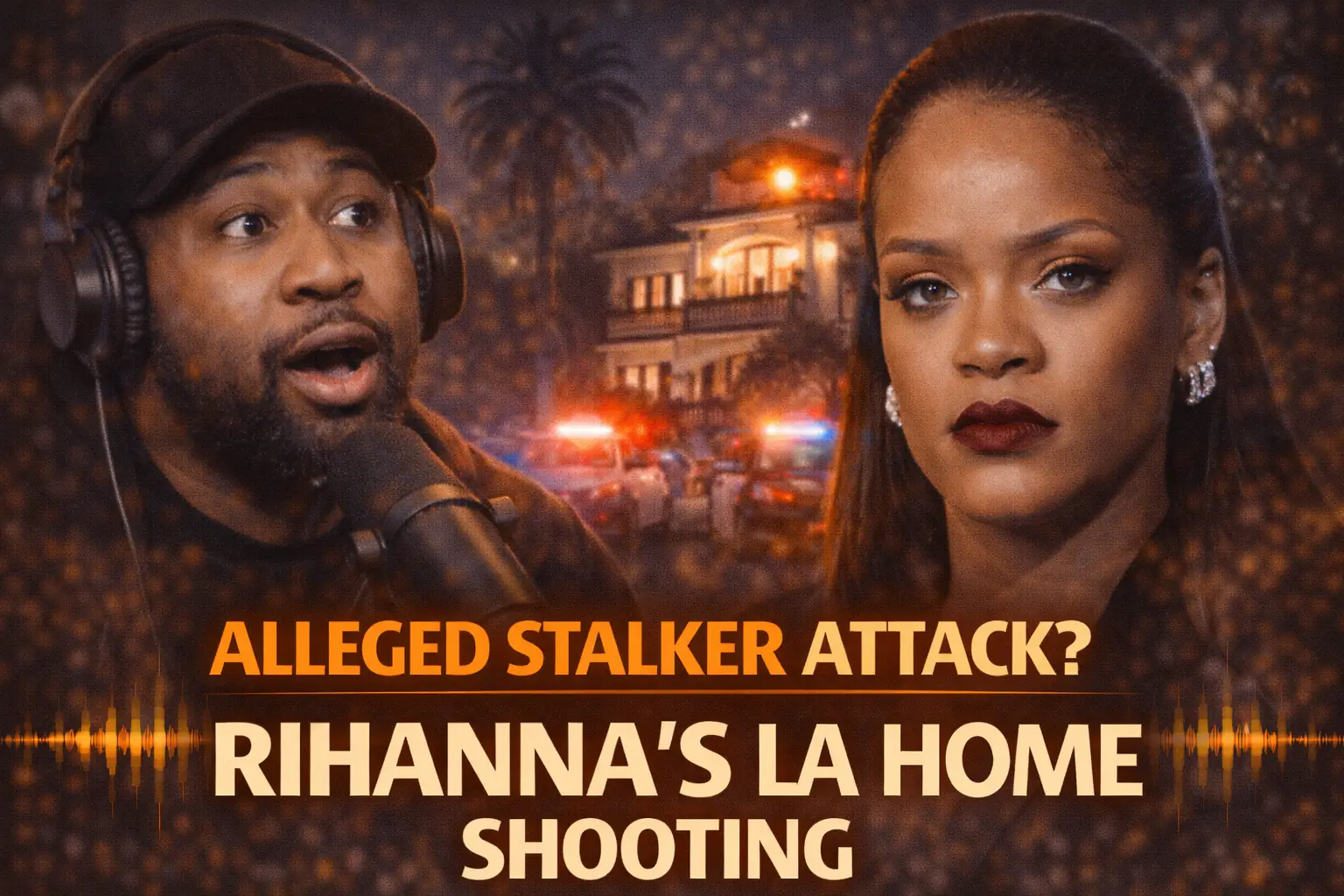
In a livestream reaction, King Akademiks discussed reports that a woman allegedly fired multiple shots at Rihanna’s Los Angeles-area home, then fled in a Tesla before police arrested her. Along the way, he zeroed in on the bigger issue: how celebrity life attracts not only thieves, but also obsessive strangers who think they’re part of the artist’s world.
What reportedly happened at Rihanna’s home
Akademiks frames the incident as both shocking and familiar, familiar because high-profile homes are constant targets, shocking because this one reportedly involved gunfire rather than a break-in.
According to the coverage he reacted to, a woman allegedly pulled up and fired around 10 shots toward the property’s front gate area. In the police audio Akademiks played (from a scanner-style broadcast), dispatch chatter describes a shooting “just occurred,” with 10 gunshots fired from a vehicle at the gate, and the suspect vehicle described as a white Tesla.
One detail Akademiks keeps coming back to is how fast something like this escalates. A person doesn’t need to get inside a home to create chaos, especially if a family is present. He also notes how unsettling the motive seems, not a robbery angle, but an obsession angle.
Akademiks also references reporting he watched that claimed Rihanna was inside the home during the incident and was not injured. He treats that as the part that flips the story from “scary headline” to “this could’ve turned tragic fast,” especially given the presence of children in the household.
For readers following the broader news coverage beyond the stream, see this report: NBC News report on the suspect identification.
Who is Ivana Lisette Ortiz
Akademiks identifies the suspect as Ivana Lisette Ortiz, described as being from the Orlando, Florida area. The stream’s tone shifts here, from “breaking news” energy to a more sober point about how mental health issues and celebrity access can collide.
He says Ortiz’s ex-husband claimed she had previously been involuntarily committed under Florida’s Baker Act in 2023, which he explains as a psychiatric hold that can last up to 72 hours under state law. Akademiks also mentions the ex-husband said she lost custody of her 10-year-old child.
He also references prior issues with law enforcement discussed in the reports he watched, including arrests described on-air (without going beyond what he states). The key framing on the stream is that she doesn’t come off like a hardened criminal, she comes off like a person spiraling, with the kind of fixation that makes ordinary security measures feel suddenly flimsy.
Here’s the profile summary, sticking to what Akademiks discussed:
| Detail | What Akademiks said on stream |
|---|---|
| Name | Ivana Lisette Ortiz |
| Reported age | 35 (as stated in the news clips he played) |
| Reported home state | Florida (Orlando area mentioned) |
| Mental health reference | Ex-husband claimed she was Baker Acted in 2023 (72-hour hold) |
| Family detail | He said she’s a mother and reportedly lost custody of a 10-year-old |
| Arrest details discussed | Booked on attempted murder, bond discussed as over $10 million |
Akademiks’ larger point is that the public often wants a clean “why,” but stories like this don’t always come with one. Sometimes it’s not a plot, it’s a fixation.
The suspect’s online posts, and the “parasocial” problem Akademiks keeps warning about
A major chunk of the stream focuses on online videos and posts attributed to Ortiz. Akademiks describes them as erratic, including religious language, accusations, and direct callouts toward Rihanna. He also reacts to the contrast between content that looks like prayer or poetry on one platform, and more hostile posts on another.
He plays clips where the speaker claims Rihanna is harassing her, suggests Rihanna wants to harm her, and mixes that with faith-based talk. Akademiks doesn’t treat this as internet drama; he treats it as a warning sign, the kind that looks “random” until it shows up at someone’s gate.
He also notes that Cardi B gets mentioned in the same online orbit, which becomes a key setup for his later point about why top-tier artists spend heavily on security even when the threat isn’t a traditional “enemy.”
Akademiks connects it to a pattern he says he’s seen up close: fans who slide into DMs with odd certainty, insisting they have secret messages, dream instructions, or past-life ties to major artists. Most fans are normal, he says, but the tiny percentage who aren’t can be the ones who create real-world danger.
The stream’s clear takeaway is that “online obsession” isn’t always confined to comments and posts. Sometimes it travels.
Police response, scanner audio, and how the arrest reportedly happened
Akademiks plays police audio where units describe the suspect vehicle and direction of travel. In the chatter, the suspect is described as a white Tesla Model 3, and officers coordinate around Coldwater Canyon and nearby streets while attempting to confirm identifying details. Akademiks describes this as a massive response, the kind you get when shots are fired in a high-profile area tied to a globally known name.
He also notes the reporting he watched said police tracked the vehicle and arrested Ortiz at a nearby shopping mall. The stream highlights how quickly police resources shift when the situation involves gunfire and a celebrity home, especially when there’s fear someone inside could be injured.
A tight timeline, based on how Akademiks lays it out:
- Shots are reported near the property, described as fired from a vehicle toward the gate area.
- Dispatch audio describes a white Tesla leaving the scene.
- Units coordinate by radio while trying to confirm identifying details and direction.
- A helicopter is referenced in the coverage he watches.
- The suspect is reportedly taken into custody at a shopping mall.
- Akademiks says she’s booked for attempted murder and held on a very high bond (he cites $10 million-plus).
For another version of the arrest-and-charges coverage Akademiks was reacting to, FOX 11 also posted related reporting: FOX 11 Los Angeles coverage of the charge.
Akademiks’ bigger point: celebrity security isn’t “extra,” it’s the job
One of the more interesting turns in the stream is how Akademiks uses this story to revisit a conversation he says he had with Cardi B about the cost of security. He describes previously thinking the spending sounded excessive, then watching this Rihanna story and basically admitting, “Okay, I get it now.”
His reasoning is simple: security isn’t only about “haters.” It’s also about overly invested strangers who think they’re in a direct relationship, conflict, or secret storyline with the celebrity. Akademiks frames this as the darker side of parasocial culture, where access to artists (music, interviews, livestreams, social posts) becomes fuel for someone already unstable.
He also brings up other public examples to underline the point that fame can attract dangerous fixation, not just ordinary attention. On the stream, he references cases like John Lennon and Selena as cautionary examples of what can happen when obsession crosses into real life.
Akademiks also comments on Rihanna’s family life and says that when children are in the picture, the entire risk calculation changes. He wonders aloud what A$AP Rocky thinks, and then pushes a blunt message: if you’re at that level of wealth and visibility, 24-hour security around primary residences shouldn’t be optional.
He’s not speaking as a security professional; he’s speaking as someone reacting in real time to how thin the line can be between “internet weirdness” and “someone at your gate.”
Why he thinks the attempted murder charge could get complicated
Akademiks spends time on the legal framing too, and he’s careful to separate emotional reaction from what he believes prosecutors can prove.
His argument goes like this: “attempted murder” is a serious charge, but it often requires proving intent to kill a specific person, not just proving that someone did something reckless and dangerous. He suggests that if prosecutors can’t show the suspect knew Rihanna was home, or can’t show a clear plan to target her specifically, the attempted murder charge might be hard to sustain in court.
He also touches on how prior online statements could be interpreted. In his view, a person saying hostile things online isn’t the same as a direct, provable statement of intent like, “I’m going to this location to kill this person.” Akademiks’ bottom line is that charging decisions and plea deals can look “soft” to the public because the legal system requires specific elements to be proven.
He also ties this back to mental health “revolving door” concerns, referencing the Baker Act concept he explained earlier. A short involuntary hold might stabilize someone for a moment, but it doesn’t automatically resolve long-term risk, especially if the person refuses ongoing treatment.
Akademiks’ repeated concern is that the system often reacts after the danger shows up, not before.
Rihanna’s history with home intrusions, and why this story hits harder
Akademiks also brings up prior incidents involving Rihanna’s homes, including reports of a break-in where an intruder stayed inside for hours before being discovered by an assistant, plus later burglaries tied to broader celebrity-targeting crime patterns.
He uses that history to support a point that’s uncomfortable but real: for major stars, “home” is a workplace perimeter. It’s an asset, a symbol, and a target, sometimes for money, sometimes for attention, and sometimes for someone’s private obsession.
He also reacts to commentary suggesting the home isn’t inside a gated community, which he treats as another factor that can make access easier. His tone here isn’t blame-y; it’s more like a grim reminder that privacy is expensive, and even then, not guaranteed.
Timeline of events
- Reports describe shots fired toward the gate area of Rihanna’s Los Angeles home.
- Akademiks plays police scanner audio describing “10 gunshots” fired from a vehicle.
- The suspect vehicle is described over radio as a white Tesla, and units coordinate direction of travel.
- Akademiks says the suspect is identified as Ivana Lisette Ortiz, described as from Florida.
- He cites reporting that Ortiz was taken into custody at a nearby shopping mall.
- The stream states she was booked on attempted murder and held on a bond described as over $10 million.
- Akademiks discusses alleged online posts attributed to Ortiz mentioning Rihanna (and also Cardi B).
- He notes reports saying Rihanna was inside the home and not injured.
What’s stated vs what’s alleged vs what’s unclear
| Category | Details |
|---|---|
| What Akademiks states from reports he watched | Shots were fired toward Rihanna’s home, a white Tesla is described in scanner audio, suspect identified as Ivana Lisette Ortiz, arrest and high bond, booking for attempted murder (as stated on stream), no injuries reported in the coverage he played |
| What’s alleged in the stream discussion | Ex-husband claiming a 2023 Baker Act hold, motives tied to obsession, meaning behind online posts and videos, why Rihanna may have left LA after the incident |
| What remains unclear from the stream | Exact motive, what evidence prosecutors have to prove intent, whether A$AP Rocky and the children were present at the time (Akademiks notes uncertainty while reacting), what final charges will look like after the legal process |
Conclusion
This story lands like a loud reminder that celebrity security isn’t about drama, it’s about risk management. Akademiks’ reaction isn’t just shock at gunfire, it’s frustration that obvious warning signals can sit in plain sight, online, until they turn physical. The most sobering part is how “random” these situations can look right up until they aren’t. If there’s a final lesson in the way he framed it, it’s that fame doesn’t only bring fans, it can also bring fixation, and fixation doesn’t follow rules.
Learn more about Pulse of Fame and our editorial team. Want to weigh in? Join the conversation in the Pulse of Fame community forum.
Related: Matt Rife vs TikTok’s Secret Algorithm: Akademiks on Trend Control