By Petty Pablo | Lead Social Analyst
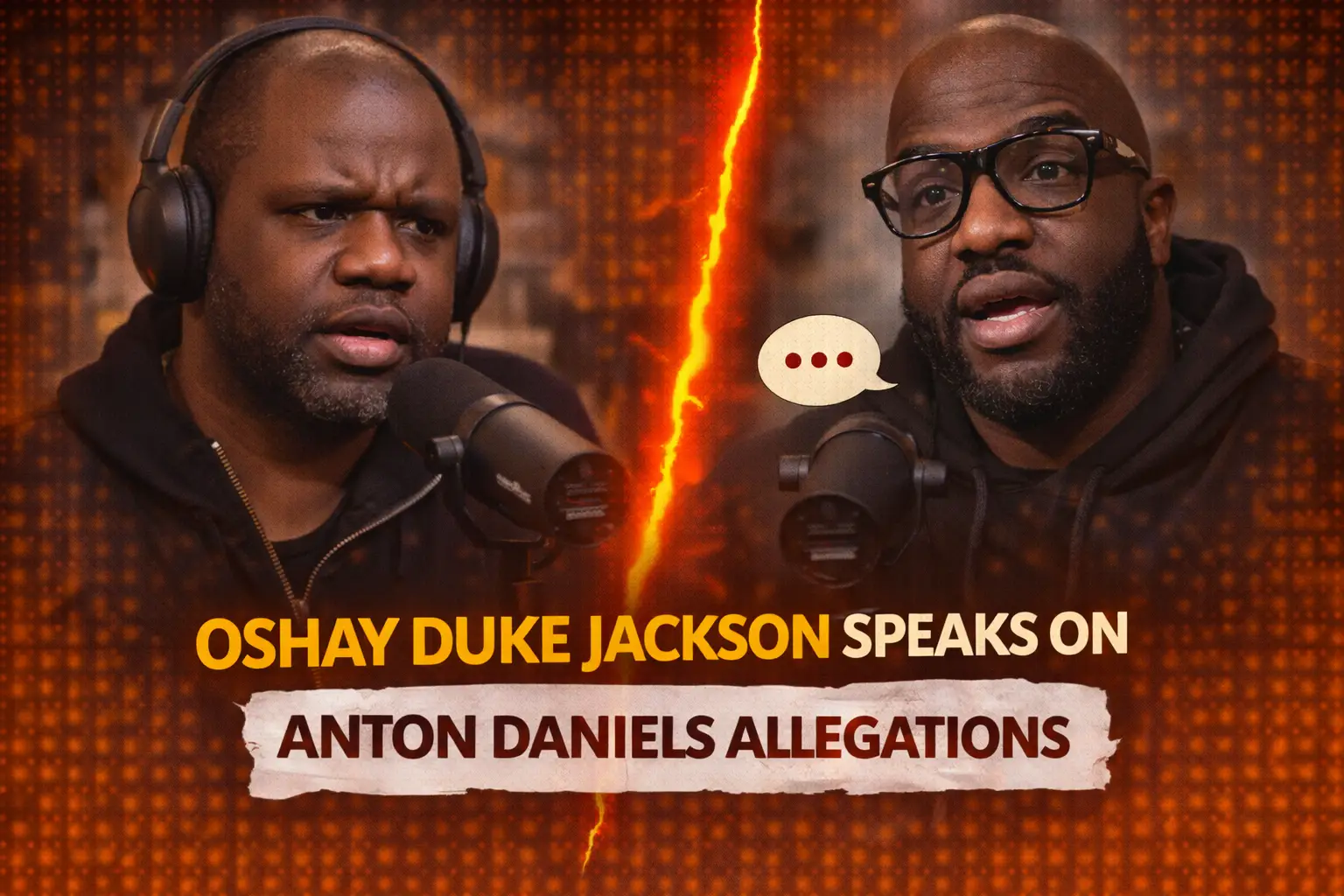
In Oshay Duke Jackson’s take on the Anton Daniels and Corey Holcomb back-and-forth, the key issue isn’t even the jokes, it’s the whiplash. Anton allegedly waved the white flag to protect his family, then showed up on Tasha K sounding ready to restart the whole thing.
How the Anton Daniels and Corey Holcomb dispute reportedly escalated
Oshay frames the situation as a dispute that got ugly fast, especially once the conversation moved from Anton to Anton’s family. In his telling, what began as the usual online roasting turned personal, and that’s the point where the “content” stops feeling like content.
He’s clear about one thing: regardless of who started what, Anton’s wife and daughter didn’t deserve to be targeted. Oshay even notes that he found himself feeling sympathy for Anton, because family members didn’t sign up to be part of a public storyline.
That matters because it sets up the standard Oshay uses for everything that follows: if the problem is that your family is getting dragged into it, then your next moves should match that priority. In other words, you can’t sell “family first” and then pivot into “run it back” energy without people noticing.
The “I give up” moment, and why it landed with viewers
Oshay points to a moment where Anton appears to surrender. The clip he references includes Anton saying he has to “pick up the pieces,” that Corey (and another person he names alongside Corey) “won,” and that he needs to figure out what collateral damage happened.
The emotional core of that message is simple: “Y’all got it, I’m done, I have to take care of my daughter.” Oshay treats that as a serious claim, not as entertainment, because it implies real-world impact on a child.
“Corey and Craig, you win. You win. I give up. I have to figure out what collateral damage happened after that.”
From Oshay’s perspective, that tone reads like someone stepping away because the cost is too high. If that’s true, the expectation becomes: stop feeding the fire, stop giving your opponent more openings, and keep your home life out of the algorithm.
The timing that Oshay calls “suspicious”
Oshay also flags a detail that, to him, doesn’t add up. He says Anton claimed his daughter was crying and had left school, yet he also notes Anton was streaming around the time she should have been in class. Oshay frames that as suspicious on its face.
He doesn’t present it as proof of anything on its own. Instead, he uses it to explain why people might re-watch the sequence and ask hard questions. If a parent says a situation is severe enough to end a public fight, viewers will naturally wonder why that same parent is live on-air narrating it in real time.
That’s the thread Oshay keeps pulling: not “what happened,” since he doesn’t verify it, but “why do the actions not match the claimed urgency?”
Why Tasha K’s platform changes the temperature
Oshay says Tasha K also doesn’t like Corey Holcomb, so putting Anton on her platform creates the perfect setup for the story to re-ignite. In his view, Anton could have tried to set a boundary, like asking for a sit-down that didn’t rehash Corey’s name, especially if his family had already been exposed to unwanted attention.
Oshay argues that’s not how these interviews work. If the main reason the guest is booked is a viral dispute, the dispute will come up. He credits “No Captivity with Freezy” for making that point land: if you step into that room, you’re stepping back into the storyline.
This is also where Oshay’s commentary gets more pointed. He says that if someone put your family “on a t-shirt” (his phrasing for the level of public disrespect he attributes to Corey), the last place he’d go is a platform likely to bring the whole thing back to the front page of the internet.
Anton’s “tough talk” on Tasha K, and the comeback of the fade
According to Oshay, once Anton got on Tasha K’s show, the energy shifted. The “I give up” posture was replaced with what Oshay describes as Anton getting back “in character,” including challenging Corey and talking about a possible boxing match.
In the clips Oshay references, Anton says the “fade” is still available, and he makes remarks about Corey’s health while also painting Corey as a jokester who uses humor as a shield. Anton also claims Corey will disrespect women but won’t take that energy to a man, which is part of his argument for why a face-to-face setting would expose what’s “really going on.”
Then the money talk shows up. Anton says that for every half amount Corey would put up, Anton would double it. Whether that’s posturing, a serious offer, or just a moment for the cameras, Oshay treats it as a key contradiction when placed next to the earlier “I’m done for my daughter” message.
For more context on how this dispute has been covered elsewhere, see this report titled Corey Holcomb and Anton Daniels nearly come to blows.
The core critique: two versions of Anton, and both raise questions
Oshay’s main argument is that viewers are watching two different presentations from the same person.
One version is the defeated father, saying he’s stepping away because the family impact is too heavy. The other version is the challenger, ready to re-engage, escalate, and re-center the dispute in public.
Here’s the contrast Oshay lays out, simplified:
| Situation Oshay references | Anton’s tone in Oshay’s telling |
|---|---|
| After remarks about family | “You win, I give up, I have to pick up the pieces” |
| On Tasha K’s platform | Fade talk, boxing talk, doubling money |
Oshay says that split leads to two possible conclusions, and he doesn’t like either.
Possibility A: clout and money come before family peace
Oshay suggests that if Anton’s family truly suffered from the online attention, then returning to a high-profile interview to revive the topic signals skewed priorities. He frames it as choosing the bag and the attention cycle over shielding a wife and daughter from another wave.
He also adds a practical point: if you already believe your opponent “doesn’t play fair,” then re-engaging publicly isn’t just risky, it’s predictable. It increases the odds of more jokes, more commentary, and more stray shots that don’t stop at you.
Possibility B: the earlier story was exaggerated or untrue
Oshay’s other option is harsher: that the earlier “I give up” moment didn’t reflect reality, and may have been used for sympathy or positioning. He argues that someone who was genuinely shaken would likely avoid giving the internet more material, especially material involving a child.
He even points back to the streaming timing as something people might use to backtrack and question the narrative. Again, he doesn’t prove it, but he says the contradiction invites scrutiny because the internet keeps receipts.
Faith, persona shifts, and why Oshay says the interview “exposed” the pattern
Oshay also brings up Anton’s self-presentation. He notes Anton describes himself as a conservative Christian, and Oshay contrasts that with behavior he labels polarizing: chasing scandals, creating moments that travel, and leaning into controversy that follows him from platform to platform.
He mentions other examples from Anton’s online orbit (including “Leif Let’s Talk,” “Ma,” and Fox News sound bites) as part of a broader critique: success is one thing, but the cost matters. Oshay says Anton is a stronger YouTube personality than he is, and more successful by platform metrics, but he questions what kind of success requires this much drama, and this much proximity to family collateral.
Oshay also claims Tasha K’s interview shows another issue: Anton’s story and demeanor shift depending on who’s interviewing him. He even jokes about whether Anton has “multiple personalities,” though he presents it as commentary, not a diagnosis. The point remains: if the story changes from room to room, people will notice, and then the credibility problem grows faster than the subscriber count.
Conclusion: the contradiction is the headline
Oshay’s video isn’t just about who said what in a messy creator dispute. It’s about the gap between “I’m stepping away to protect my family” and “let’s set up the next round,” said on a major platform where the clips will travel.
If the family impact was real, Oshay suggests re-engaging publicly is reckless. If it wasn’t real, he suggests the audience got played. Either way, the brand hit is the same: people stop trusting the story.
Learn more about Pulse of Fame and our editorial team. Want to weigh in? Join the conversation in the Pulse of Fame community forum.
Related: Dont Call Me White Girl Shares Her Side of Getting Fired by Gillie & Wallo