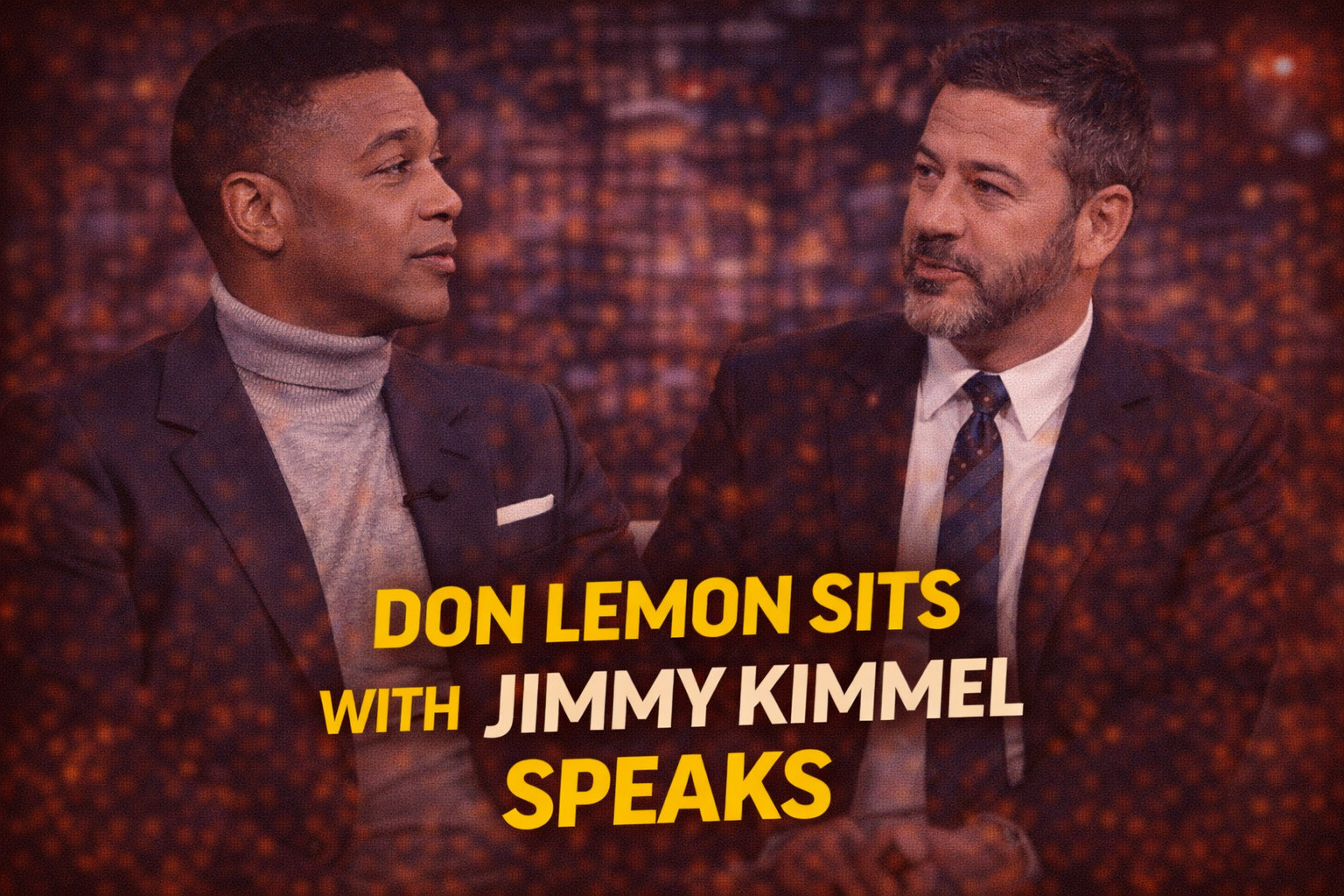
Don Lemon walked onto Jimmy Kimmel Live with the kind of smile people wear when they’re trying not to show you the stress. It was his first sit-down after being arrested.
Kimmel’s opening joke landed because the situation is real
By The Legal Eye
Kimmel introduced Lemon as a “longtime TV and digital newsman” who was arrested for “committing journalism,” framing the moment with late-night irony while still treating it like a serious event. Lemon didn’t rush to reassure anyone.
“I don’t know,” he said when asked how he was doing, then clarified that he’s okay, but also not okay. He added that he’s not letting anyone “steal my joy,” but he kept coming back to the same point: these are federal charges.
Kimmel also pointed out the obvious context. Lemon and Donald Trump have a long public back-and-forth dating to Lemon’s CNN years. Lemon joked right back that Trump “doesn’t know” him, adding, “I don’t know who he is.” It was a line built for laughs, but it also underscored the tension behind the story: Lemon believes this isn’t just about one day of reporting, it’s about making an example out of a journalist.
For readers trying to place the moment in the wider news cycle, CNN also recapped Lemon’s comments from the interview in its own write-up: CNN’s report on Lemon’s Kimmel interview.
The St. Paul church protest that set everything off
Lemon said the incident began on January 18, when he was covering an anti-ICE protest at a church in St. Paul, Minnesota. In Kimmel’s telling, protesters interrupted a Sunday service, tied to the unusual detail that a pastor at the church was also described as a local ICE official. Kimmel quipped that it sounded like something “just as Jesus would want,” leaning into the obvious irony.
The key question Kimmel raised is the one that keeps popping up in this story: is there a difference between protesters entering a church during a service and a credentialed journalist entering to cover what those protesters are doing?
Lemon’s answer was careful, since he said he’s limited in what he can discuss. Still, he drew a bright line around his role. He said he was not a protester, and that he went there to “chronicle and document and record what was happening.” He described following a group and reporting on what unfolded.
That distinction matters because the story isn’t framed as “Lemon got caught up in a crowd.” Lemon’s whole defense, as presented in the interview, is that he was doing the job: filming, observing, and reporting. The debate is less about whether the moment was disruptive (it clearly was) and more about whether documenting disruption gets treated like participating in it.
The drumbeat online, and Lemon’s claim he offered to surrender peacefully
According to Lemon, the day after the protest Trump reposted commentary suggesting Lemon should be arrested and sentenced to prison for violating the FACE Act. Lemon said he didn’t immediately assume an arrest was coming, until he noticed what he described as a “drip drip drip” of public talk from figures including Todd Blanche and Attorney General Pam Bondi.
Lemon said he retained an attorney, and that his attorney reached out to authorities with a pretty standard offer: if the government was serious, Lemon was “perfectly willing to self-report,” meaning he’d turn himself in rather than getting swept up in a public arrest. He said he never got a response.
Kimmel stressed how normal that courtesy can be, and Lemon agreed, noting that people accused of worse often get the chance to surrender. He also pointed out that Trump himself was allowed to turn himself in in his own legal situations.
Then the process got even stranger, at least as described in the interview. Lemon said the Department of Justice tried to get judges to sign off on charging him and was turned down. He described it as two judges and an appeals court, three “altogether,” before a grand jury was ultimately involved.
Lemon also offered a blunt critique of indictments in general. He said you can write “whatever you want” in an indictment, and claimed prosecutors can say things “with impunity.” That’s his perspective from researching while living through it, and it captured the mood of the segment: less procedural lecture, more a journalist reacting to the machine he’s now standing inside.
For additional reporting about the legal backstory around charging decisions, The Washington Post published a separate account: The Washington Post report on what happened behind the scenes.
The night in Los Angeles: Grammys coverage, then an arrest at the hotel
Lemon said he was in Los Angeles for Grammys week, planning to cover red carpet events. The night he was arrested, he’d attended a Black Music Collective event and a Spotify party. He described meeting younger fans who told him they watch him on TikTok, a funny reminder that his audience has shifted from traditional cable to a new, mobile crowd.
Back at his hotel, he said the arrest happened fast. He walked in carrying a swag bag, pressed the elevator button, and suddenly felt himself being jostled as people grabbed him and tried to put him in handcuffs. He said he demanded to know who they were. According to Lemon, they eventually identified themselves, but there was another issue: he said they didn’t initially present a warrant.
Lemon told Kimmel an FBI agent later showed him a warrant on a cell phone. In the chaos, his belongings fell, including his glasses, which he said he needed to read what was on the screen. He described the scene as involving about a dozen people, calling it a waste of resources, especially because, as he claims, his attorney had already offered a peaceful surrender.
He also believed the point wasn’t efficiency. Lemon said the show of force was meant to embarrass and intimidate, to create fear. Whether you agree or not, the description is vivid: the elevator area, the confusion, the scramble for the glasses, and the sense that this was staged to be seen.
Processing, custody, and the “one phone call” myth
After the hotel arrest, Lemon said he was taken to a federal courthouse holding area. He said he was photographed and fingerprinted, “the whole nine yards,” and that it happened twice. He also told Kimmel there was no strip search, and that he was placed in a holding room rather than a traditional cell.
He estimated he was held from around midnight (12:30 a.m.) until about 1 p.m. the next day. Kimmel asked the question everyone asks: who did he make his one phone call to?
Lemon said he didn’t get one.
He told Kimmel he asked for it and was told no, that he’d only speak to his attorney when the court allowed it, which wasn’t until the next day. He described finding a workaround because he still had his Apple Watch on. He used Siri to call his husband, Tim, and then his attorney (he referred to his attorney as “Abby LOL”), but both went to voicemail.
A small detail turned into the moment his husband actually realized what was happening. Lemon said he was handcuffed in the front of an FBI agent’s truck, and his wedding bracelet kept catching and hurting. Agents offered to remove it. Lemon asked if someone could bring it up to his husband in the hotel room, and one agent agreed. Lemon said that delivery is how Tim found out where he was, otherwise “no one would have known.”
Inside the holding room, Lemon said his instincts stayed journalist-mode. Without a phone, he mentally logged details: how many agents were present, who he rode with, what he observed. Even bathroom breaks were controlled. He said he had to knock, wait for someone to escort him, and an agent stood there while he used the restroom. The way he told it wasn’t melodramatic, just matter-of-fact, like someone describing how quickly dignity can become procedural.
Media attention, support from journalists, and why Lemon’s staying independent
Lemon said he realized the scale of the story when a door opened to an area where agents had monitors, and CNN was on screen with a headline stating that former CNN anchor Don Lemon had been arrested in Los Angeles. He said an agent told him, “You’ve been on all morning,” and called it a “big deal.”
He still didn’t understand how big until he walked outside. Lemon said his attorney told him to prepare a statement because people were waiting. When he exited with his husband, he described reporters, paparazzi, and even helicopters. He also worried about his YouTube channel, since it’s his livelihood now. Lemon said the channel had been live all day, for about nine hours, with guests and fill-ins including Monique Presley, an attorney and friend.
Kimmel noted how much support Lemon received from other journalists, and Lemon thanked them, plus everyday people who approached him with variations of “good to see you,” to which Lemon replied, “It’s good to be seen.”
The segment also widened beyond his case. Lemon mentioned Washington Post reporter Hannah Natanson and said the FBI searched her home, arguing it didn’t get enough attention because people are afraid. He criticized corporate media as “neutered,” describing pressures around access, deals, and fear of angering powerful people. In contrast, Lemon celebrated being closer “to the ground,” going mobile, talking to people directly, and skipping gatekeepers.
He and Kimmel ended on a practical note: if people want journalism that isn’t built around access politics, they have to support it. Kimmel plugged Lemon’s show schedule, noting it’s live at 10 a.m. and 5 p.m. Eastern on weekdays, streaming on YouTube and Twitch. If you want the official show hub Kimmel referenced, here’s Jimmy Kimmel Live’s YouTube subscription link.
Conclusion: the real takeaway from Don Lemon’s first interview after the arrest
This Don Lemon Arrest Post-Arrest interview wasn’t just a retelling of an unpleasant night, it was a clear argument about intimidation, visibility, and who gets treated like a threat. Lemon’s point, repeated in different ways, was that he showed up to document a protest, and he believes the response was designed to make that choice feel risky.
If there’s a final gut-punch detail, it’s the simplest one: he says he could have turned himself in, but instead he was taken at a hotel elevator, processed overnight, and told he didn’t get a phone call. Whatever happens next legally, the story already did what these moments always do, it forced people to pick a side on what journalism is allowed to look like. Being seen is the whole job, until someone decides it’s the problem.
Learn more about Pulse of Fame and our editorial team. Want to weigh in? Join the conversation in the Pulse of Fame community forum.