By Petty Pablo | Lead Social Analyst
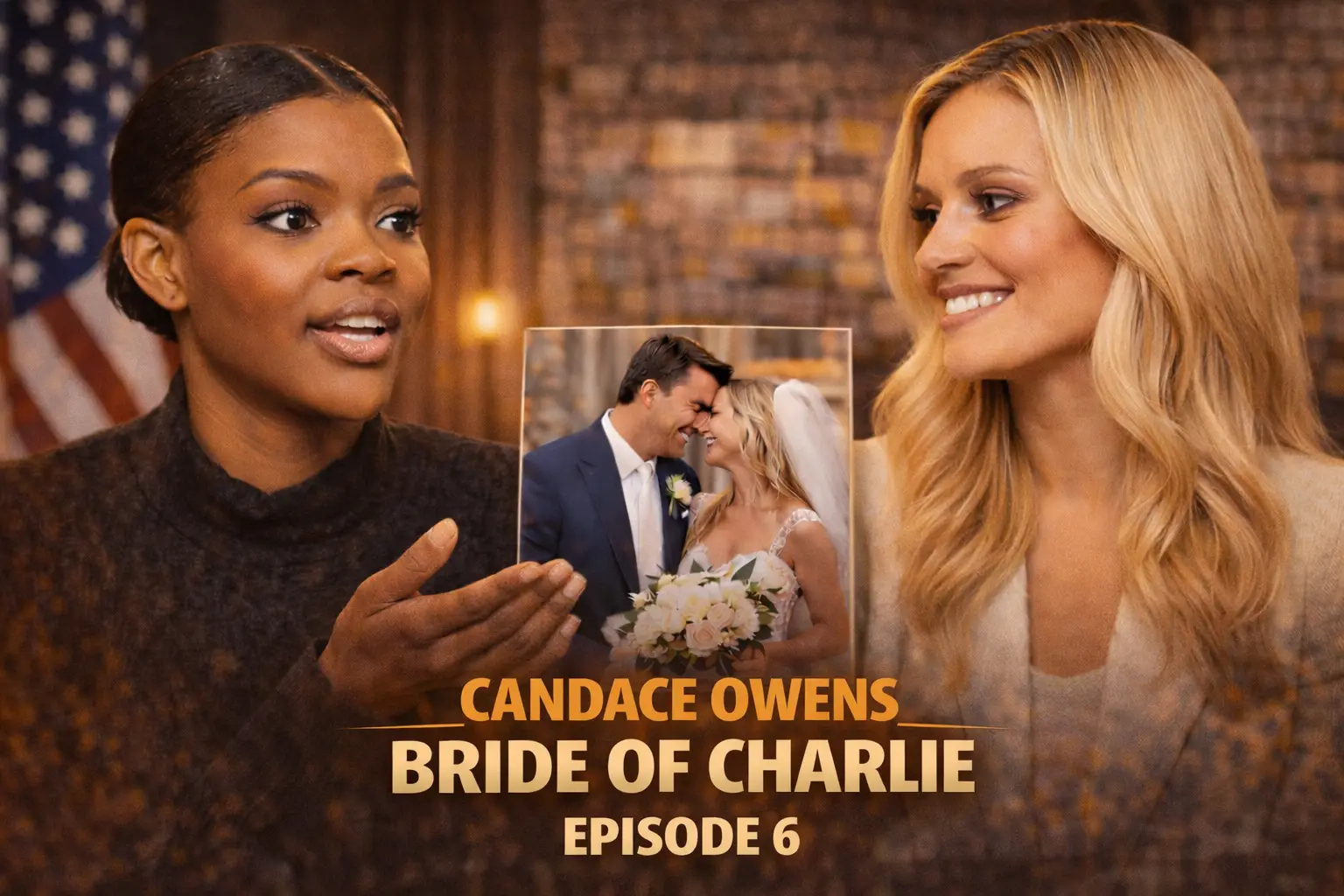
When a story keeps circling the same country, the same names, and the same time window, it stops feeling like background noise and starts feeling like a pattern. In Episode 6 of Bride of Charlie, Candace Owens keeps the spotlight on Romania, arguing it’s the connective tissue behind a cluster of military references, nonprofit branding, and disputed origin stories.
She also drops a smaller but important update: a school-year gap in Erika’s timeline (as Owens frames it) gets a new lead, and Owens treats that as another puzzle piece clicking into place.
What Episode 6 is trying to prove
- Owens says she emailed Erika on Feb. 24 asking how often and how long she visited Romania, and claims she still hasn’t received an answer beyond a lawyer’s delay note.
- Owens claims a tip identifies the Scottsdale middle school Erika attended (filling in part of the 2000 to 2003 gap in her timeline).
- The episode pivots into Romanian history, then ties it to EU gambling policy changes and US military activity.
- Owens highlights Tyler Boyer, the Black Sea Rotational Force, and Reno, Nevada as recurring details she wants viewers to notice.
- She reads from a bio she says was posted, then removed, describing Lori’s tech work in dense “cyber” language.
- Owens adds a second thread: TPUSA figures and their proximity (or claimed proximity) to major shootings, including a clip featuring TPUSA COO Justin Strife discussing a 2008 Missouri incident.
A quick investigation update: the middle school gap (and the Romania email)
Owens opens with a direct question aimed at commentary she attributes to Blake Neff: what’s going on in Romania, and why do so many people in her storyline touch that location?
To sharpen the point, Owens says her team emailed Erika on February 24 asking how many times, and for what duration, she visited Romania. Owens claims a lawyer replied that Erika was busy preparing for the State of the Union, but that days later she still hasn’t provided answers. Owens frames the silence as part of a broader theme she’s repeated across the series: when questions land on certain dates, places, or relationships, she says details suddenly get vague.
Then comes the practical update. Owens says she received an email tip identifying Erika’s middle school as Cocopah Middle School in Scottsdale (Owens pronounces it as “Cakopa”). She says they haven’t obtained yearbooks yet, but claims the school previously referred to Erika as an alum in a public post thanking her for sharing “everyday hero” messaging. In Owens’ structure, this matters because it tightens a timeline window she’s been treating as hard to verify.
Romania backstory, told as a warning about power vacuums
Owens spends time re-centering Romania’s post-communist turning point, describing the 1989 removal of Nicolae and Elena Ceaușescu as a brutal, rapid proceeding that she characterizes as a “show trial.” She uses that moment to frame a bigger argument she returns to often: when leadership collapses, a vacuum forms, and opportunists rush in.
Her takeaway isn’t presented like a history lecture. It’s presented as a worldview statement about how influence moves: countries fall into disorder, and then money and networks reorganize the place around whatever is profitable. Owens extends that idea into a broader critique of “left versus right” as a trap, arguing both sides keep regular people fighting while the same powerful interests stay protected.
This episode also echoes her broader series message, familiar from earlier installments: emotion and symbolism aren’t verification when money, access, and public leadership are involved. (For a snapshot of the online argument around the series itself, see AOL’s report on the online dispute.)
EU gambling rules, a US base announcement, and “interesting timing”
From there, Owens jumps to Romania joining the EU (she notes 2007), then focuses on 2009 gambling regulation. In her telling, Romania’s parliament moves to require licenses for casino operations while restricting online gambling, and then the EU pushes changes that loosen online gambling restrictions.
Owens treats this as a case study in regulatory power: expensive licensing, controlled access, and policy shaped by a larger body above the country. She describes the EU as a layered bureaucracy, and she implies that the structure invites backroom deal-making.
Then she lines up a second date she says matters: around the same period (2009 into 2010, as she frames it), the United States announces plans for a military base in Romania. In Owens’ argument, it’s the overlap that’s suspicious, not any single fact by itself. She keeps returning to the idea that Romania becomes a pipeline for multiple storylines at once.
Black Sea Rotational Force, Reno Marines, and Tyler Boyer’s first Romania appearance (per Owens)
Owens says the Black Sea Rotational Force arrives in 2010, and she pairs that with what she calls Tyler Boyer’s first appearance in Romania around the same time. She also emphasizes a detail she finds too neat: she claims many of the Marines referenced in the force came from Reno, Nevada, a place she repeatedly ties to gambling culture.
She then points to student travel as another Reno-adjacent detail, referencing a 2011 item about Nevada students going to Romania. Owens doesn’t present this as proof of a single coordinated plan. Instead, she stacks it as recurring coincidence.
For readers who want background context on the unit Owens references, the Marines’ own site has a write-up titled “BSRF-11 officially comes to a close in Romania”.
Lori’s “tech” description, read like a word maze
Owens pivots to Lori’s business footprint and reads from a biography she says used to appear on the Everyday Heroes website, but has since been removed. In Owens’ telling, the bio describes Lori’s work as research and development in “disruptive cyber technologies,” tied to how humans think, sustainability during power shutdown scenarios, and patents supporting parts of the Department of Defense and other agencies.
Owens’ editorial point is simple: the language feels like credential fog, heavy on impressive-sounding terms and light on plain explanation. She mocks the phrasing as a word pretzel, and says she’d like an interview where someone explains what the work actually is in normal human sentences.
Owens’ recurring thesis is that compelling storytelling can’t replace basic clarity, especially when institutions, money, and influence sit in the background.
This “wording versus meaning” critique lines up with a theme she’s pushed across the series: when biographies are presented as simple, Owens argues the supporting record should also feel simple, not slippery.
2011 to 2012: the timeline Owens builds (pageants, ASU, and Romania)
Owens uses a timeline format to organize what she claims is happening in parallel.
Here’s the sequence as she lays it out in Episode 6:
| Year | Event (as described by Owens) | Why she says it matters |
|---|---|---|
| 2011 (April) | Tyler Boyer confirmed as student regent for the Arizona Board of Regents | Owens frames it as an access and influence marker |
| 2011 (Fall) | Erika enrolls at Arizona State University for her final year | Owens calls the timing “synergy” with Boyer’s role |
| 2011 (November) | Erika wins Miss Arizona (for the 2012 title year) | Pageant track becomes more visible and documentable |
| 2012 (February) | Everyday Heroes Like You launches “Johnny’s Locker” ministry | Owens highlights the charity branding and messaging |
| 2012 (May) | Erika graduates from ASU (Owens cites magna cum laude) | Treated as a “rise” moment in her narrative |
| 2012 (May) | Miss USA competition in Las Vegas | Owens emphasizes Vegas as another gambling-adjacent setting |
| 2012 (August to November) | Romania visits and “Romanian Angels” project begins | Owens ties it to Marines, bases, and named military leaders |
Owens also replays a clip from a 2020 podcast appearance where Erika describes Romania as a joint base environment and refers to it as a midway point for troops connected to Afghanistan operations. Owens highlights Erika also referencing a relative (a cousin on her dad’s side) who showed her around and pointed to humanitarian-related efforts.
Separately, Owens brings up Erika’s public post about having a best friend present during the 2012 Aurora theater shooting, treating it as another example of proximity to high-profile tragedies inside this broader orbit.
Romanian Angels, military names, and allegations versus facts
Owens claims that “Romanian Angels” begins in partnership with US Marines, and she names military figures Erika thanks publicly in that context. Owens also references later accusations involving one of those figures, and she uses that to raise broader doubts about the environment around the project.
Because the episode blends documented acknowledgments (like thanks and affiliations) with claims about later controversy, the safest way to read this segment is as Owens presenting a “why does this keep clustering” argument, not as a settled case. She’s building a suspicion map, then daring the people involved to clarify it.
For people who prefer to follow Owens’ audio discussions more directly, there’s also a searchable listing at Candace podcast transcript archives.
The Tyler Boyer origin story dispute, and why Owens won’t let it go
Owens returns to what she calls the cleanest contradiction: how Erika met Tyler Boyer, and why she allegedly can’t pin it down.
In the episode, Owens contrasts:
- A claim she attributes to Boyer, that he met Erika at a Trump rally.
- A separate version Owens says conflicts with that, where Boyer previously described Erika calling him to ask how she could help, which Owens treats as implying an existing relationship.
Owens also says Erika gave her an uncertain answer, suggesting it might have been through an Arizona political figure, but that she would need to check messages. Owens says she still hasn’t.
Owens frames this as the central trust issue of Episode 6: if the relationship is normal and simple, the story shouldn’t keep changing.
TPUSA and shootings: the proximity thread expands to Justin Strife
The episode’s final major pivot returns to a theme Owens has teased before: a cluster of TPUSA-adjacent people who, in her framing, have personal proximity to major shooting events.
In Episode 6, she adds Justin Strife, described as TPUSA’s COO. Owens claims Strife became COO shortly before Charlie Kirk was assassinated, then plays an older news clip from a 2008 Kirkwood, Missouri city hall shooting where Strife appears speaking about the alleged shooter’s prior behavior and complaints at council meetings.
Owens doesn’t prove a direct connection beyond the clip itself. Her point is pattern-based: she finds it unusual to have so many people in one professional and social sphere who can narrate personal links to separate headline tragedies.
That’s also where her broader media critique comes back. Owens argues that narratives get packaged instantly, and the public gets pushed into predictable “left versus right” responses, while deeper questions get dismissed as out of bounds.
Official links mentioned in the video description
The bottom line: Episode 6 is a pressure test, not a conclusion
Owens doesn’t “solve” Romania in Episode 6. She uses it as a stress point, a place where military timelines, nonprofit branding, and relationship origin stories overlap in ways she says deserve clear answers.
The episode’s strongest, most consistent takeaway matches the theme she’s been pushing throughout the series: public power invites public questions, and a compelling narrative doesn’t end the need for verification.
For readers tracking the broader public backlash and counter-backlash around the project, coverage has followed the debate, including this write-up from PRIMETIMER on the “Bride of Charlie” backlash.
Conclusion: Owens ends Episode 6 still asking for basic clarity: Romania travel details, relationship timelines, and plain-language explanations for the tech and charity claims circling the story. If Episode 6 has a job, it’s to make the viewer sit with one question: if everything is ordinary, why does it take so much effort to say it plainly?
Learn more about Pulse of Fame and our editorial team. Want to weigh in? Join the conversation in the Pulse of Fame community forum.
Related: Bride of Charlie Episode 5: The “Lost Years” Timeline, Romania Questions, and th