By Petty Pablo | Lead Social Analyst
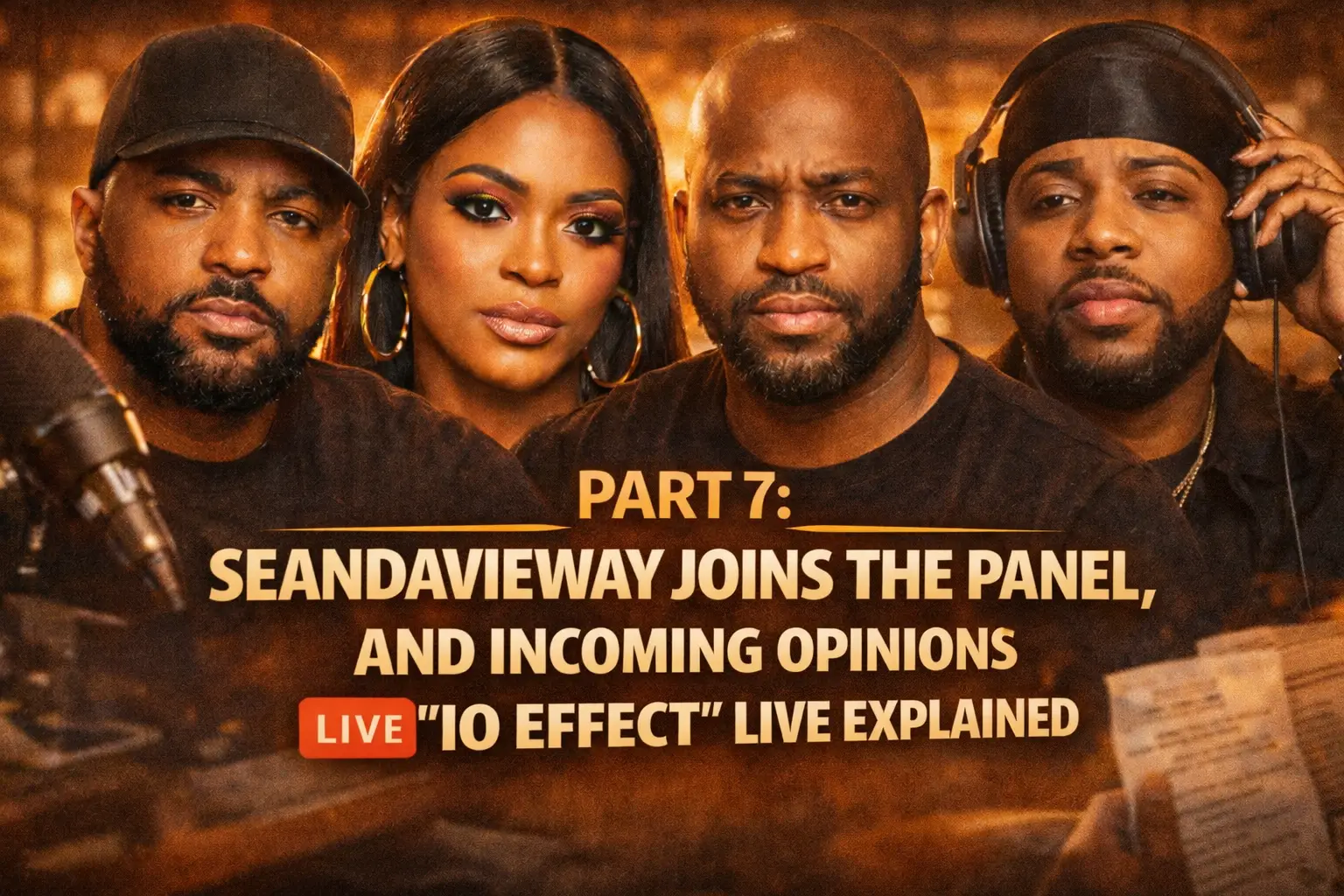
Incoming Opinion (IO) opens this episode the way she likes to open a lot of them, loud, branded, and built for audience participation. The “IO Effect” anthem runs long, the chat gets told to grab their megaphones, and the message is clear: this is not a quiet check-in.
Then the panel forms, and the conversation snaps into two lanes at once. On one hand, it’s small talk (ko-fi, news, who’s in the building). On the other, it’s a dispute about who started what, what counts as harassment versus response, and why “restraining order” talk keeps showing up as a pressure tactic in online back-and-forths.
World news gets a quick mention, then it becomes “YouTube war” again
Seandavieway joins the panel, and the dynamic shifts. Sean is friendly, quick, and observational, and he takes the role of the “been watching this” narrator, someone who can speak on what he’s seen across spaces, including Discord chatter and paid “ko-fi” streams.
There’s also some light joking about ko-fi subscriptions and payments, plus quick back-and-forth with names in the chat (including Melanated Drip, Medusa, and Danny Lynn). It’s messy, but it’s the normal kind of messy that happens right before the room pivots into a serious argument.
JR Curry joins and immediately pulls the room into a real-world sidebar, reacting to breaking news and describing it as serious, scary, and potentially global. The panel briefly balances that stress against the irony of also having their own “war” happening on YouTube.
Even in that short segment, you can see how these lives work. They’re not tidy episodes with one topic. They’re late-night radio with a rotating playlist: news, jokes, community updates, then right back to the main storyline.
That pivot matters because IO is trying to argue she’s not “obsessed,” she’s responding. In other words, she wants viewers to see her as someone living her life (eating, running errands, talking off-stream), then stepping in when her name gets pulled into other people’s content.
The room also takes a second to remind people to like the video and “pray for the people,” which lands as a quick moment of calm before the main dispute heats up again.
Restraining order talk becomes the big debate, response vs harassment
The conversation turns when IO asks about restraining orders connected to the ongoing conflict with Cleo and Tremaine. JR’s reaction is blunt: he doesn’t like the idea, and he frames it as “playing victim” after participating in the same online behavior (including sharing pictures and escalating the situation).
Sean answers in a more measured way. His point is practical: restraining orders make sense when there’s a physical, real-world concern, like someone being in your area or showing up where you are. If the conflict stays online and the parties live far apart, he suggests it can look frivolous, and it often won’t do what people think it will do.
Most importantly, Sean says a restraining order isn’t a magic mute button. A judge can restrict physical proximity without restricting speech. So, if someone’s goal is to stop commentary, that strategy can backfire.
A repeated theme on the panel is simple: if you start a public fight, you don’t get to pick the size of the response.
IO presses the point by asking if she’s “harassing” them. Sean’s answer is basically, not if the other side is still active too. He mentions seeing Tremaine involved in Discord back-and-forth recently and hearing Cleo speak as well. From that angle, IO’s lives become “defense,” even if the delivery is sharp.
This matches the broader framing IO has used across this storyline: they spoke first in public, then tried to re-label her rebuttal as harassment once she answered, using serious-sounding language to chill the response.
The Treez Stationhead dispute, Discord screenshots, and the “I didn’t email anyone” claim
A major flashpoint in this episode is IO revisiting the moment she appeared on Treez’ Stationhead while a picture involving Rich circulated. IO insists she didn’t send anything to Treez and doesn’t even have Treez’ email. She says Treez sent her screenshots tied to Cleo and Tremaine’s Discord activity, and she positions herself as the recipient, not the source.
In IO’s telling, Cleo posted “backstabber” style memes and tried to pin the whole chain of events on IO because IO was present on that panel. IO says she stayed quiet, then dropped down and left once Rich and Treez started going at Cleo.
She also repeats an important boundary claim that shows up throughout this saga: she and Cleo are not friends, and she removed Cleo from her group months ago (she references July). That date is doing a lot of work in IO’s story because it supports her argument that this isn’t a sudden betrayal. From her angle, the friendship ended privately, and the public explosion came later.
She also raises the “moles” point, saying Discord spaces leak and screenshots travel fast. That’s a recurring Blacktea Sector mechanic: private rooms start feeling like “evidence lockers,” then a single screenshot turns into a headline within hours.
Receipts culture: phone logs, recordings, and the “victim narrative” argument
This episode also shows IO’s second signature move, documentation. She keeps repeating some version of “the evidence exists,” pointing to phone bills, call logs, timestamps, and recorded clips.
At the same time, the conversation gets ugly in tone, especially when the panel discusses alleged photo sharing and past clips involving Cleo. IO frames those clips as proof of a pattern, constant crisis language, constant claims of being wronged, and frequent escalation to authorities when the response gets uncomfortable.
It’s worth noting what the panel is really arguing about under the noise. They’re not just fighting about what was said. They’re fighting about who gets to label it first:
- If IO responds, is she “defending herself” or “harassing”?
- If Cleo mentions police, is that safety, intimidation, or narrative control?
- If Discord posts circulate, who is responsible for the spread?
In IO’s broader framing (which she has repeated across this saga), the paperwork talk is also about reputation. She has described recording audio and organizing receipts because she believes some claims crossed from messy commentary into potential defamation. In this live, that idea shows up as a promise: keep talking, but don’t act surprised when the response comes with screenshots, logs, and a timeline.
JR Curry and IO, relationship boundaries, and the wedge claim
Another thread running through the live is IO and JR Curry’s relationship status, and the claim that someone tried to drive a wedge between them. IO says they broke up in October 2025, yet she still emphasizes that they’re close and that his feelings matter to her.
JR’s role in this episode is partly “supportive reality check.” He tells her to rest her voice, drink tea or warm water, and stop pushing herself. IO, meanwhile, keeps insisting she’s ready for “war” because she refuses to let people “lie” on her name.
Sean makes a key point here too: even if viewers think private relationships are public property because they happen on YouTube, they’re still not entitled to every detail. He argues that once other people make someone’s private life the topic, they can’t act shocked when it triggers a strong response.
The episode ends with IO reading a text from JR (he’s waiting to talk after the live), and she treats it like a closing argument: whatever the wedge strategy was, it didn’t land.
Official links mentioned in the video description
- Support Incoming Opinion via Cash App
- Shop Night and Day Herbals
- Join Incoming Opinion channel membership
Conclusion
Part 7 is a pressure-release valve. IO uses the panel to reinforce two ideas: a response isn’t harassment when the other side is still speaking, and receipts matter because first impressions stick.
The bigger takeaway is how quickly online disputes turn into quasi-legal posturing, especially when Discord screenshots, recorded clips, and “restraining order” talk get pulled into the same argument. However this storyline ends, IO is clearly betting on one thing: the timeline, and whoever can defend it without contradictions.
Learn more about Pulse of Fame and our editorial team. Want to weigh in? Join the conversation in the Pulse of Fame community forum.
Related: PART 6: T&K, and the Lies They Tell, Incoming Opinion’s “IO Effect” Live Explain