By Petty Pablo | Lead Social Analyst
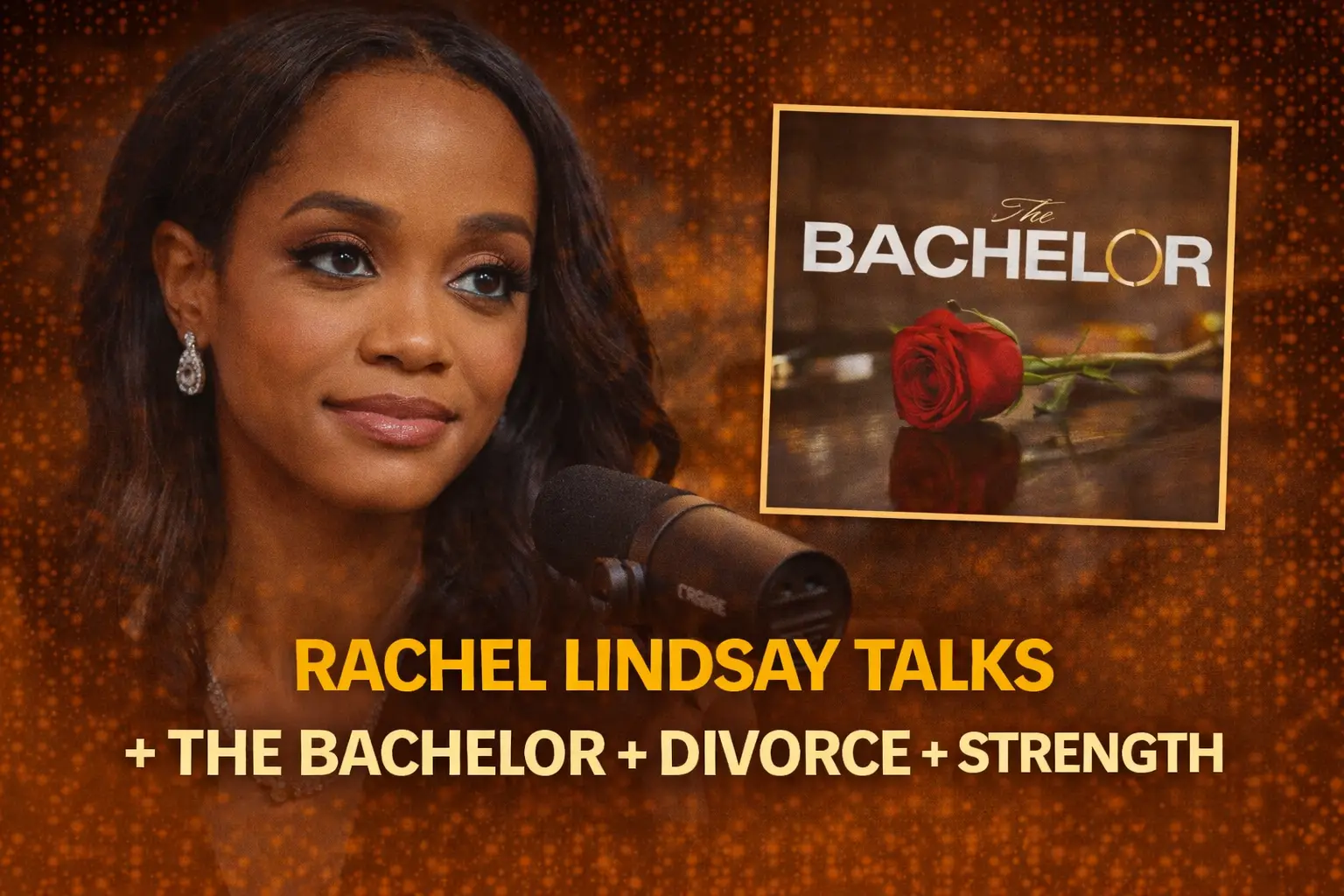
Reality TV loves to pretend it’s just “life happening,” but the edit always has an agenda. In Pop Syllabus, host Cristiana Bach Medina sits down with Rachel Lindsay to talk about what it meant to walk into a franchise that wasn’t built with Black women in mind, then become its first Black lead anyway. The conversation is part media study, part group chat honesty, and it gets real about vulnerability, stereotypes, and the very public price tag of a divorce.
Subscribe to Pop Syllabus on YouTube.
Rachel Lindsay’s unexpected entry into Bachelor Nation

Rachel’s origin story in The Bachelor universe is still wild because she didn’t enter as a superfan with a vision board. She entered like someone answering a dare, and then realizing the dare came with a full camera crew.
Her headline confession says it all: “I said yes before watching.” Only after agreeing did she put on a season (Ben Higgins’), and the emotions hit fast. She remembers crying and thinking, “I don’t think I can get out of this,” worried she wouldn’t fit in with the cast or handle the constant “talk to the camera” pressure.
What makes it funnier is that Rachel wasn’t anti reality TV. She just wasn’t a Bachelor watcher. Her taste leaned VH1 and Bravo: Flavor of Love, I Love New York, For the Love of Ray J, and the early era of The Real Housewives. In other words, she knew mess, she just didn’t know Bachelor Nation.
Coworkers saw star power before she did
Rachel shares that two coworkers pushed her toward auditions happening nearby. She resisted because she didn’t even watch the show and, as she bluntly told them, Black people didn’t tend to go far. Their response was simple and oddly prophetic: “If you do it, you’ll go far.”
Even Rachel describes the decision as more than logic. She felt a pull she couldn’t explain, something spiritual, like she had to show up to the audition even if she didn’t expect to be cast.
Reality TV “truth” vs. performance, and why romance makes it worse
Cristiana frames a core paradox: reality TV sells “truth,” but cameras turn truth into performance. Rachel agrees, and the conversation adds another layer: romance itself comes with performance.
Dating can feel like presenting the best version of yourself, especially early on. There’s vulnerability, but also fear. There’s sincerity, but also self-protection. Put that inside a show format built around confessionals and storyline beats, and the pressure doubles.
For Rachel, the early days on The Bachelor were uniquely disorienting because she didn’t understand the rhythm of the experience. Still, she says the pressure felt oddly low. She’d come out of a bad relationship and wanted an escape, so she approached the process with a “let’s see what happens” mindset instead of a strict strategy.
That looseness matters later, because it helps explain why her season didn’t always follow the usual “Black contestant boxed into one role” template.
The first impression rose, and the moment she let herself believe
Rachel points to one key turning point: receiving the first impression rose. She says she was the first Black woman to get it, and that early signal cracked her guard just enough to let the experience feel real.
Instead of assuming it was producer-driven, she remembers asking, “Who told him to give me this rose?” Producers had to reassure her: “Rachel, relax. He wanted to give it to you.” Later, back in her room, she stared at the rose and had a quiet realization: maybe she could stop bracing for impact and just exist in the moment.
From there, Rachel describes “falling into the journey,” not only in romance but in friendship. She emphasizes how meaningful the bonds were with the women on her season, to the point that she’s still close with several of them.
That sisterhood even made her “forget” the central premise at times. She laughs that producers once pulled her aside to ask how much she’d been drinking because she was having such a good time in all the downtime. It’s a small detail, but it reveals something bigger: her emotional center wasn’t just the male lead. It was the social world around her.
Vulnerability as a Black woman on a white-majority show
Cristiana names what many viewers clocked immediately: Rachel appeared as textured. She showed up as an attorney, confident and sharp, but also emotionally open in a romantic setting. That combination is rare on TV, not because Black women lack softness, but because the world often punishes them for showing it.
Rachel puts it plainly: people want vulnerability, but to be vulnerable you have to feel safe. She says the rose felt like validation, and that validation helped her lower her defenses.
She also challenges the idea that “strong Black woman” means emotionless. She isn’t anti the phrase, but she refuses the way it can be used as a cage. Strength doesn’t cancel tenderness. It just means you’ve learned how to survive, often in rooms where you’re watched more closely than everyone else.
When politics hit the fantasy suite, and other ways racism shows up
Cristiana references research (including work discussed in the episode) about how racism gets replicated when Black and white women are cast together. The idea is that Black women can end up supporting other people’s arcs while their own inner lives get reduced.
Rachel says her experience was different. Other women even told her, repeatedly, “You’re going to be the Bachelorette,” and she resisted hearing it because she still wanted to see where her own story went. She describes being “protected” or uplifted in a noticeable way, and she didn’t feel like she was driving other contestants’ narratives.
The bigger cultural moment still broke through, though. Rachel reveals she was still filming when the 2016 election happened. Her fantasy suite date landed the day after, and she wanted to talk about it. The show’s structure didn’t allow that conversation, and she says she drank and passed out, making the night a “disaster” for any romantic progression.
It’s one of those moments that captures the weird isolation of reality TV. You’re living in a bubble, then you step out and realize the country changed while you were away.
Becoming the first Black Bachelorette, and the “angry” label that followed
Rachel says she knew she’d be the first Black Bachelorette, but she didn’t grasp how massive it would be because her family and friend circles didn’t even watch the franchise. Once it hit the public, the scrutiny came from every direction. She felt pressure to answer impossible questions: Are people watching to support me? To judge me? Do I need to be softer? Harder? “More pro-Black”? Should I tone down my Blackness?
Her mother’s advice was grounding: know who you are, trust your gut, and stay true to yourself. Rachel decided the only way through was to be unapologetically Rachel. If she was “too Black” for someone, that was their issue. If she wasn’t “Black enough” for someone else, same deal.
She also talks about why she was “legible” to a mainstream audience: lawyer, older, father a judge, comfortable in mostly white spaces. Rachel’s take is direct: “We’re not a monolith.” She liked that her presence complicated the stereotype that Black women have to fit one narrow type to be the star.
Still, she describes how fast the edit and audience reaction can snap into familiar tropes. By her finale, she says she was framed as the “angry Black woman” for showing attitude toward a white man on stage, even though she insists she didn’t curse or say anything extreme. She remembers producers telling her to calm down, and even Chris Harrison leaning over to tell her to relax.
Her point lands: Black women often get punished for tones and facial expressions that read as “normal” coming from others.
Interracial love, “throwing out the list,” and what became aspirational later
Cristiana connects Rachel’s season to a wider pop culture trend: more attention, and sometimes “aspiration,” around interracial couples featuring a Black woman and a white man. Rachel notes that kind of couple branding wasn’t how audiences framed her relationship at the time, and she says her Blackness still gets questioned because of who she chose.
Rachel shares something she wrote about in her dating mindset: she once had a list that only included Black men, based on a belief that only a Black man could fully understand her. In her 30s, she reconsidered whether that list was limiting her options for love. She decided to focus on energy and compatibility instead.
Her message to viewers was less “date this type of person” and more “give yourself freedom.” She says Black women can care about Black men and still choose love for themselves, even if it looks different than what the community expects.
That ties into a deeper point she makes: in the US social hierarchy, Black women often get treated like they’re at the bottom. Seeing Black women openly adored, on big platforms, pushes back on that lie.
If you want Rachel’s own framing in long form, start with Rachel Lindsay’s Real Love.
The “dark side” of reality TV, stereotypes, and using the system back
The conversation doesn’t dodge the hard stuff. Cristiana brings up how common it is for reality shows to center conflict, violence, and unstable relationships, and how Black women get hit with “Jezebel” and “Sapphire” style stereotypes when similar behavior plays as comedic chaos for others.
Rachel says she once wanted to do a series called Being Black on Reality TV because she kept seeing the same pattern: audiences, especially non-Black audiences, can seem “trained” to understand Black women only through a narrow set of roles. If you don’t fit, they question if it’s real.
She also admits her own complicated feelings. She used to judge some reality stars, then realized part of her envy was about freedom. Respectability politics can make you feel like you always have to “act right,” while other people get to be messy without having their whole identity condemned.
Rachel’s line in the sand is clear: the one time she struggles to support the performance is when someone whitewashes their Blackness to fit in, especially on white-led shows.
At the same time, she respects the hustle. She points to figures like Cardi B and Natalie Nunn as examples of people who turned reality TV into bigger opportunities. Her framing is basically: don’t let the system use you, use it for your benefit.
For more on the public chatter around her divorce and support payments (separate from the episode), see E! News coverage of her spousal support comments.
Rachel’s reality TV favorites, from Bravo to VH1 classics
When the talk turns fun again, Rachel gives her current rotation: mostly Bravo.
Her “right now” standouts include The Real Housewives of Salt Lake City and The Real Housewives of Potomac. She also praises The Real Housewives of Miami for feeling less produced, more fly-on-the-wall, and naturally funny without trying too hard. She mentions The Valley too.
All-time, she shouts out The Real Housewives of Atlanta as the best franchise, plus The Real World (a foundational text, basically), America’s Next Top Model, and Flavor of Love. She credits Flavor of Love with spawning an entire ecosystem, including Tiffany “New York” Pollard as a Mount Rushmore-level reality star.
What Rachel would tell a young woman considering reality TV
Rachel won’t tell people not to do it, even when asked the “would you want your daughter to go on TV?” question. Instead, her advice is practical: go in with a plan, because you can’t control the edit.
She explains that she turned down other reality offers, including doing her own show, because she knew what she wanted her platform to be for. Her best guidance is simple:
- Have a mission for what you want the show to do for you.
- Know what you want your life to look like after filming.
- Use the system, don’t let it use you.
She also mentions giving advice to Taylor Hale from Big Brother, and she loves seeing her flourish.
You can keep up with Rachel through Rachel Lindsay’s official website and Rachel Lindsay on Instagram. She also plugs her podcasts, Higher Learning and Morally Corrupt, with new episodes on Tuesdays and Fridays.
The Bachelor lawyer Alimony chapter: Rachel’s divorce book, her way
Near the end, Rachel shares what she’s working on next: a third book, built as essays, focused on her divorce and what she calls a public, messy process. She says people have said a lot about it, while she has stayed mostly quiet, aside from a few comments on her podcast and social posts.
She describes feeling powerless because she didn’t have a prenup and says her ex was “ruthless” in the process, with no compromise. Still, she also describes feeling proud that she made it through and got to the other side. She wants to write the divorce book she couldn’t find when she needed it.
Her planned themes are personal and wide-ranging: community, shame, societal pressure, intimacy, dating in her 40s, and fertility (a story she says she’s never told publicly before). She also says the public nature of the divorce wasn’t her choice, and because it became public anyway, she wants to tell it accurately, with lessons at the end of each essay.
It’s the full-circle tension of her public identity: the accomplished lawyer, the romantic “success story” viewers rooted for, then the reality that marriage can still break, loudly, and you still have to rebuild.
“We’re not a monolith,” Rachel says, and her arc backs it up: there’s no single correct way to be a Black woman on TV, in love, or on the other side of it.
Conclusion
Rachel Lindsay’s conversation with Pop Syllabus is a reminder that representation isn’t just “being there,” it’s being allowed range. She talks about vulnerability without pretending it’s easy, and she names how quickly audiences reach for stereotypes when a Black woman shows real emotion. Most of all, she’s clear that survival comes from staying yourself, keeping a plan, and refusing to be reduced to one story. That’s the kind of freedom reality TV rarely edits in, but viewers always recognize when they see it.
Learn more about Pulse of Fame and our editorial team. Want to weigh in? Join the conversation in the Pulse of Fame community forum.
Related: Trump Supporter Dad Fatally Shoots Daughter After Argument About Trump