By Agent 00-Tea | Cultural Analyst
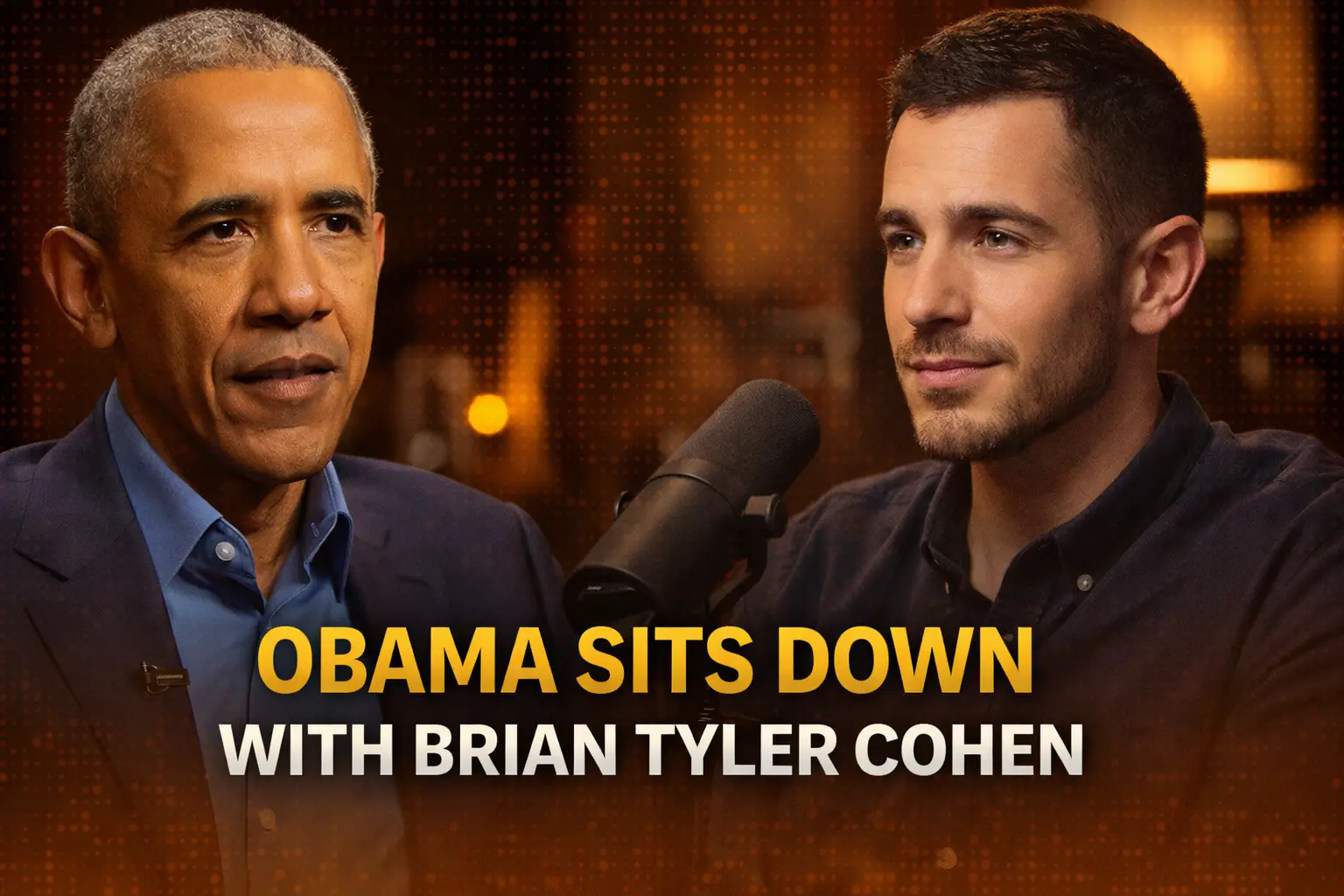
In a wide-ranging sit-down with Brian Tyler Cohen, Barack Obama responds to the Obama Ape Video controversy involving Donald Trump, the chilling stories coming out of immigration enforcement, and the constant pressure on Democrats to “fight fire with fire.”
His message is basically this: the internet may reward chaos, but real life still rewards community.
Brian Tyler Cohen opens with a blunt read on the moment: “the discourse has devolved into a level of cruelty” that used to be disqualifying, but now gets rewarded. He rattles off examples that reflect how normalized harsh rhetoric has become, including officials labeling victims as “domestic terrorists,” and comments that frame identity politics as a permission slip for hostility.
Then comes the flashpoint: the controversy surrounding the Obama Ape Video Donald Trump originated from a social media post shared on Truth Social, depicting both Barack Obama and Michelle Obama through the racist trope of apes. It’s a moment that’s less about one post and more about what gets treated like entertainment now. The “shock value” economy of this racist video doesn’t just live on fringe accounts, it shows up near power.
Obama doesn’t take the bait emotionally. Instead, he zooms out to the bigger question: how does a society walk back from a public culture where disrespect becomes the default setting? His answer is not a clever clapback. It’s a reminder that the audience at home still has agency, even when the feed looks hopeless.
For additional reporting context on the same viral storyline, see The Washington Post’s coverage of the Obamas-apes video.
Obama’s bet: most Americans still want decency, not the “clown show”
Obama’s first move is to separate the loudest voices from the biggest group. He argues the “majority of the American people find this behavior deeply troubling,” even if the outrage machine gets the clicks. In his view, a lot of what looks dominant is just amplified, a “clown show” on social media and TV fueled by fake outrage from Republican lawmakers who have abandoned traditional decorum, and that isn’t actually how most people want to live.
That matters because it shifts the strategy. If you believe everyone loves cruelty now, you’ll copy it, or you’ll quit. If you believe most people still value decency, then you organize around that and stop acting like your neighbor is your enemy.
He also points to a real cultural change inside politics: the loss of shame. There used to be a baseline expectation of decorum, a sense that public office demanded restraint. Obama’s read is that this has slipped, and some figures who once protected “propriety” now act like there’s no penalty for going low, rarely feeling the need to apologize for their rhetoric.
The idea isn’t that everything is fine, it’s that the fix won’t come from “better tweets,” it’ll come from people refusing to accept the new normal.
Minneapolis and the kind of courage that doesn’t trend
Obama talks about what he describes as unprecedented federal behavior during immigration enforcement actions in Minnesota, particularly Minneapolis and St. Paul, actions that Karoline Leavitt has defended as necessary for border security. He references claims of agents deployed without clear guidelines or training, people pulled from homes, and allegations that officials used a 5-year-old to “bait their parents.” He also mentions tear gas used on crowds he describes as peaceful.
Those are heavy allegations, and they set up the emotional core of his argument: the government can overreach, but ordinary people can still show up for one another in ways that change the story.
Obama highlights community responses that sound almost old-school, in the best way, serving as a counter-narrative to the current administration’s policies:
- Neighbors buying groceries for impacted families
- Adults accompanying kids to school
- Teachers standing up for their students
- Citizens organizing, filming, and protesting peacefully, even in subzero weather
He frames it as a kind of American heroism that doesn’t require a title. Cameras, truth, and sustained nonviolent presence can put pressure on bad behavior. In other words, sunlight still works.
Democracy doesn’t restore itself, people restore it
Obama keeps returning to one line of thinking: democracy functions when citizens do. He says restoring “norms, rule of law, decency” happens because people get activated, pay attention, navigate false claims like voter fraud, and decide “enough.”
He also adds a moral gut-check that lands hard because it’s simple: values are easiest to praise when they aren’t challenged. Free speech is easy when no one’s trying to crack down. The Golden Rule is easy when it doesn’t cost you anything.
In the aftermath of the 2020 election, he argues, Americans are being tested. And he takes hope from what he’s seeing in places like Minnesota and Los Angeles: a “good number” of people choosing to live out the values they claim, even when it’s uncomfortable.
If citizens stay engaged, elected officials follow, courts respond, media coverage shifts, and institutions can be forced back toward accountability. If people check out, the chaos wins by default.
Why Democrats feel out ofmatched, and why Obama says that’s the job
Cohen voices a frustration a lot of Democrats feel: one party defends norms and process, while the other pursues outcomes “laws be damned.” Obama doesn’t dismiss that. He does, however, argue Democrats have the harder assignment because they’re trying to build, not just burn.
He describes Democratic goals as policy-heavy and consequence-heavy: jobs, climate action (“make sure that the planet doesn’t roast”), broad-based growth, education. Leaders like Hakeem Jeffries are pursuing these policy-heavy goals for the party. That requires majorities, negotiation, and follow-through, including the detailed work of White House staffers on the mechanics of government.
By contrast, tearing down existing rules is easier and faster.
Still, Obama doesn’t give Democrats a pass. He calls out a past reluctance to break institutional barriers simply because “it’s always been done that way.” His biggest example is the Senate filibuster. The Senate already tilts toward smaller states (Delaware and Wyoming matching California in Senate seats), and the filibuster adds another layer of minority control. In his view, that gridlock makes government look broken, and that perception creates openings for demagogues.
He also points to redistricting as another structural fight. Politicians drawing their own maps is, in his telling, backwards. Obama mentions working with Eric Holder and the National Democratic Redistricting Committee (NDRC), and he praises moves to respond lawfully when one side tries to tilt the field, such as those by Gavin Newsom dealing with state-level majorities and institutional barriers.
Don’t copy the other side, but don’t get played by tradition either
Obama draws a line that’s both ethical and tactical. He rejects Donald Trump’s “slash and burn” approach where Democrats lie, ignore truth, and shred guardrails just because the other side does. In an era where offensive content is deleted so quickly on the internet, he argues such tactics carry extra risks. If you fight that way, you lose what you’re fighting for.
At the same time, he warns against clinging to tradition for tradition’s sake. The standard should be whether a rule helps democracy function and helps ordinary people, not whether it feels familiar.
He even offers a personal example: as president, he could have abused power, like ordering the military to intimidate political opponents or punishing states for not voting for him. He didn’t, because it violates his view of how democracy should operate. The point is clear: restraint matters, but so does being smart enough to win within the system, and when needed, to reform it.
The Democratic “civil war” is often tactical, not moral
Looking toward 2028, Cohen asks how Democrats can build a winning coalition by engaging Black voters and avoid a repeat of left-vs-center blowups. Obama’s answer starts with a reality check: Democratic divisions get magnified in media compared to multiparty systems overseas or even the GOP, where Tim Scott’s optimistic approach to conservatism shows tactical differences that rarely erupt into the same family group chat drama. In a parliamentary world, these factions might be separate parties. Here, they’re forced into one family group chat.
He argues Democrats largely share core values: equality and non-discrimination, a safety net, market rules that prevent monopoly power, and tax policy that reduces extreme inequality. Most arguments, he says, are about tactics, like how high taxes can go or how aggressive regulation should be.
He also advises against nationalizing every issue. A campaign that works in New York City may not work in Virginia, and that’s not betrayal, it’s politics. He cites a contrast between Abigail Spanberger in Virginia (a more centrist style) and Zohran Mamdani in New York (a more explicitly socialist, grassroots style). Different candidates, different coalitions, both potentially valid where they run.
Housing becomes his example of what “both/and” politics looks like. You can support higher taxes to subsidize affordable housing and also admit that some well-intended zoning rules and homeowner opposition block new construction. He rejects the idea that acknowledging those barriers equals “selling out.”
Morals and majorities: immigration and homelessness as the stress test
Obama’s most delicate argument is about holding two truths at once.
On immigration, he describes a moral scene: a child watching a parent taken away. Ethically, that child’s humanity is not up for debate. Yet, he says, the country also has borders and laws, and most voters want an orderly system. Democrats, in his view, can insist on enforcement that is sensible and compatible with values without pretending enforcement itself is immoral.
On homelessness in Los Angeles, he takes a similar approach. It’s unacceptable that a wealthy country leaves people on the street. At the same time, he says the average person doesn’t want to navigate tent encampments downtown. If the message becomes “they should be able to do whatever they want,” public support for services, treatment, and housing collapses. He frames practicality as a way to help people, not abandon them.
His bigger warning is about online politics turning every disagreement into a purity trial. If someone suggests enforcement, they get cast as not caring. If someone pushes for bold change, they get dismissed as unrealistic. Democrats must address concerns about election fraud and voting machines with the same balance of pragmatism and morals. Obama argues Democrats need to stop performing for the internet and start building durable majorities.
How Democrats win back young voters: joy, trust, and less scolding
Obama gives a surprisingly simple reason he once connected so well with young voters: he was young. He jokes that he’s 64 now, feels great, but doesn’t even catch half the social media references his daughters make. Candidates eventually “age out” of the moment.
Beyond age, he says Democrats need candidates plugged into the present and the future, not stuck in nostalgia. He also argues Democrats lost something important: joy. His campaigns felt like community, not just transaction. Young people weren’t mascots, they ran things. That empowerment made participation feel meaningful. Social media plays a big role here too, as platforms teem with divisive content like the Obama Ape Video Donald Trump, a harmful internet meme that is a racist video. Some versions used cultural references like the Lion King, The Lion Sleeps Tonight, or King of the Jungle to mask offensive content.
Then he goes right at the “scold” problem. He criticizes a kind of virtue signaling where ordinary voters feel chastised for imperfect language or failing a litmus test. People are complicated. A welcoming movement leaves room for learning.
To illustrate what inclusive culture looks like, he points to Bad Bunny’s halftime show as a non-political example of community. It “wasn’t preaching,” he says, it was showing intergenerational belonging, grandparents and kids and messy humanity all in one frame. Obama connects it to Dr. King’s “beloved community,” imperfect but open.
The Obama Presidential Center and the case for stepping back
Cohen asks why Obama doesn’t stay at the center of day-to-day politics, especially when many Democrats feel a leadership vacuum. Obama’s answer is blunt: he’s not a politician anymore, he’s term-limited, and he’s not trying to test his marriage by attempting a comeback.
Instead, he frames leadership as lifting other leaders. He describes the work of the Obama Foundation, where Barack Obama now chairs efforts to identify young talent beyond the usual “fancy schools” pipeline or former White House staffer roles, including union organizers, journalists, teachers, health professionals, and human rights activists. He says thousands have gone through their programs, working on everything from health clinics abroad to opioid interventions in Appalachia to education tech in rural areas and Native communities.
He also previews what he calls the “heart” of the Obama Presidential Center: spaces where young people tell stories through music, record podcasts, access a Chicago Public Library branch, and meet visiting leaders. The mission is civic muscle-building, pulling people away from doom-scrolling and toward local action.
For more on that work, he points viewers to the Obama Foundation’s official site.
Lightning round: aliens, pranks, and Tupac (because the internet demanded it)
The conversation ends with rapid-fire questions, and Obama plays it cool:
- Are aliens real? While aliens are a fun topic, AI video technology makes it harder to distinguish truth from fiction. He says they’re real, but he hasn’t seen them, and he doubts there’s a secret facility hidden from the president.
- First question as president? He jokes: “Where are the aliens?”
- Who does he want to meet? He names the new pope from Chicago, a White Sox fan, and praises Pope Francis as someone who “walked the walk.”
- Favorite world leader? Obama says he grew close with Angela Merkel, calling her smart, practical, and full of integrity.
- Best White House prank? He says pranks weren’t really a thing, and a president “punching down,” a style sometimes associated with Donald Trump, isn’t the vibe.
- Is Tupac alive? “He’s alive on my playlist.”
Conclusion: the politics of belonging still works
Obama’s through-line is consistent: Americans aren’t doomed to the loudest, cruelest version of public life, like the Truth Social post that mocked Michelle Obama’s dignity. Community, fairness, and decency still have an audience, but they need people willing to show up and keep showing up. The Obama Ape Video Donald Trump moment may dominate headlines, yet Obama’s focus stays on what lasts: civic action, honest debate, and coalitions built for real victories. If Democrats want to win 2028, the answer isn’t copying the other side, it’s building something people actually want to join.
If you want to explore more of Cohen’s work, start with Brian Tyler Cohen’s newsletter or his book page for Shameless by Brian Tyler Cohen.
Learn more about Pulse of Fame and our editorial team. Want to weigh in? Join the conversation in the Pulse of Fame community forum.
Related: Aba Interviews Sneako: The “Old Sneako,” Red Pill Rage, Islam, and a Lot of Push