By Petty Pablo | Lead Social Analyst
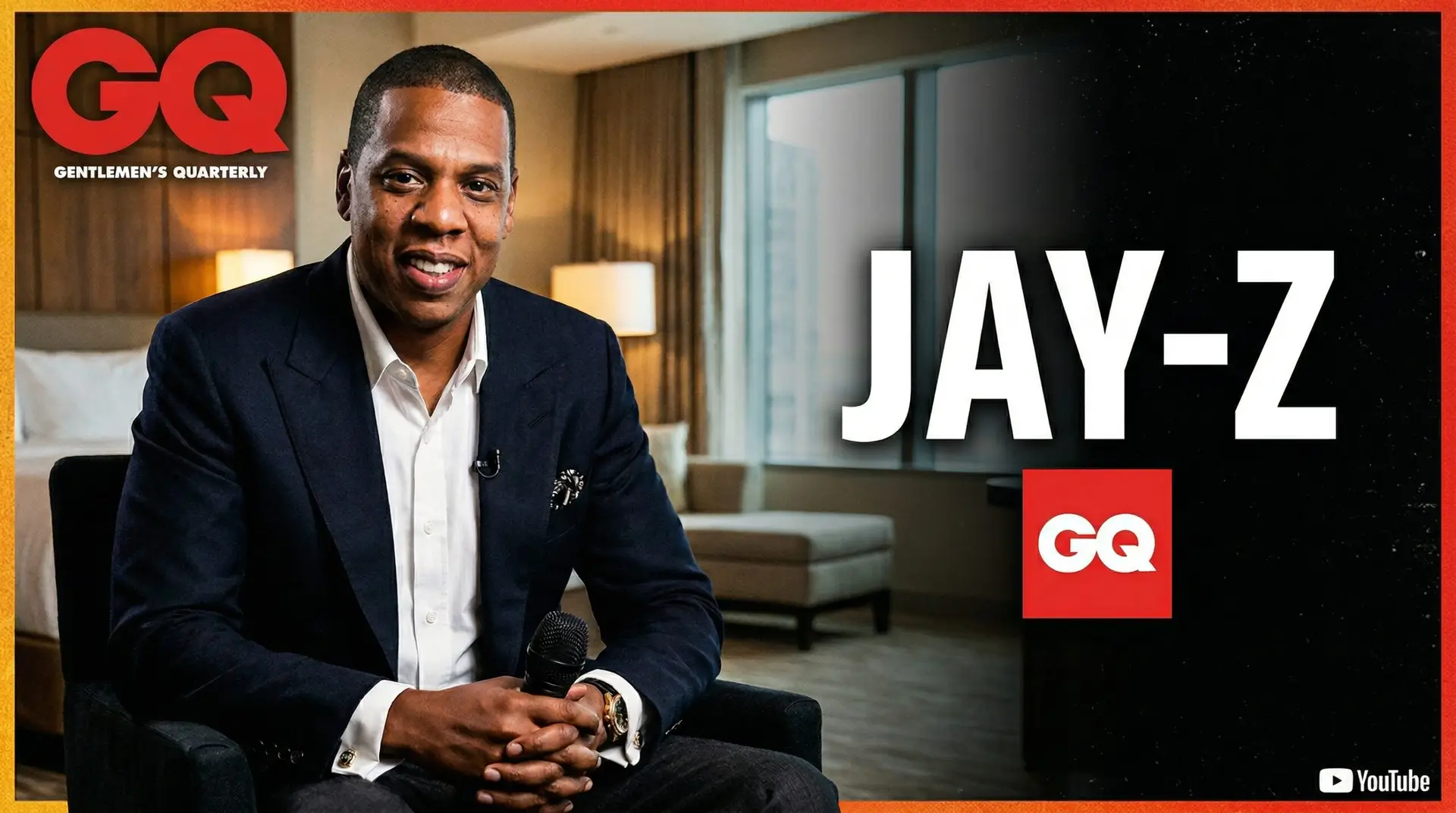
Across the conversation, Jay-Z talks about heartbreak, anger, music, fatherhood, wealth, independence, and the current shape of rap culture. He also makes one thing clear, this isn’t about nostalgia. It’s about authorship, control, and what happens when a figure this established decides to reintroduce himself on his own terms.
- Jay-Z described 2025 as “hard” and said he was heartbroken and deeply angry over the sexual assault lawsuit he said was dropped or dismissed.
- He said the experience forced him to rely on family and a trusted inner circle, and he rejected the idea of settling because it “wasn’t in his DNA.”
- Looking back at Reasonable Doubt, he framed early rejection as fuel, not defeat, and said not getting a deal was one of the best things that happened to him.
- He revisited A Written Testimony and 4:44, calling 4:44 the hardest album he’s ever made because it exposed the interior version of himself, not the larger-than-life icon.
- On success and money, he pushed back on the idea that wealth alone defines morality, and he rejected the word “allowed” when talking about Black ambition.
- He praised Kendrick Lamar’s Super Bowl set as brave, but said the modern form of rap beef between Kendrick Lamar and Drake may be doing more damage to hip-hop culture than good.
- He also shared thoughts on future plans, including his new album.
Jay-Z on 2025, heartbreak, and the decision to stop playing defense
The most striking part of the interview arrives early. Asked to rate the previous year, Jay-Z doesn’t dodge, soften, or dress it up. He calls 2025 hard. Really hard. Then he goes sharper and says he was heartbroken.
That matters because Jay-Z usually speaks in architecture, not exposed wiring. Here, the language is plain. He says the sexual assault lawsuit tied to attorney Tony Buzbee took a lot out of him, and he describes feeling a kind of anger he hadn’t felt in a long time. Not irritation, not annoyance, but what he calls uncontrollable anger.
His explanation isn’t just emotional, it’s moral. Jay-Z frames the issue through the code he says he carried from the street, the idea that there are lines you do not cross. In his telling, today’s culture, amid the industry’s current legal landscape exemplified by Sean Diddy Combs, moves so fast that a conspiracy to undermine through allegation, reaction, narrative, judgment barely leaves room for consequence.
That’s why his comments about refusing a settlement land so hard. He says it would have been cheaper and quicker to make the problem go away, but he couldn’t do it. For him, that would have cost something bigger than money. He even backs up to say the first real conversation had to be with Beyoncé, because he knew the weight this would bring onto the family.
What kept him standing, according to the interview, was the circle around him. He says he needed his people more than ever, especially because music, his usual release valve, wasn’t there in the same way this time. Instead of rapping it out and moving on, he had to sit with it.
“We played enough defense. 2026 is all offense.”
That line works as a comeback slogan, sure. But it also works as a strategy memo. Jay-Z isn’t saying the pain didn’t happen. He’s saying he’s done letting it set the pace.
The Reasonable Doubt mindset, rejection, survival, and seeing the win
On the 30th anniversary, Jay-Z still talks like the hunger never left. In the full GQ cover story, that anniversary sits in the background like a quiet clock. In the interview, the lesson is simpler. Early rejection didn’t break his belief, it clarified it.
He remembers the debut album selling 34,000 copies and MTV treating a performance slot like a favor. The industry response, at least from his perspective, was basically: you’re new, you haven’t proved enough yet. His response was the opposite. Releasing the album at all was proof. That was the hard part. As an independent artist, distribution, marketing, and access were someone else’s system. The win was that they got the music out.
That distinction is classic Jay-Z. He says he felt rejected, not dejected. Same closed doors, different internal math. He didn’t walk away thinking he wasn’t good enough. He thought the people in charge were missing the vision.
There’s a useful split in that mindset. One version of ambition needs permission. The other version builds a table in the parking lot and starts selling. Jay-Z is clearly speaking from the second school.
He also admits that, at the time, he still wanted the deal. That honesty matters because it keeps the story from turning into fake mythology. He wasn’t above industry validation. He just didn’t let rejection rewrite his opinion of himself.
His analogy for ignorance is one of the better ones in the conversation. He describes moving through a dark room and only later realizing it was full of pits and snakes. In other words, sometimes naivete keeps you moving when overthinking would make you quit.
That worldview extends well beyond music. Jay-Z says everything in life is happening for your greatest good, even when it doesn’t feel like it at the time. Not getting signed led to the career he eventually built, scaling from modest sales to filling Yankee Stadium. Surviving street life, multiple cities, and dangerous moments without jail time or physical harm made him intensely curious about fate, chance, and design. He credits books like The Seat of the Soul and The Celestine Prophecy for helping shape that lens.
“It’s not happening to you. It’s happening for you.”
That’s the philosophy underneath the flex. It also explains why he can look at owning even a tiny piece of the Nets and call it a win. For Jay-Z, the scoreboard is rarely one event deep. He’s always looking at the board two or three moves later.
What Jay-Z said about the music, from A Written Testimony to 4:44
One reason this interview works is that Jay-Z doesn’t speak about music as content. He speaks about it as release, structure, timing, and emotional weather. That difference shows up when the conversation turns to Jay Electronica’s A Written Testimony and then to 4:44.
On A Written Testimony, he highlights “Flux Capacitor” as one of his favorite verses from that project. What catches his ear isn’t polish, it’s tension. The track is noisy, odd, and slightly unruly, and that’s the appeal. He even confirms that the verse sounding offbeat was intentional. That’s a useful reminder that, for Jay-Z, being in the pocket has never meant sitting politely in the middle of the bar. He likes the line stretched to the edge, then snapped back at the last second.
He also revisits a line from “Universal Soldier,” where he says people don’t keep the same energy for legacy industrial families like the DuPonts and the Carnegies. That point sits at the center of his broader critique. America loves the dream in theory, then gets suspicious when certain people achieve it in practice.
When the interview moves to 4:44, the tone shifts. Jay-Z says it’s still hard for him to listen to that album because it was the one he had always been afraid to make. That tracks with how the record was received. Even NPR’s review of 4:44 framed it as a soul-baring project, and Jay-Z more or less confirms that reading here. He says the album stripped away the superhero version of himself and left the interior thoughts on the table.
The key point is that he didn’t just release that material, he toured it. Night after night, in public. He describes that chapter, from 4:44 through Everything Is Love, as healing because it documented real life as it was happening.
His comments on Beyoncé are just as revealing. He calls her a monster in the studio and praises her production instincts, especially her ability to remember a tiny sound from months earlier and know exactly where it belongs. That kind of detail is not fan talk. It’s peer recognition.
Still, he says contributing to her creative zone often fulfills his own spark rather than pushing him toward a solo album. The music he did sketch out recently sounded too heavy, too angry, too destructive. So for now, the new album doesn’t exist because the feeling hasn’t settled into the right form yet.
Power, wealth, and the language Jay-Z wants erased
Jay-Z’s most pointed comments are not about charts or rivals. They’re about language, ownership, and the quiet rules people are expected to accept. That’s where the interview gets most surgical.
First, he pushes back on the old idea that the struggling artist is pure only when broke. He says that growing up, the American dream was sold as a universal goal. Yet when Black artists got paid, some critics suddenly framed money as a moral failure. He’s not buying that switch.
His argument is pretty direct. He makes art first, then makes sure he gets paid for it. In his version of events, he didn’t build his position by exploiting people or gaming loopholes. He built it through talent, judgment, and a refusal to let others define his ceiling.
Then comes the sharpest language note in the interview. When the conversation turns to what successful Black men are “allowed” to do, Jay-Z stops it cold. He says he wants that word removed from the vocabulary entirely. To him, “allowed” suggests someone else holds rightful authority over your movement.
That’s not just semantics. It’s worldview. And it explains why he says speaking this way can make you a target. In his framing, “they” means any force, across race or class, that wants to preserve the status quo and keep people mentally parked inside smaller boxes.
His comments about wealth follow the same logic. Asked about morality and money in capitalism, Jay-Z says character doesn’t change at a neat financial threshold. If a millionaire is automatically suspect, then where exactly is the line? At $999,000 are you still good? His point is that people often want a clean moral shorthand for a messy system.
The higher-floor story makes the same case in business language. He once thought staying on the top floor meant he had made it, until a Russian billionaire showed him that there was another, more private level above that. The next move, Jay-Z says, isn’t reaching the top of the building. It’s owning the building.
That instinct also shapes how he talks about other artists, especially J. Cole. Jay-Z rejects the idea that artist development should mean total control. He says he offered tools, options, and opportunities, including hit-making collaborators like Stargate, but not orders. In his telling, the point was never to turn Cole into a house product. It was to let him find his own lane.
That’s a subtle but real distinction. Jay-Z likes influence. He just doesn’t like babysitting grown talent.
Family, Blue Ivy, and the safe circle behind the icon
For all the talk of systems and strategy, the warmest part of the interview is the family material, with Blue Ivy at its heart. Jay-Z says that during his hardest stretch, he needed the people around him more than ever. Not associates, not fair-weather business partners, but people who genuinely love him and aren’t using him.
That line says a lot with very little. Public power attracts proximity. It does not always attract safety. Jay-Z makes clear that he has spent years building a circle where he can drop the armor.
That same emotional key carries into the part about Blue Ivy. His description of her growth on tour is one of the most human moments in the conversation. On the first run, he says, she was going through the motions. Later, she started fighting back. To him, that was the breakthrough, not just better execution, but the moment she wanted it enough to work for it.
He sounds especially proud of the work ethic. She wanted to dance in every number. She was memorizing choreography, performing in heels, and, in his telling, taking the job seriously at 13. That pride isn’t framed as celebrity-parent branding. It’s framed as respect for effort.
Then there’s the piano. Jay-Z says Blue has perfect pitch and can hear a song, ask for it again, and work it out herself. He also says she doesn’t want formal instruction because she wants the instrument to stay fun. That detail is small, but it lands. It shows a family trying, at least in pockets, to protect joy from turning into labor too early.
His comments about Beyoncé fit neatly beside that. He admires her as a creative force, yes, but also as part of a shared family engine. The vibe in the studio, the exchange of ideas, the ability to contribute without needing the spotlight, that seems to matter to him right now as much as making a solo statement.
Kendrick, Drake, the Super Bowl, and Jay-Z’s bigger worry about rap culture
Jay-Z’s comments on the Super Bowl and the Kendrick Lamar, Drake back-and-forth reveal something bigger than taste. They reveal what he thinks representation is for, and where he thinks the culture is losing balance.
On the Super Bowl halftime show, his framing is straightforward. The goal is to present popular music in its total form, not just one slice that historically felt safer to gatekeepers. That’s why he treats Kendrick’s placement not as a controversial swing, but as an obvious call backed by numbers. He points to the stats, the reach, and the reality that rap is central to popular music, not adjacent to it. A broader look at Roc Nation’s influence on the event has been covered by Fortune’s report on the halftime show era.
What impressed him most about Kendrick, though, wasn’t the selection. It was the set list. Jay-Z calls it brave to stand in front of an audience that massive and choose the newer material rather than only feeding the biggest expected moments. That, to him, showed commitment to vision over comfort.
His take on the Kendrick Lamar, Drake feud is more complicated. He says he loves the excitement and the music that battling can produce. But he also argues that the current environment makes the fallout much uglier than it used to be. In his view, social platforms turn a rap beef into a never-ending campaign of fan-army attacks, character smears, and damage to family life. The issue isn’t sparring. The issue is that the ecosystem no longer lets the music stay the music.
That’s why he makes the startling point that battling may not need to remain part of hip-hop culture at all. He says it reluctantly, and you can hear the conflict in the thought. He knows how foundational battle energy is to rap history. Still, he thinks the present-day version may be costing too much.
He also rejects the idea that choosing Kendrick for the Super Bowl meant choosing a side in that dispute or any conspiracy to undermine Drake. From his perspective, that online theory says more about conspiracy-brained fandom than about him. As he basically puts it, he’s Jay-Z. Why would he be quietly enlisted in someone else’s fight?
His memory of the Nas feud adds texture here. He says that battle had been building long before the public explosion, and he admits he regrets aspects of it because he genuinely likes Nas. That’s a mature read, not a revisionist one. He isn’t denying the electricity. He’s saying the collateral sticks around longer now.
Timeline of Events
In the Jay-Z GQ interview, Jay-Z lays out the following timeline of events.
- Jay-Z opens by saying it had been a while since he had done a sit-down like this.
- He describes 2025 as a painful year and says he was heartbroken by everything that occurred.
- He points to a sexual assault lawsuit he said was dropped or dismissed, and says it left him angry in a way he had not felt for a long time.
- He explains that he relied heavily on his family and close circle because he could not process the moment through music the way he usually does.
- From there, he pivots to a forward-facing message, saying 2026 will be “all offense.”
- He looks back on Reasonable Doubt, the early label rejections, and the street-level hustle that made the album feel bigger than its initial sales.
- The conversation shifts into his worldview, including the idea that life happens for you, not to you, plus the books and life experiences that shaped that belief.
- He discusses A Written Testimony, the intentional looseness of “Flux Capacitor,” and why 4:44 remains hard for him to revisit.
- The billionaire then talks about capitalism, independence, language, and why he rejects the word “allowed.”
- He shares personal pride in Blue Ivy’s growth on tour and praises her perfect pitch and studio instincts.
- The interview closes on the Super Bowl, Kendrick Lamar’s performance choices, the Kendrick and Drake feud, J. Cole’s path, wealth, morality, and the idea that there is always another floor to climb.
What We Know vs What’s Speculation
Here’s the cleanest way to sort the interview’s firm points from everything else that could get over-read online.
| Category | Details |
|---|---|
| What’s stated in the video | Jay-Z said 2025 was hard, said he felt heartbroken and angry, said he relied on family and close friends, said he refused settlement, praised Blue Ivy’s work ethic, praised Beyoncé’s studio ability, and said 2026 is “all offense.” |
| What’s alleged | Jay-Z referred to a civil legal dispute connected to Tony Buzbee and Roc Nation and described it as dropped or dismissed. He also described how he experienced the situation emotionally and morally. Those are his claims and characterizations in the interview. |
| What’s speculation | Any broader theory about a conspiracy to undermine, hidden alliances, backstage motives, secret industry coordination, or what unreleased music might sound like goes beyond what he actually confirmed here. The interview does not provide evidence for those extra storylines. |
The takeaway is simple. The interview gives a lot of perspective, but it does not invite readers to turn inference into fact.
Note: This article discusses commentary from a publicly available video. Claims described are attributed to the speaker(s) and are not presented as confirmed facts.
The Final Verdict
Jay-Z’s GQ interview works because it isn’t chasing viral heat. It’s about narrative control, yes, but also about what kind of man he wants to sound like at this stage: less myth, more clarity. The through-line is consistent, whether he’s talking about lawsuits, rap battles, fatherhood, or billion-dollar optics; he wants authorship without permission and growth without performance. That’s a tidy message outlining his vision for a monster year in 2026 and beyond, and for a figure this seasoned, it’s probably the only one that still matters.