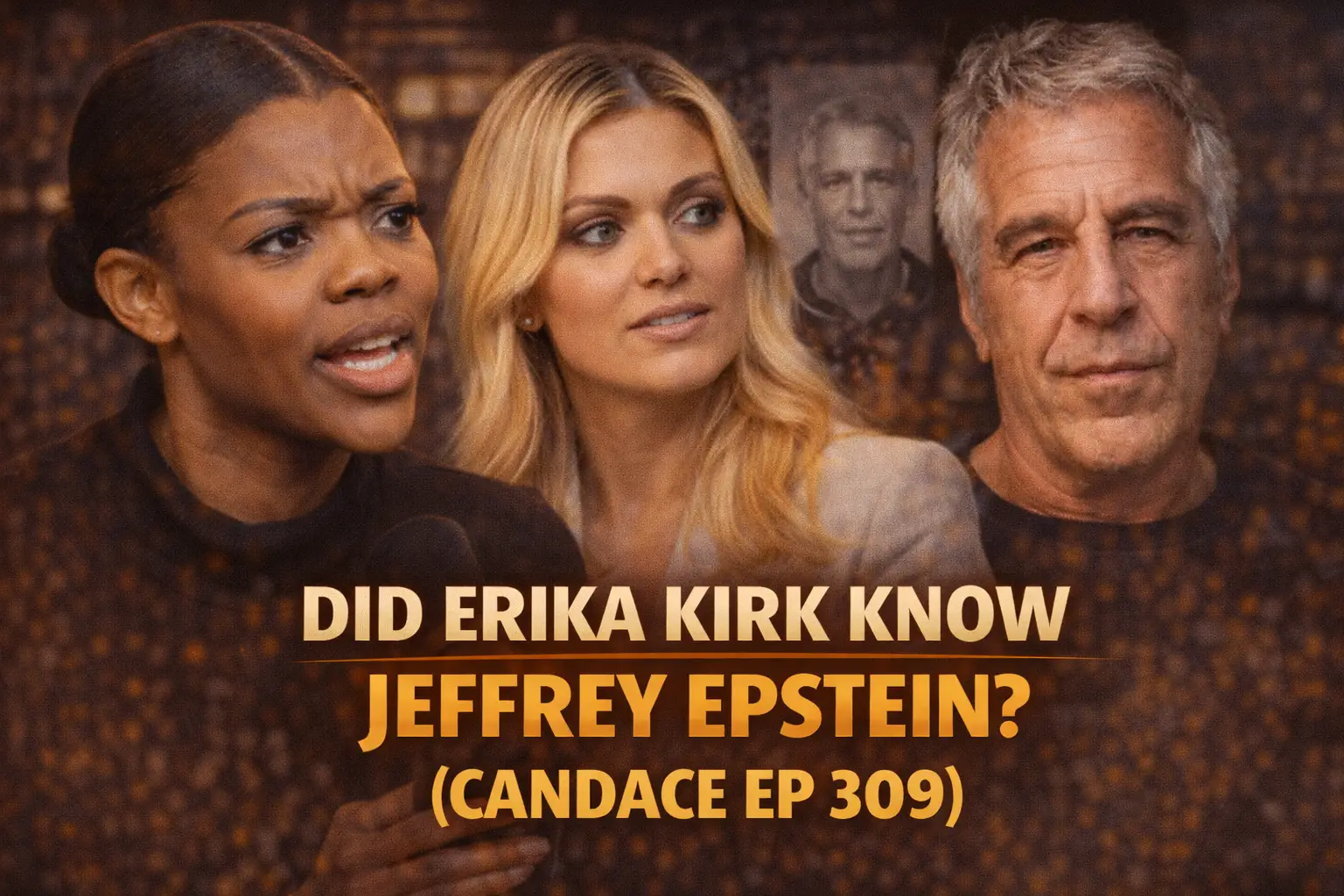
By Petty Pablo | Lead Social Analyst
Podcaster Candace Owens’ latest episode in her YouTube series runs on two tracks at once: a very real headline about Erika Kirk’s new military advisory role, and a growing suspicion that the “official” story around her rise leaves too many basic questions unanswered. The show’s through-line stays the same, public influence should come with public verification, even when grief and symbolism are part of the messaging.
- President Trump appoints Erika Kirk, formerly Erika Frantzve, to the U.S. Air Force Academy’s Board of Visitors, an exclusive panel Owens says has only 15 other members.
- Owens argues the job involves serious oversight (morale, finances, academics), then mocks unfounded claims that Erika is “qualified” mainly because she’s Charlie Kirk’s widow.
- The episode pivots into Owens’ hunch that Erika’s life keeps intersecting with Jeffrey Epstein-adjacent spaces (pageants, schools, overseas projects, modeling).
- Owens says she asked TPUSA’s PR and legal contacts about Erika’s alleged meetings at Next Model Management in New York, and claims she got no answer within 48 hours.
- A long September 8 timeline segment narrows in on where Owens thinks Erika was (or wasn’t) on a key night, based on texts, TV appearances, and witness chatter.
Trump appoints Erika Kirk to the Air Force Academy Board of Visitors
Owens opens with the headline: President Trump appoints Erika Kirk to the U.S. Air Force Academy’s Board of Visitors. She frames it as another leap upward for someone she describes as being pushed into elite rooms at elite speed within the conservative movement.
She also emphasizes the exclusivity. In her telling, Erika joins just 15 other members on a board that advises the Defense Department. Owens then lists what the board is expected to do: make recommendations to the Defense Secretary about the Academy and produce an annual report covering morale, finances, and academics.
That job description matters because it’s not ceremonial. Even if the board is advisory, Owens’ point is that the topics are heavy, and the stakes are national.
To underscore the contrast, Owens keeps returning to the “before and after” image: Erika presented publicly as a stay-at-home mom, now a digital force positioned to help shape institutional feedback for a major military academy. Owens doesn’t argue that widows can’t work. She argues that promotion-by-tragedy is being used as a substitute for basic résumé math.
For readers who want the straight news version of the appointment, see coverage from cleveland.com on the Air Force Academy oversight role.
“Her husband died” isn’t a résumé, Owens says
Owens’ critique sharpens when she compares Erika to Charlie Kirk. In her framing, Charlie Kirk, a conservative activist much like Ben Shapiro in the media landscape shaped by The Daily Wire, had long-running political influence, a history of leadership, and (as Owens describes it) a clear track record that made him legible to the people making appointments.
She reminds viewers that Charlie Kirk was appointed to the same board in March 2025, and she says there was backlash even then about politics mixing with military institutions. But the bigger punchline is her claim that Erika is being treated like a plug-and-play replacement, as if the credential is transferable.
Owens satirizes the logic like this: Charlie Kirk was qualified, therefore Erika is qualified, because Erika is “taking his place.” She likens the vibe to a “House of Cards” type of political ascension, less about transparent preparation and more about fast elevation through proximity and narrative.
This is where the episode’s theme from earlier installments shows up again (as Owens has argued in the series): emotion-heavy messaging can’t replace verification when someone becomes the face of a large, powerful operation. She keeps it focused on the mechanics, not just the personalities.
Owens also drops in a few cultural signals she thinks don’t add up, including her commentary about Erika’s background tied to Utah Valley University, pageants, and a clothing concept built around Bible-verse merchandise, then asks viewers to take seriously how far the new role reaches.
The Epstein “overlap” hunch, and why Owens says it’s getting harder to dismiss
From there, Owens pivots to her “growing hunch,” what some dismiss as one of the conspiracy theories: Erika Kirk and Jeffrey Epstein may have crossed paths, or at least moved through the same networks more than once.
Owens doesn’t claim she has a definitive photo or a signed document connecting them. Instead, she argues that there’s a pattern of repeated intersections, and she’s no longer buying the idea that it’s all random.
She anchors that suspicion to a broader view of his operations. In the episode of her investigative series, Owens describes him as operating through systems that hide in plain sight, with particular attention to modeling pipelines and international recruiting. She argues that fashion and pageantry can act as the perfect social camouflage, a “normal” reason to see many young women gathered, traveling, and being introduced to powerful people.
Owens also reads from a 2012 email she attributes to Epstein and a Norwegian royal figure, framing it as a window into elite attitudes about depopulation and lab-based human design. She uses it to argue that ideological messaging can be flexible, left-coded or right-coded, as long as it moves audiences toward the same end goal.
Because this segment is philosophical and political at once, Owens ties it to a bigger complaint: people are trained to ignore their gut, distrust intuition, and accept official framing, even when the story feels stitched together.
Occult talk goes mainstream (and Father Ripperger enters the chat)
Candace Owens notes that her show trended after discussing occult claims. She treats this as cultural momentum, saying topics that used to get dismissed by communications directors now get aired openly.
To support that, she plays a clip from Father Chad Ripperger on Shawn Ryan’s podcast. In the clip, Ripperger describes how some people are introduced to occult practices through secret societies, and how some families, in his account, pass down these beliefs through generations.
She uses the clip less as “proof” and more as a framework: if audiences are watching public life start to resemble ritual and symbolism, she wants them to consider that some people might be operating from a worldview the average person doesn’t take seriously.
She folds this back into her Epstein suspicion by saying Epstein, in her view, operated with a “mystical” belief system, and she implies that these belief networks can overlap with elite institutions, social access, and protection, as noted in Molly Olmstead’s relevant commentary.
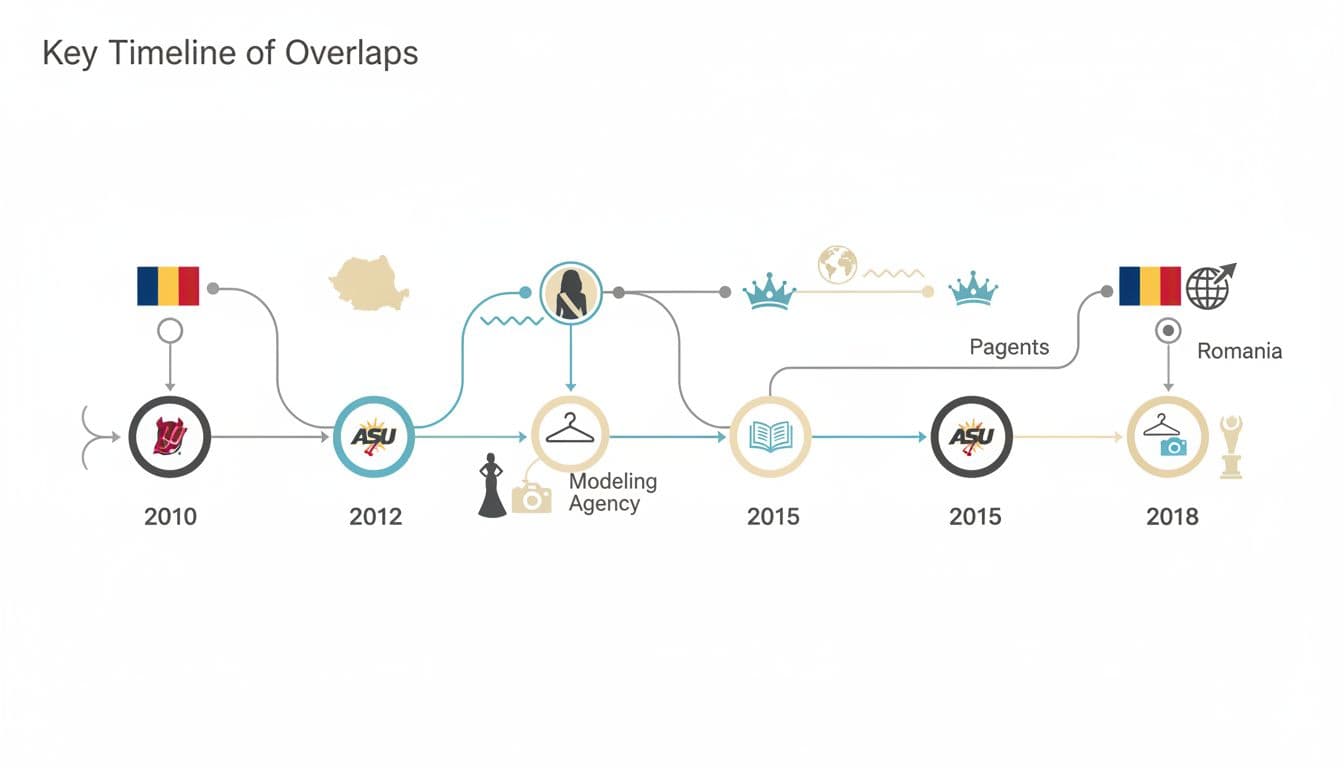
A timeline of Romania, ASU, pageants, and why Owens keeps circling 2010 to 2012
Owens then lays out a timeline designed to feel like a corkboard, with dates that (in her telling) cluster around Romania, Arizona State University, and military adjacent projects.
Here’s where prior context from the broader “Bride of Charlie” arc matters. Across earlier recaps, Owens has repeatedly highlighted that Erika Kirk’s story becomes easier to track around visible milestones, including enrolling at ASU for her final year in fall 2011, winning Miss Arizona in November 2011 (for the 2012 title year), and graduating in May 2012 (which Owens has described as a “rise” moment). Owens has also highlighted that a Romania-focused charity effort becomes more visible later in 2012, with military proximity as part of the public branding and networking at events like AmericaFest.
In this episode, Owens’ timeline argument runs like this:
- The Epstein files (as Owens describes them) show efforts to procure models from Romania starting around 2010.
- Owens claims Erika Kirk’s cousin, a lieutenant colonel, was connected to a Marine rotation in Romania around the same time.
- Owens says Tyler Boyer is in Romania socializing with models and officials, then returns to Arizona.
- Owens claims Epstein money later touches ASU through an “origins” project.
- Owens then places Tyler Boyer’s rise at ASU, and Erika Kirk’s enrollment and pageant win, in the same general window.
- After that, Owens says Erika Kirk’s charity work ties into a Romania project that partnered with U.S. Marines.
To Owens, the “weird” part isn’t that charity exists. It’s the added detail of partnering with U.S. Marines to do gift-oriented charity work in an EU country, which she argues wouldn’t normally require that kind of structure.
 Next Model Management: Owens’ key question, and the silence she says she got
The most pointed “receipt hunt” in the episode centers on the agency in New York.
Owens says she received a tip that Erika Kirk had involvement with the agency. She then spends time on Faith Kates, a co-founder Owens claims appears repeatedly in Epstein-related emails. Owens describes Kates as deeply loyal to Epstein in those messages, even after his legal trouble.
Owens then makes her core claim: she says she confirmed “multiple ways” that Erika Kirk took meetings at Next Model Management, in the company of business-side “suits.” According to Owens, people who knew the environment didn’t know why Erika Kirk was there, and they didn’t describe it as a typical modeling meeting.
Owens is careful about one piece: she says sources didn’t claim they personally saw Erika Kirk meet Epstein. Still, Owens argues that Epstein’s closeness to Kates made his presence around that office feel routine, which is why she thinks the question matters.
So she says she emailed Turning Point USA’s PR and legal contacts (copying Andrew Kulvette) with a direct question: what was the nature of Erika Kirk’s meetings at Next Model Management, and did she encounter Epstein through that circle? Owens says she got no response within 48 hours.
Her bottom line here is simple: if there’s an innocent explanation, it should be easy to give.
The New York real estate license, Corcoran, and why Owens mentions “money movement”
Owens also questions Erika’s 2018 New York real estate chapter, the same year as the State of the Union address.
In this Bride of Charlie episode, she describes Erika as unusually busy in that period (education claims, brand-building, Turning Point involvement, and a relationship timeline), yet still obtaining a real estate license and landing at Corcoran.
Owens adds two more elements:
- She mentions a person named Pam Leman, saying she appears in the Epstein files in connection with real estate dealings.
- She claims she can’t find public records of deals Erika closed in New York, and says real estate agents told her the career path described doesn’t match normal industry expectations.
From there, Owens argues that real estate can function as a convenient channel for moving money. She doesn’t present a proven scheme. She presents a question she wants answered, especially given what she sees as repeated proximity to Epstein-adjacent names and institutions.
September 8: the timeline squeeze, the Bears game, and the missing public sightings
The final major section is Owens tightening a timeline around September 8, a date she treats as important for confirming Erika Kirk’s whereabouts and the credibility of the account.
Owens contrasts Erika’s claim that she was home making dinner with the fact that, in her telling, no independent witnesses have confirmed seeing Erika that day in a neighborhood where the family was well-known.
She plays commentary from Frank Turk, who references dinner with “the family” and then a walk later. Owens notes that he doesn’t explicitly name Erika in that clip, which she finds interesting.
Then Owens brings in a new data point: Charlie Kirk discussing a Chicago Bears game with detailed play-by-play frustration, describing himself as yelling at the TV. Owens uses that segment to narrow the window of time, arguing that the timeline is getting too tight for certain other claims to fit cleanly.
Owens also references:
- a Jezebel article about a supposed “curse” published that morning, which critics have called antisemitic
- Erika breaking a long social media silence with a Bible verse shortly after
- more text-message timing that Owens claims doesn’t make sense in close quarters
- witness talk about Charlie Kirk being seen later walking with security (amid the political climate following a recent assassination attempt), plus another tall man who (in Owens’ telling) wasn’t Frank Turk
Owens ends this section with an “APB” style call for confirmations, saying she’s still looking for anyone who can credibly place Erika that day.
Timeline of Events
This timeline summarizes the key allegations:
- Trump appoints Erika Kirk to the Air Force Academy’s Board of Visitors, which Owens says includes 15 other members.
- Owens describes the board’s duties: recommendations to the Defense Secretary and annual reporting on morale, finances, and academics.
- Owens claims her team asked Turning Point USA (TPUSA) for context about Erika’s alleged Next Model Management meetings, and says they didn’t get a timely reply.
- Owens reads from a 2012 email she attributes to Jeffrey Epstein and a Norwegian royal figure, arguing it reflects depopulation thinking.
- The episode plays a clip of Father Chad Ripperger discussing occult grooming through secret societies and family lineages.
- Owens revisits a January 29 tweet about Turning Point USA figures allegedly being in the West Wing while an episode was presented as a live call-in.
- Owens outlines a Romania, ASU, pageants timeline and argues the overlaps are too frequent to ignore.
- Owens analyzes September 8 scheduling details using clips (Frank Turk, Bears game commentary), witness chatter, and message timing.
What We Know vs What’s Speculation
| Category | Details |
|---|---|
| What’s stated in the video | Trump appointed Erika Frantzve to the Air Force Academy’s Board of Visitors, Owens describes the board’s responsibilities, and she says she reached out to TPUSA with questions about Next Model Management. |
| What’s alleged | Owens alleges Erika took multiple meetings at Next Model Management, and alleges recurring overlaps between Erika’s timeline and Epstein-adjacent institutions and people. |
| What’s speculation | Owens speculates Erika and Jeffrey Epstein may have crossed paths, and speculates about what Erika’s New York real estate role may have involved, why certain meetings were kept quiet, and related national security concerns including assassination risks. |
Conclusion
Owens’ episode is less a single accusation than an argument about pattern and access: if someone keeps rising into high-trust spaces in the conservative movement, the public should be able to track the basics without needing a detective board and a prayer circle.
She’s also betting on a simple principle, the cleaner the story, the easier the answers. For now, her pressure point stays the same: the more power Erika Kirk gains, the more the unanswered questions look like part of the story, not a distraction from it, despite antisemitic pushback that echoes broader media rifts like her fallout with Ben Shapiro.
If you want the official sponsor references mentioned in the video description on social media, they include PreBorn donation information, Balance of Nature subscription details, and PureTalk savings for new customers.
Learn more about Pulse of Fame and our editorial team. Want to weigh in? Join the conversation in the Pulse of Fame community forum.
Related: Candace Owens Accuses Trump of Betrayal as Iran War Talk Explodes (Candace Ep 30