By Agent 00-Tea | Cultural Analyst
He calls it the “biggest day” of his broadcasting career, then spends the episode stacking claims about politics, power, and why he believes the fallout is only beginning.
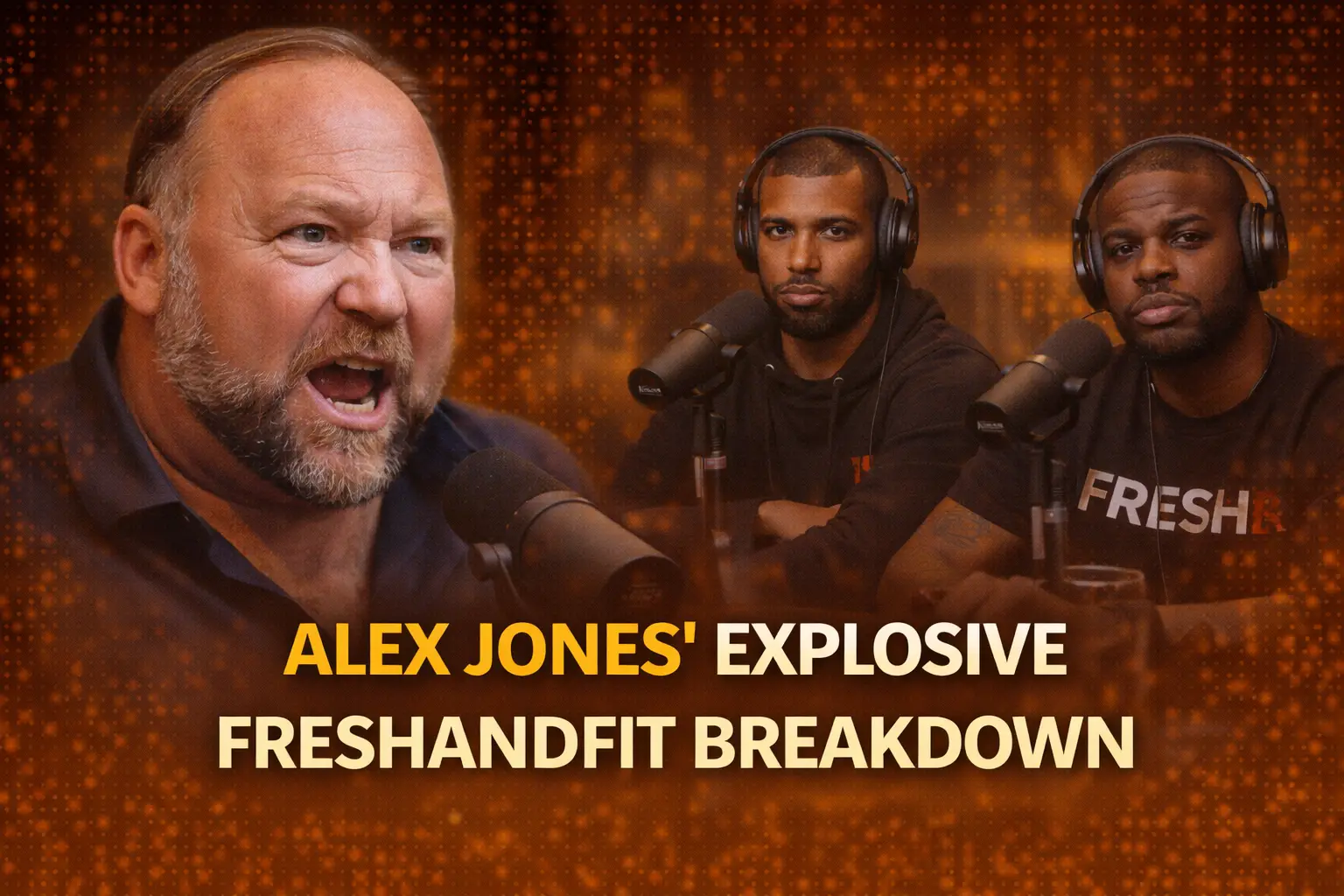
- FreshandFit went live on a Saturday to host Alex Jones in Miami.
- Jones claimed a new, massive Epstein-related document drop hit that day, and he said it completes the “blueprint” of how the network worked.
- He said his own name appears in the materials, but framed it as being referenced as a target or critic, not as a participant.
- Jones argued Epstein’s power came from elite political and finance circles, naming groups like the Trilateral Commission and families like the Rockefellers and Rothschilds (as his framing).
- He claimed Trump faced internal pressure not to release everything, then “went nuclear” and forced more disclosure.
- The conversation escalated into extreme allegations, plus a segment about Peter Nygard that the hosts reacted to in real time.
Why this “Epstein files” moment took over the livestream
The episode opens with FreshandFit’s hosts basically handing Jones the keys. They tell him to steer, promise not to interrupt, and offer to pull up anything he wants on screen. Jones, for his part, leans into urgency. He says he has been on air for 32 years, and that what he saw that day changed his understanding of the Epstein story.
His core claim: another multi-million-page tranche (he repeatedly cites “three million more”) got released, and it includes a fuller set of names, references, and context. He frames it as something that goes beyond gossip and into structure, meaning who had influence, who acted as an intermediary, and how pressure campaigns worked.
One of the more viral moments is Jones saying he’s “on the list,” then clarifying he believes the context is that Epstein’s circle viewed him as an enemy. He references the 2016 era and what he describes as people trying to stop him from reporting. He also jokes about how critics will clip the “Jones is in the files” line without context, which he suggests will be used to smear him.
From there, the stream shifts into a larger thesis: Jones claims the story is not just a scandal, it’s a power map.
For readers who want a more structured rundown of what document dumps contain (as a concept), Jones points viewers toward “searching the files,” while outside summaries like the Epstein Document Archive’s guide to the Transparency Act release can help explain how large releases get organized and described.
Jones’ “blueprint” claim: Epstein as an elite operator, not just a criminal
Jones repeatedly positions himself as an early media figure on Epstein, saying he’s tracked the story for roughly 18 years. In his telling, the new material confirms what he “already knew,” but fills in missing pieces.
His big swing is about status. Jones claims Epstein had formal or informal proximity to global policy and finance networks, especially via the Trilateral Commission. He describes Epstein as a stand-in who could attend meetings on behalf of older, more established power brokers. He compares it to an old empire model where an emissary carries authority into other rooms and other countries.
He also references an interview he says Steve Bannon did with Epstein years ago, arguing it contains revealing admissions about Epstein’s rise. FreshandFit asks why it took so long to surface; Jones answers that people don’t always know what they have until they search it, and that archives are massive.
From there, he adds another layer: intelligence. He claims Epstein’s recruitment traces back to figures connected to U.S. intelligence, plus foreign services (as he frames it). He specifically brings up Bill Barr’s father, Donald Barr, and claims Epstein once worked at a school Donald Barr ran, before allegedly moving into a much higher orbit.
Important context: these are Jones’ assertions as presented in the episode. The stream does not pause to verify documents on air. It’s a fast, talk-heavy segment built around Jones’ interpretation of what he says he read and cross-referenced.
Trump, Pam Bondi, and the “you’re all fired” storyline
A major chunk of the livestream centers on Jones’ belief that politics, not just law enforcement, shaped what did and didn’t come out. He points to Pam Bondi and claims she said in a hearing that releasing everything could “crash the stock market.” In Jones’ narrative, that line is the tell, because he says he has warned for months that financial panic was used as a reason to slow-roll disclosure.
He claims Trump didn’t understand the full scale early on, then got boxed in. Jones describes a scenario where Trump’s opponents could weaponize delay, even if Trump had no direct involvement in the original wrongdoing. He goes further, claiming Trump was pressured with recycled rumors and personal smears, and that Trump eventually snapped and demanded more release.
Jones also says people around Trump feared a market reaction because elites across sectors would be implicated, including finance, universities, and political circles. He repeatedly frames it as lopsided toward Democrats, although the stream doesn’t present a verified breakdown. He also claims members of Congress had access to more complete versions of the material, including unredacted names, and that what they saw was disturbing.
Then comes his headline-style line: Trump “dropped a nuke” on the so-called deep state. FreshandFit echoes the energy, treating it like a moment where the gloves came off.
As always, the audience should separate two things: (1) what Jones says he heard from sources in meetings, and (2) what is publicly confirmed. The stream mostly lives in bucket one.
How the episode describes recruitment and “layers” in the operation
After the political fireworks, the show circles back to mechanics. FreshandFit asks how Epstein recruited, and Jones, plus the hosts, describe a layered system: younger recruiters bring in other young women, which creates distance between the top and day-to-day intake.
Jones claims that some people labeled as victims later acted as recruiters, which in his view complicates witness narratives. He argues that relying on individuals alone won’t tell the full story, because incentives and pressure exist. Therefore, he says, the documents matter more than public-facing interviews.
The hosts add their own commentary based on their understanding of older case material. They describe a pattern where “massage” setups acted as an entry point, then expanded through peer recruitment. The point, in their telling, is insulation. The more layers between the top and the bottom, the harder it is to pin responsibility.
Jones also mentions multiple locations (including Zorro Ranch in New Mexico) as part of the broader story.
To be clear, the livestream presentation blends: past reporting, internet lore, and Jones’ claimed reading of new material. It’s confident in tone, but it’s not paced like a court filing. It’s paced like a live performance, with a studio audience on the other side of the screen.
The most consistent theme isn’t a single name, it’s Jones insisting the “system” is the story.
Trump and Epstein: social proximity vs “best friends” narratives
FreshandFit presses Jones on a question viewers always ask: what was Trump’s relationship with Epstein, really?
Jones argues it’s overstated to call them “best friends.” He acknowledges social overlap in New York circles, plus shared proximity in Palm Beach, but he claims Trump’s connection was more business and event-based than personal loyalty. He also says Trump reportedly “dropped the dime” to local authorities years ago, and he describes Trump banning Epstein from Mar-a-Lago after alleged misconduct involving staff.
He also brings up Michael Wolff (he says Wolff appears frequently in the material) and claims Wolff and Epstein discussed trying and failing to compromise Trump, because Trump “never took massages” and didn’t engage the way others did. Again, that’s Jones relaying his interpretation of references and conversations.
Jones also disputes a common tabloid-style storyline about who was a “wingman.” He claims Roger Stone, not Epstein, played that role in Trump’s single years.
Even with that defense, Jones critiques Trump for what he sees as a political mistake: letting the issue linger. He frames the delay as creating “complicity” optics, even if Trump wasn’t involved in the alleged conduct. In other words, Jones treats it like crisis communications, not just criminal justice.
For readers tracking Jones as a media figure beyond this episode, there’s broader context around his public controversies, including coverage like NPR’s reporting on Alex Jones and the Sandy Hook case.
Clintons, British royals, and the “money equals control” theory
FreshandFit shifts to Bill and Hillary Clinton, referencing “Lolita Express” internet chatter and asking for Jones’ read. Jones responds with a power-chain argument: he claims Epstein functioned as a boss-level operator, not a celebrity friend. In that framing, politicians sit downstream from funding, and funding sits downstream from whoever controls the gate.
Jones claims Ghislaine Maxwell played a role in connecting money to major political projects, and he links that to the Clinton Global Initiative in his telling. He also describes Robert Maxwell (Ghislaine’s father) as an intelligence-linked figure, and claims Epstein inherited or continued parts of that network.
The stream briefly gestures toward British royal implications, with Jones claiming there’s panic in elite circles and that even establishment outlets are forced to acknowledge uncomfortable connections. It’s a “rats leaving the ship” vibe, in his words.
A key takeaway from this section is Jones’ worldview in one line: funding isn’t charity, it’s control. Whether viewers agree or not, that’s the lens he uses to interpret nearly every name that comes up.
The Peter Nygard segment and why the chat went silent
Late in the episode, Jones brings up Peter Nygard. FreshandFit then plays a clip they describe as showing Nygard speaking openly about buying or soliciting biological material, including eggs and other material connected to pregnancy. The hosts react with visible shock and repeatedly pause to process what they’re hearing.
Jones uses this to support a broader claim that parts of the elite world normalize behavior the public would find grotesque. He extends that into claims about “ritual” ideology, saying history shows collapsing cultures adopt extreme practices, and he connects that to religious references like Moloch.
This is the point where the show becomes less “news recap” and more “apocalyptic monologue.” It’s also where viewers should be most careful about separating: what’s shown in a clip, what’s alleged about motives, and what’s extrapolated into a grand narrative.
What We Know vs What’s Speculation
| Category | Details |
|---|---|
| What’s stated in the video | Alex Jones claims new Epstein-related materials were released, says he appears in the references as a critic, asserts Epstein had ties to elite groups, and alleges Trump forced further disclosure after internal pressure. |
| What’s alleged | Claims about who controlled funding, who acted as an “operator” for global institutions, what specific public figures did, and what members of Congress allegedly saw in unredacted materials. |
| What’s speculation | Predictions about retaliation scenarios, broad theories tying many institutions into one chain of command, and interpretations that infer motives beyond what’s shown on-screen. |
Official links referenced by FreshandFit
Conclusion
This FreshandFit episode is built like a pressure-cooker: a flashy Miami setup, a guest who treats the mic like a courtroom, and a topic that turns every sentence into a headline. Jones’ central message stays consistent, he says the documents matter more than vibes, and he frames the day as a shift from rumor to structure.
Whether viewers see it as investigation, performance, or both, the stream shows how fast creator-led coverage can dominate the conversation when the internet senses a new drop.
Epstein Files RELEASED! Alex Jones Breaks It All Down
Learn more about Pulse of Fame and our editorial team. Want to weigh in? Join the conversation in the Pulse of Fame community forum.
Related: Rampage Jackson on Million Dollaz Worth of Game: UFC Wars, Streaming Fame, and t