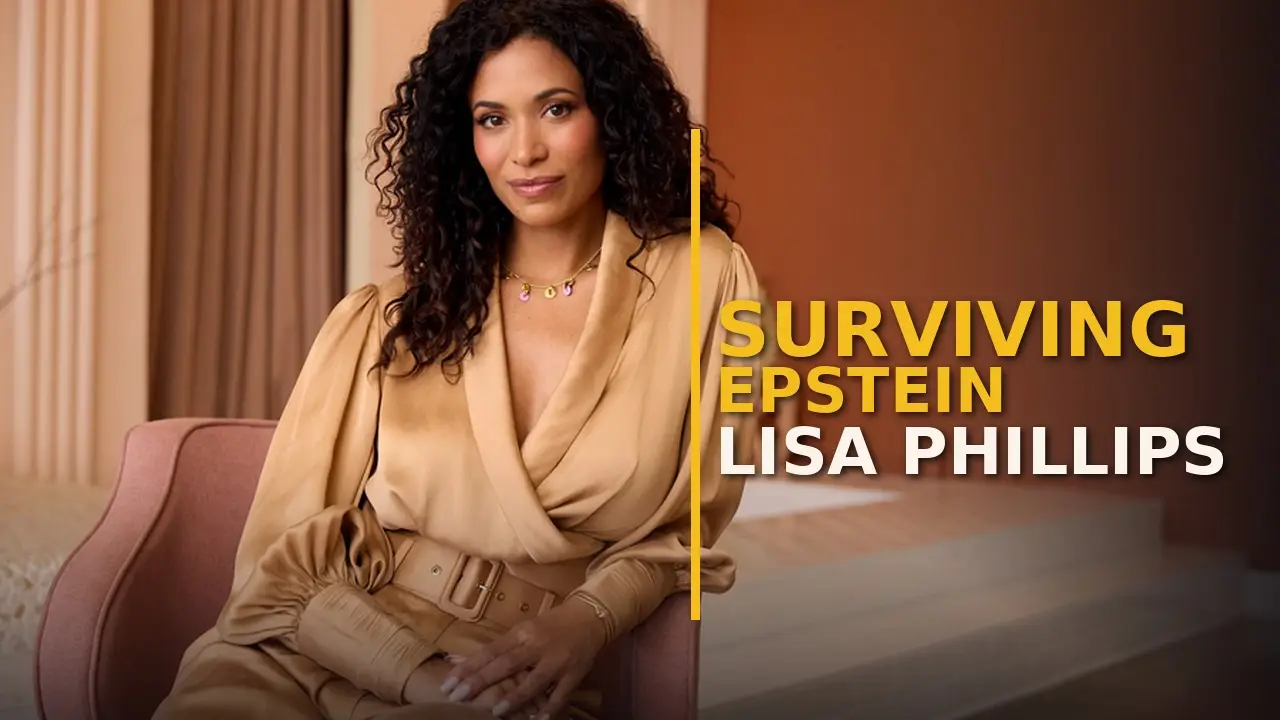
In a raw, Emotional conversation on Stepping Into The Shade Room, former model Lisa Phillips shared how she says Jeffrey Epstein pulled her into his world, how the grooming worked, and why speaking up took nearly two decades.
Lisa Phillips’ modeling rise, big dreams, and a “perfect” work trip
By Agent 00-Tea | Cultural Analyst
Lisa describes chasing modeling from the time she was 13 or 14. By the late 1990s, she says she was doing what she had always wanted, building momentum in an industry where ambition is basically part of the job description.
Her background was global. She graduated high school in Belgium, where her father worked in the service at NATO, then headed straight to Miami Beach during what she calls the late-90s heyday. From there, she worked in different places, including South Africa, Greece, Los Angeles, and eventually New York City at the end of 1999.
In early 2000, she booked a major job, a magazine cover and spread, and flew out to Tortola in the British West Indies with another model from her agency. In her telling, it was one of those moments that feels like proof your plan is working.
Then came the detour.
On a day off during the shoot, the other model suggested they visit a nearby island owned by a “friend.” The crew okayed it, which Lisa notes is strange in hindsight, and a boat was sent to bring them over.
At that point, she says, it still felt like a harmless perk of the job: beautiful scenery, warm water, and an industry connection showing off access.
Arriving on the island, fun first impressions, and the first quiet red flags
A boat ride that seemed innocent at the time
Lisa says they traveled by boat from Tortola to Little St. James (she refers to it as Little St. John’s during the conversation). When they arrived, she describes a typical “rich-people island” kind of day: ocean time, a trampoline in the water, and hanging out near the pool.
One detail stood out immediately. She remembers seeing an older man with younger girls, and she noticed they were all blonde. The friend who brought her was blonde too. Lisa says that dynamic did not instantly set off alarms because she’d already seen versions of “older men and younger women” around modeling circles, and at the time it read as common, not dangerous.
Meeting Jeffrey Epstein over dinner
Later, Lisa says, everyone sat down for dinner and that’s when she met Jeffrey Epstein. She describes the setting as warm and normal on the surface: good food, conversation, attention from someone older and charming.
The shift for her did not happen because the island suddenly looked sinister. It happened because the attention felt personal, targeted, and oddly intimate for a first meeting, even if she didn’t have language for that in the moment.
“Jeffy’s ready for your massage”: how Lisa says the night changed
The knock on the door and the moment everything turned
Lisa says she and the other model were in their quarters at night when someone knocked. It was one of the younger girls they’d seen earlier. According to Lisa, the girl told them, “Jeffy’s ready for your massage.”
That was the first time Lisa says she’d heard anything about a massage.
She recalls asking her friend what was going on, and being told, in effect, that Epstein liked massages and she “just had to do it.” Lisa describes going back and forth internally, feeling confused, but ultimately walking to Epstein’s room.
Walking into a situation she says she didn’t consent to
Lisa says Epstein was nude on a massage table when they entered. She describes the start as an actual massage using real techniques, which is part of why she says her brain still struggled to label the danger immediately.
Then, she says, the tone changed. She remembers Epstein’s voice getting darker, and questions turning strange and intrusive, like asking whether she had a boyfriend. Lisa was in her early 20s, not a teenager, but she describes herself as young, inexperienced, and unprepared for what she says happened next.
Lisa states that Epstein physically and sexually abused her and the other girl that night. She also talks about how serial predators can use control and fear as the point, and she references parallels to how other abusers have been described in public cases.
She says she and the other girl ran out, went back to their room, and she stayed awake, staring at the ceiling, feeling trapped. Because they could not leave until morning, she describes waiting for the boat like it was the only exit.
Getting off the island, then going right back to work
Lisa says they left as soon as the boat arrived and returned to the photo shoot. She finished the job, went back to New York, and kept working.
She also explains why she thinks so many women stayed silent back then: shame, self-blame, and an industry culture that didn’t leave much room for talking about exploitation without risking your career.
How Lisa says Epstein reeled her back in with opportunity and pressure
The calls that wouldn’t stop
After she returned to New York, Lisa says she felt changed. She describes feeling “damaged,” pulling away from dating, and leaning more into partying and the social scene while staying quiet about what happened.
Then, she says, Epstein’s operation showed itself.
Lisa claims Epstein’s staff began calling her repeatedly. She remembers messages like: Jeffrey thought you were amazing, you were powerful, he wanted to help you. She isn’t sure how they got her contact information, though she suspects it came from the other model.
The larger point she makes is important: she says it wasn’t just Epstein, it was a system of assistants and callers whose job was to keep women within reach.
The Ford Models hook, and why it worked
Months later, Lisa says Epstein called her directly and brought up something she’d told him at dinner: her dream was to become a Ford model.
According to Lisa, Epstein claimed he was friends with Katie Ford and offered to set up a meeting. Lisa went to Ford Models’ office in Soho, met with Ford, and says she was signed. In that moment, she describes feeling confused but also tempted to reinterpret the past: maybe she was overreacting, maybe he wasn’t “all bad,” maybe this was mentorship.
She now frames it differently. In her view, the “dream opportunity” was part of how he maintained control, using ambition as a lever.
Lisa also says she learned later that multiple modeling agencies had connections to Epstein, including the exchange of young women moving through powerful circles. In the interview, she’s careful about what she can prove, and she emphasizes that she’s still learning more herself.
The “trafficking” people don’t picture, real auditions used as bait
When people hear “trafficking,” Lisa says many imagine kidnapping or physical imprisonment. Her description is different: she says the trap was often wrapped in something that looked like a real opportunity.
She gives examples of being told about auditions or meetings tied to major players in entertainment, and flying out to Los Angeles for what appeared to be legitimate casting. In her account, it was easy to say yes because she was in school, taking acting classes, signed to top agencies, and that kind of travel for work was already normal.
Her claim is that, over time, she realized other women were being sent to the same people. She describes the pattern as consistent: if Epstein sent you, the meeting could become more aggressive, more isolating, and sometimes included unwanted advances or assault.
Lisa also explains how she believes powerful men could “know” who sent a woman without needing to say it out loud: schedules are handled by teams, and those teams communicate. She suggests that gatekeepers can track whether an appointment came from an agency, a manager, or Epstein’s office.
In other words, she describes trafficking as a pipeline disguised as access.
For more context on the interview itself and how it was presented, The Shade Room also published a write-up tied to the episode: The Shade Room’s Lisa Phillips interview article.
From silence to speaking out after Epstein’s death
Why it took 19 years to name it out loud
Lisa says the island incident happened in 2000, and she didn’t feel able to talk about it for years. Life moved on from the outside: marriage, kids, and day-to-day survival. On the inside, she describes suppressing it.
She remembers earlier public reporting and legal trouble around Epstein in the mid-2000s and later, which began to reshape her understanding. Still, she says it wasn’t until Epstein died in 2019 that the experience came rushing back in a way she couldn’t ignore.
Reaching for support, and being shut down
Lisa describes having an intense breakdown when she saw the news of Epstein’s death. She says other survivors were speaking out at the time, including Virginia Giuffre, and she began reaching out to understand what she had been part of.
One of the hardest moments she shares is personal: she says she tried to tell her then-partner what happened, and he responded that he didn’t want to hear it. Lisa connects that lack of support to why so many survivors stay silent longer than people expect.
In her view, healing doesn’t start with a headline, it starts when someone believes you, or at least doesn’t turn away.
Capitol Hill, the “list” chatter, and what survivors say they actually want
Lisa also addresses a moment that sparked huge online conversation: survivors gathering and speaking publicly, pushing the Department of Justice to release information about who enabled Epstein and who benefited from the network.
She says people got confused about the idea of survivors releasing “their own list.” In her telling, the point was not that survivors were going to stand at a mic and name every person. She argues that the government already has records, including flight logs and other evidence, and that survivors were demanding accountability and transparency.
Lisa expresses frustration that, in her view, consequences have landed unevenly. She talks about anger that only Ghislaine Maxwell is in prison, and she says talk of a pardon would be deeply upsetting.
She also brings up JP Morgan as an entity she says funded Epstein’s operation, referencing the fact that the bank settled. Her broader argument is that systems, not just individuals, kept Epstein’s world running.
Healing, boundaries, and “From Now On”
The cycle Lisa says followed her into later relationships
Lisa doesn’t describe her story as something that ended when she got off the island. She talks about patterns that showed up later, including abusive dynamics in relationships and the consequences of not getting support or therapy earlier.
She also discusses Virginia Giuffre’s passing and says she believes Giuffre took her own life, tying it to what she calls a cycle of abuse and the way shame can compound over years.
What helped most: therapy, not payouts
Lisa talks about receiving a settlement connected to JP Morgan and makes a point that stands out: she says money helps with stability, but it doesn’t fix the trauma.
What she credits most is therapy. She says the settlement included five years of therapy, which she calls life-changing. She also describes doing EMDR therapy, explaining the process in simple terms: working through memories and putting them “in a safe place,” including experiences from childhood and adulthood.
The result she describes is boundaries. Strong ones. The kind that make it easier to breathe.
Building a survivor-to-survivor space
Lisa hosts a podcast called From Now On, designed as a survivor-to-survivor space. She says each guest is asked to finish the sentence “From now on I’m…,” so the conversation isn’t only about pain, it’s also about what comes after.
She also says she wants to include men in these conversations, noting she’s raising three boys and believes abuse and trauma affect people of all genders.
If you want updates and clips tied to the interview, The Shade Room’s social channels are where many viewers first find them, including The Shade Room on Instagram and The Shade Room website.
Epstein’s death, doubts about “suicide,” and what justice looks like now
Lisa is blunt about one question many people still argue over. She says she does not believe Epstein took his own life. She suggests he was too confident, too connected, and had too much leverage on powerful people.
She also talks about cameras, saying she believes the volume of surveillance in his homes points to blackmail, not personal “trophies.” In her mind, it’s simple: people don’t record everything everywhere without a reason.
When asked what justice looks like now, Lisa’s answer is complicated. Part of her wants accountability. Another part recognizes the cost of legal fights for survivors, especially those trying to protect their kids and their privacy.
So she focuses on what she can control: advocacy, legislative change, community, and telling the truth as safely as possible.
Conclusion: “From now on,” the power is in the boundaries
Lisa Phillips’ story, as told in Stepping Into The Shade Room, is about more than one night on an island. It’s about how grooming can look like opportunity, how silence can last for years, and how Emotional healing often starts when a survivor finally feels supported.
Her closing message is simple: some people will stay silent and that’s their choice, but speaking your story out loud can unlock a level of strength you didn’t know you had. And for her, “from now on” means something clear, strong, and non-negotiable: boundaries.
Learn more about Pulse of Fame and our editorial team. Want to weigh in? Join the conversation in the Pulse of Fame community forum.
Related: Larry Wheels, Kick Clippers, and the Perils of Oversharing on Stream