By Petty Pablo | Lead Social Analyst
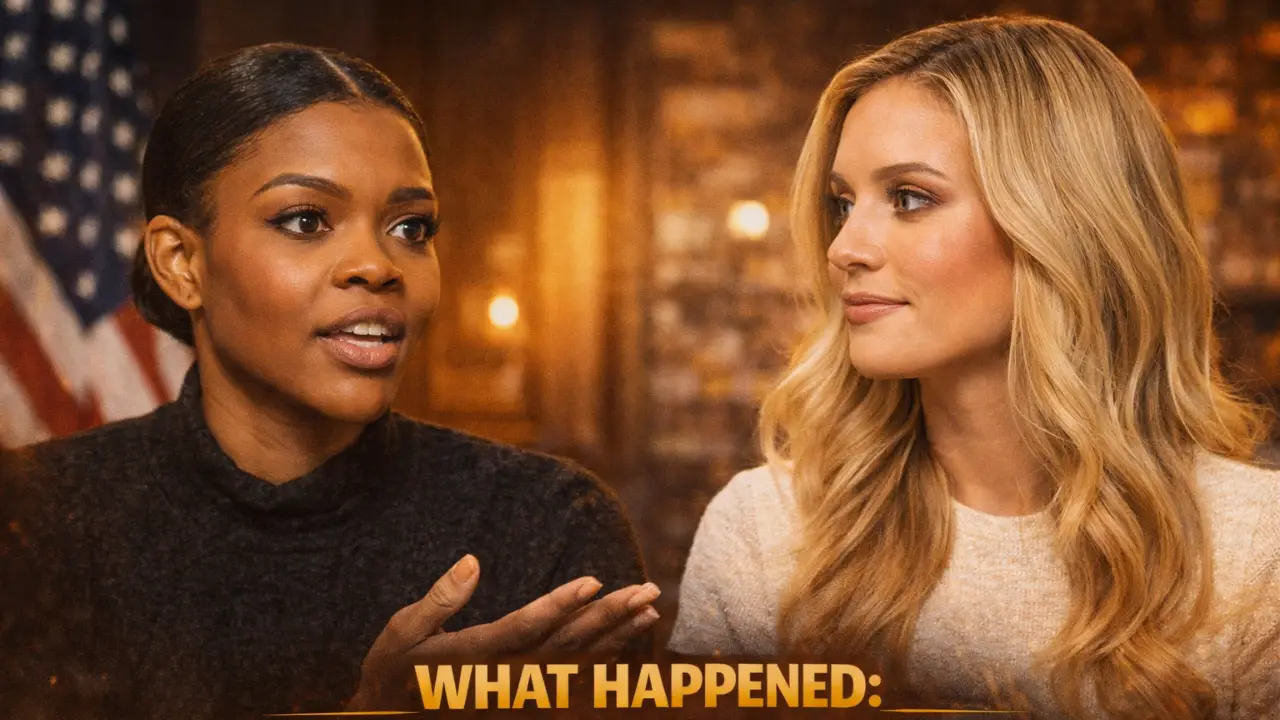
In Episode 1 of Bride of Charlie: A Wrinkle in Time, Candace Owens argues that Erika Kirk stepping into top leadership at Turning Point USA (which she describes as a massive charity operation) should come with scrutiny, not scolding. The point of the episode is less “gotcha” and more “why is this so hard to verify?”
The push to silence questions about Erika Kirk and Turning Point USA
Owens opens by saying something “strange” is happening in public view: a young woman, whom she describes as having no professional qualifications, has been placed at the top of an organization that she says took in more than a quarter billion dollars last year. In the episode’s framing, the public response is not, “Sure, who is she?” It’s, “How dare you ask?”
The argument Owens mocks is simple: Erika is a grieving widow, therefore she should be insulated from questions. Owens pushes back on that framing by emphasizing that the role is not private, it’s executive. In her telling, this is a tax-advantaged nonprofit structure, and she claims there are also big-dollar business dynamics around it (including references to a deal with someone named Pierre).
To make the point feel tangible, Owens describes a steady stream of fundraising emails that, in her words, use emotionally loaded phrasing like “My Charlie needs your help,” and she portrays the messaging as designed to short-circuit skepticism. The theme is clear: if the audience feels uncomfortable, the response is not clarification, it’s moral condemnation.
Owens’ baseline claim is not that questions prove wrongdoing. It’s that questions are normal when someone becomes the face and decision-maker for a major fundraising machine.
Why the public demands answers from a nonprofit leader
Owens repeats a line that she says is used as a shield: “She’s a grieving widow.” She compares that phrase to a cultural permission slip, the kind that ends discussion instead of inviting facts. Her critique is about persuasion mechanics, not etiquette. If the organization wants public trust, she argues, it should not treat curiosity as cruelty.
A short way to capture her stance is this:
A personal tragedy can be real, and accountability can still matter when someone holds power.
Owens also argues that a large PR effort would be unnecessary if the story were straightforward. In her view, “the truth does not fear inspection,” and a large defensive campaign signals anxiety rather than confidence.
A preemptive PR strike after a two-minute trailer
Owens says the blowback began before the series even properly aired. According to her, a two-minute trailer triggered a fast, aggressive counter-messaging push. She alleges that people associated with her production were targeted, including her manager’s family and her producer receiving heavy voicemail pressure.
She presents this as a line-crossing moment, not just “internet drama.” The episode’s tone suggests she expected disagreement, not what she characterizes as intimidation by association. Owens also says the scale of the reaction changed her plans, what began as three episodes now might become multiple seasons.
Her message to critics is basically: if you want Erika to be treated as a private citizen, don’t place her on a public stage as the new leader of a political brand and fundraising operation. Owens argues that Bride of Charlie exists because that leadership shift creates public stakes.
Elizabeth Lane’s viral critique and the “can’t watch her” reaction
Owens highlights a post she attributes to investigative journalist Elizabeth Lane, saying it went viral on X because it articulated what many people “feel” when watching Erika. Owens reads the statement at length and centers one idea: people report a visceral discomfort, and they struggle to explain it.
Lane’s explanation, as Owens recounts it, leans on psychology language, including the idea that humans detect mismatches between facial expression, tone, and content. Owens also repeats a reference to psychologist Robert Hare and “shallow affect,” while keeping it in the category of commentary and interpretation.
Owens then piles on her own observation: Erika, she claims, has managed to unify skeptics across ideological lines. The unusual part, in Owens’ telling, is not criticism. It’s the shared discomfort from people who usually agree on nothing.
For readers who want mainstream context on who Erika is and what has been reported publicly, Owens references media coverage, while disputing some of the narrative framing. Here are examples of outlets that have published explainer-style pieces: OPB’s profile on Erika Kirk becoming TPUSA’s CEO and People’s overview of what Erika did before leading Turning Point.
“Wrinkles” in Erika’s backstory: the single-mom claim and family structure
Owens says her team contacted Erika with a short list of questions, which she later describes as reduced to four. The episode does not show answers, it focuses on why Owens believes the questions are reasonable.
Her first major example is the “single mother” storyline. Owens claims Erika and major coverage described her as raised by a strong, independent single mom, and she references an interview she says Erika did with The New York Times shortly after Charlie Kirk’s public killing.
Owens then presents what she says is contradictory evidence, including a clip where Erika recounts her dad being a stay-at-home parent for a couple of years. Owens also says Erika’s parents divorced when Erika was 10, and she describes classmates and yearbook material that, in her view, suggests Erika’s father remained involved.
Owens adds another point: she says Erika also had a stepfather figure, Larry Ginta, in her life since elementary school. In other words, Owens argues the “raised alone” messaging doesn’t match the family setup she says she found.
The accusation is not just “someone embellished.” Owens frames it as strategic, small edits that accumulate. She cites Xavier Proussard’s book Becoming Brigitte as an example of how repeated minor tweaks can build a larger public legend over time.
Dates, documents, and a biography that’s oddly hard to pin down
Owens spends significant time on what she calls “mundane facts” that should be easy to verify but aren’t, at least not cleanly.
She gives two examples:
- Birthdate mismatch: Owens says a newspaper birth announcement lists November 20, 1988, but divorce filings list November 22, 1988.
- Marriage date confusion: Owens describes multiple different marriage dates appearing across documents connected to Erika’s parents’ divorce, plus a separation agreement she says appears unnotarized or oddly scanned.
Owens claims she could not find a record of the parents’ alleged Marblehead, Massachusetts marriage, while also acknowledging that some documents may be restricted or corrected later. Her point is less “this proves X,” and more “why is everything messy?”
She also argues that if someone edited official documents with pen, that would be irregular. However, she does not present an independent verification inside the episode, she presents suspicion based on how she says court modifications should work.
Gambling, family history, and the Swedish “morfar” wrinkle
Owens pivots to family history and patterns. She describes Erika’s maternal line (the Abbis family) as associated with historic gambling and lottery-related arrests, citing old newspaper coverage as she narrates it. Then she points to the paternal line, describing Erika’s Swedish side and a grandfather connected to the American Bank Note Company, which she says printed lottery tickets.
Next comes the oddly viral detail: the Swedish terms for grandparents.
Owens says she received emails from Swedish viewers pointing out that morfar means “mother’s father,” while farfar means “father’s father.” Owens claims Erika referred to her paternal grandfather using “morfar,” and she treats that as either an error no Swedish family would ignore, or a clue that something deeper is off.
From there, Owens moves into broader speculation about paternity and how that could connect to other relationships. She repeatedly labels these parts as conjecture while exploring how certain connections would “make sense” if family ties were different than presented.
The Rothstein connection and the Zion Gate caption
Owens describes Erika’s closeness with former roommate Nicole Rothstein and raises questions about why Erika would call the restoration of Zion Gate in Jerusalem “my family’s dedication sign,” when Owens says that dedication belongs to the Rothstein family.
Owens also notes that Erika posted a tribute to Alan Rothstein and referred to him as “uncle,” which Owens argues would be an unusually close label if there is no meaningful blood connection. She then maps, verbally, how distant the relation would be under the publicly stated family structure.
The episode introduces Jack Solomon, who Owens says financed the Zion Gate restoration and later married a relative (Carla) in 2002. Owens lists credentials and roles connected to Utah Valley University and Brigham Young University, and she also says Solomon’s wealth ties back to slot machine and casino business history.
This section functions as a connective-tissue board on the wall. Owens is not “closing the case” in Episode 1, she is showing why she believes the web of relationships deserves a harder look.
A Wrinkle in Time: the school, the “Looking Glass,” and why Owens thinks it matters
The episode’s title pays off late. Owens says she traced Erika’s early schooling and found attendance at a short-lived charter school in Paradise Valley, Arizona, tied to the “Tesseract” name (a reference to A Wrinkle in Time). Owens describes the school’s origin story as involving major names and institutions, and she says the specific campus later became difficult to research because it closed.
Owens adds a detail she finds almost too on-the-nose: she claims the building was rented from a Jewish school called “Looking Glass School,” which she treats as an ironic coincidence given her prior on-air talk about “Project Looking Glass.” The segment is part investigation, part performance, and she uses it to argue that critics react strongly because they fear what will surface.
Owens says she has yearbooks that place Erika there in first through third grade (1995 to 1998), and she suggests the school’s broader story includes alleged fraud and financial misconduct, which she says will be addressed later.
Conclusion: what Episode 1 is really doing
Episode 1 doesn’t try to “solve” Erika Kirk, it tries to justify why public scrutiny exists at all when someone takes the wheel of a powerful organization. Owens’ central claim is that emotion-heavy messaging can’t replace verification, and that a leader of a major nonprofit-style operation should expect questions about biography, records, and relationships. If the series continues the way it starts, the real storyline won’t be any single rumor, it’ll be the mechanics of how public images get built, defended, and monetized.
Learn more about Pulse of Fame and our editorial team. Want to weigh in? Join the conversation in the Pulse of Fame community forum.
Related: What Happened: “Mystery Guy Speaks” Breaks Down the Chicago Meetup, Money Claims