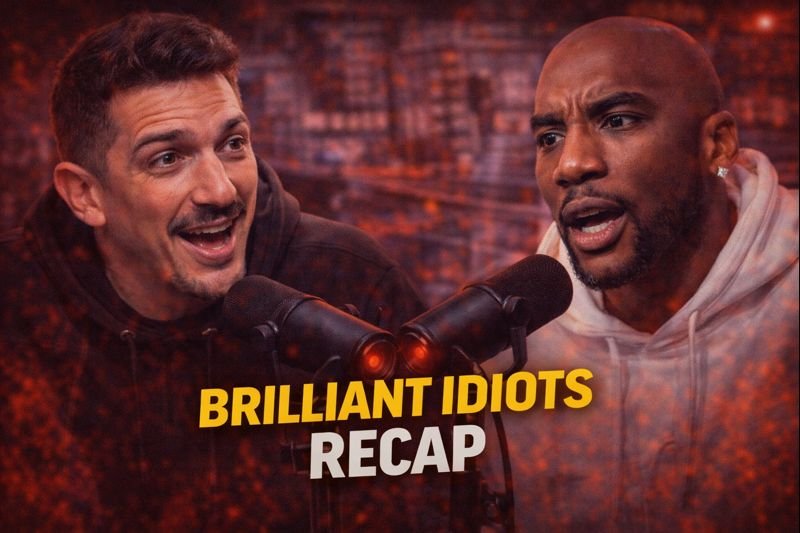
A single episode of The Brilliant Idiots managed to cover three different Americas: the one where a snowstorm becomes a side hustle, the one where sports legacies get judged like group chats, and the one where constitutional rights suddenly feel less “guaranteed” than people were taught.
A Jersey snowstorm turns into a lesson about work (and who still does it)
By The Legal Eye
Charlamagne opens with a simple winter story: he’s outside clearing snow behind the garage so he and his wife can get out safely. He’s doing the classic homeowner math, “Why am I doing this myself?” right as help arrives.
According to him, a plow truck showed up with a crew ready to work, no call needed, and they got straight to it. Charlamagne frames it as perfect timing, real neighborhood efficiency, and a reminder that the people who do the unglamorous work often keep everything moving. He’s openly appreciative, emphasizing how “right on time” they were.
zEveryone loves the first clean fall, that untouched backyard look, the “movie scene” white. Then the plows hit, the piles turn gray, and the streets turn into ice rinks. The shared takeaway is simple: snow is pretty for about a day, after that it becomes a chore.
“Kids aren’t taking advantage”: the lost art of snow-day money
From there, Charlamagne goes on a mini-rant that’s half joke, half economics lesson. In his view, kids are missing an easy seasonal hustle: shoveling driveways. He compares snow to money sitting right in front of you, and he can’t understand why more kids aren’t outside getting after it.
Schulz pushes back with a class read: in a lot of nice neighborhoods, the kids aren’t shoveling because they don’t need to. There’s also the technology factor. They mention electric snow blowers and tools that make the job easier than it used to be, which somehow makes it even funnier that the hustle feels less common.
It’s a small conversation, but it sets up the episode’s larger theme: who does the work, who gets the credit, and who gets treated like a problem instead of a person.
Nail salon confusion, tipping pressure, and the “apron system”
Charlamagne shares a nail salon story that’s painfully relatable if you’ve ever zoned out during an appointment. He describes getting a pedicure, then moving to a manicure, and realizing he might not have the same person. The issue is not service, it’s the social anxiety of not knowing who to tip and how much.
He jokes about the staff “switching up” just to see if he notices, and for a moment, his solution is to tip everyone so he doesn’t look confused. Then he figures out the real identifier: different-colored aprons. Mystery solved.
The bigger point is modern etiquette panic. People want to do the right thing, but the rules feel unwritten and shifting. Charlamagne says he typically tips $20, and if the same person does multiple services, he’ll tip per service. It’s the most wholesome version of chaos: trying to be generous while your brain is buffering.
Massage talk, “happy ending” rumors, and why some stories sound too perfect
The episode also detours into massage culture, mostly through Schulz saying he goes to Massage Envy because he has points. He jokes that he rotates therapists because he can’t remember anyone, which leads to a broader conversation about those “this randomly happened to me” stories people tell.
Schulz brings up a friend who claimed he got an unexpected adult offer during a massage. The group treats it like urban legend, not impossible, but suspiciously cinematic. The funniest detail is the friend allegedly negotiating timing, basically trying to schedule the moment so he still gets the full hour.
Nobody is giving instructions, nobody is glamorizing anything, it’s more like a commentary on how people tell stories to sound like life is constantly happening to them.
Ray J’s health scare, and why overstimulation feels like the default setting
When the mood turns serious, it turns fast. The hosts react to Ray J speaking about alarming health news he says he received from doctors, tied to heavy substance use and alcohol. They emphasize hope that it’s exaggerated or misunderstood, because the alternative is grim.
Charlamagne mentions texting Ray J and urging him to see a cardiologist, referencing a heart scan he himself has done. The medical specifics are discussed the way people talk when they’re scared: not as experts, but as friends trying to make sense of what they’re hearing.
From there, the conversation widens into what they think is making people sicker in general. Schulz connects rising health scares to stress, overstimulation, and constant cortisol. The line that sticks is the idea that peace can start to feel “off” when your nervous system has been trained to expect chaos.
They also touch on kids and screens, including a regret about not being strict enough and how quickly creativity can get replaced by phones. It’s not a “phones are evil” speech, it’s more like admitting how hard it is to compete with an algorithm.
If you want the show in audio form, it’s widely available, including The Brilliant Idiots on iHeartRadio and The Brilliant Idiots on Apple Podcasts.
Bill Belichick’s Hall of Fame snub becomes a legacy argument (and a trust issue)
Charlamagne’s sports frustration is loud and clear: he can’t accept Bill Belichick not being voted a first-ballot Hall of Famer. He frames it as personal, petty, and reputation-based rather than merit-based. For him, the resume is obvious, championships, wins, and an era of dominance that defined modern football.
Schulz explores a different angle: how narratives shift. He points to the post-Tom Brady years and how the public re-scored both Brady and Belichick once Brady won elsewhere and Belichick struggled without him. Even if Belichick’s overall career still stands, people love a storyline, and storylines influence voters.
The discussion also turns into a broader indictment of “Hall of Fame” culture. If voters can keep someone like that out on the first try, what does the honor even mean? Charlamagne calls it hate. Schulz calls it a system problem. Either way, they agree it makes the institution look unserious.
They briefly compare the conversation to baseball debates like Barry Bonds, arguing about performance-enhancers, level playing fields, and whether winning titles should matter more than individual greatness.
Minnesota and ICE: the episode’s breaking point on power and constitutional rights
The heaviest segment centers on a killing in Minnesota the hosts discuss at length, involving a man they refer to as Alex Prey (spelling unclear in the audio). They describe him as a registered nurse connected to veteran care, and they say he had legal permission to carry a firearm.
According to the hosts’ description of the video they watched, he was recording ICE activity on a street, moved to help people who had been pepper sprayed, was then disarmed, and was shot. They focus less on speculation and more on what they say the footage shows: escalation, confusion, and a deadly outcome after the weapon was taken away.
What angers them most is the immediate official messaging they say followed. They criticize what they view as an attempt to override public perception by insisting the event happened differently than what viewers could see. Schulz frames it as the kind of reality control that scares people, not because it persuades, but because it tries to command.
They also discuss structural issues: training time, accountability, and identification. A key concern raised is the idea of agents without clear names or visible identification, which makes oversight harder and distrust easier.
Even more, they connect it to core rights Americans argue about constantly: the First Amendment (speech, press, assembly), the Second Amendment (bearing arms), and the Fourth Amendment (limits on searches and entering homes). Their point is not that everyone must agree on policy. Their point is that basic rights can’t be treated as optional when it’s convenient.
They mention surprising pushback from unlikely corners, including gun-rights groups, and note that moments like this can shift who pays attention, and why.
“Ask an Idiot” turns reflective: books that changed perspectives
The episode ends with a lighter segment that still has substance: books that changed how they see life. Charlamagne lists several influential titles, and the theme is growth through reading outside your own experience.
Chris shares a strong recommendation for Elena Ferrante’s Naples novels, describing how he initially dismissed them and then got pulled in completely. The point is simple: great stories make other lives feel familiar, even when your starting assumption is “this has nothing to do with me.”
Here’s a quick snapshot of the titles they name:
| Book or Author Mentioned | Why it mattered in the conversation |
|---|---|
| The Autobiography of Malcolm X | A perspective-shifting life story |
| Message to the Black Man (Elijah Muhammad) | A formative text for Charlamagne |
| The Four Agreements | Personal mindset and behavior |
| The Secret | A well-known modern self-help title |
| Elena Ferrante’s Naples novels | Empathy through storytelling |
| The 48 Laws of Power | Awareness of manipulation and strategy |
Conclusion: comedy, culture, and the part where everyone has to pay attention
This episode works because it doesn’t pretend life stays in one lane. One minute it’s snow shovels and tipping stress, the next it’s a real conversation about health, media trust, and what happens when institutions act like they can rewrite what people saw.
The sharpest takeaway is that outrage isn’t the only response. Attention is. The hosts keep returning to the same idea: people can disagree on policy, but they can’t survive a country where shared facts don’t matter.
Learn more about Pulse of Fame and our editorial team. Want to weigh in? Join the conversation in the Pulse of Fame community forum.
Related: Leaked Jeffrey Epstein Steve Bannon Interview: Wall Street, Power, and the Limit