By Petty Pablo | Lead Social Analyst
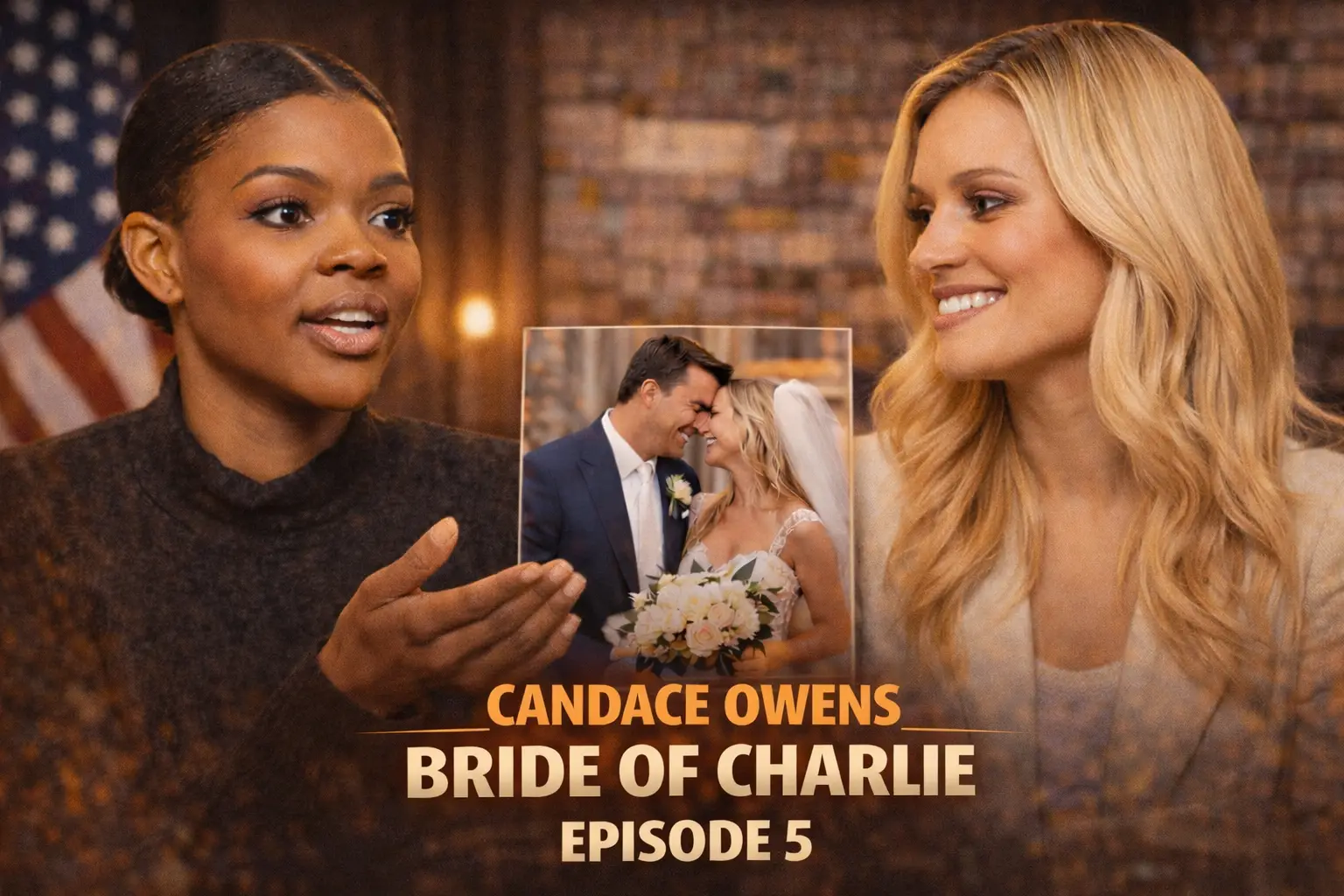
Candace Owens’ Episode 5 is built like a corkboard reveal, same thesis, bigger map. She says the “cast of characters” is now established, so it’s time to stack the dates, schools, LLC filings, and overseas references into one cleaner timeline, with special attention on the years she says she still can’t account for.
The result is part timeline audit, part narrative critique. Owens argues that when someone rises into high-visibility leadership, the biography should get simpler to verify, not harder.
The episode’s organizing idea: “missing years” and why Owens keeps circling them
Owens opens by saying the pieces are “in place” to start pulling everything together, especially around Erika (Erica) Kirk, her mother Lori France, and Turning Point-world figure Tyler Boyer (Owens also mentions “Eastern Europe” repeatedly as a setting she wants viewers thinking about).
Her main claim stays consistent with earlier episodes: emotional framing can’t substitute for verification when leadership, money, and influence are involved. Episode 5 pushes that idea through a practical question: where was Erika during the years Owens believes are hardest to document?
Owens also folds in new angles she flags as unresolved or suspicious, including:
- overseas references (Eastern Europe, Romania, China),
- military-adjacent claims around Lori’s tech work,
- and a renewed look at a family-connected name, Rick Urbanbeck, tied (in Owens’ telling) to paperwork and a later legal controversy.
A clean timeline, as Owens lays it out (1988 to 2009)
Owens attempts a year-by-year structure, mixing what she says she can document with what she says is still missing. This quick table mirrors the backbone she builds onscreen.
| Year(s) | Owens’ timeline claim | What she emphasizes |
|---|---|---|
| 1988 | Erika born (Nov 20 or Nov 22) | Conflicting dates depending on the record |
| 1990 | Dr. Jerri France Fay travels to Eastern Europe for gender-related research | Owens questions the purpose and timing |
| 1991 | Walnut Corner daycare, Cincinnati | Photo evidence (Halloween) |
| 1994 to 1995 | St. Ursula Villa (kindergarten) | Presented as confirmed |
| 1995 to 1999 | Tesseract School in Paradise Valley, Arizona | “Looking Glass” naming and institutional backstory |
| 1998 | Divorce filing (Lori in Cincinnati, Kent in Arizona, per docs Owens references) | “Messy records” theme continues |
| 2000 to 2002 | Unclear school placement | Owens asks viewers to help identify it |
| 2005 | Notre Dame Prep, sports, pageants | Trail becomes easier to follow, she says |
| 2007 to 2008 | Regis University basketball, major listed as business administration | Sets up her “missing year” argument |
| 2009 | Lori’s charity filing, Erika’s pageant participation | Owens highlights contradictions |
A consistent beat here is Owens’ insistence that the “boring” parts should be the easiest parts, dates, schools, basic enrollment, and the fact that they are not (in her view) becomes the story.
The birthdate discrepancy Owens repeats
Owens again frames Erika’s birthdate as disputed across records. She presents it as either clerical confusion or something that raises broader questions about documentation in the family story.
- Date 1: November 20, 1988
- Date 2: November 22, 1988
- Owens’ framing: if it’s a clerical issue, why does it show up more than once?
Tesseract School, charter-school power, and the military-adjacent thread
Owens resumes the Tesseract storyline from earlier installments, describing the school as part of a charter-school wave in Arizona, with private operators and public funding. She repeats her earlier framing that the institution was backed by elite money (she names major families) and designed with heavy input from psychologists, including Dr. Jerri France Fay.
Owens uses this to sharpen a broader motif: institutions close, money gets questioned, and the paper trail gets harder to reconstruct.
Nancy Gerard Hall, as Owens presents her
Owens identifies a Tesseract principal, Nancy Gerard Hall, and then stacks biographical details meant to suggest “strong military ties” in that family. She highlights service history, military-law-enforcement roles, and fraternal or honor-society affiliations, then speculates about whether that background shaped school operations with what she calls “military precision.”
Owens presents this as context, not as proof of a specific act. The point, in her telling, is pattern recognition: charter-school influence plus military-adjacent leadership plus record confusion later.
Tesseract’s collapse (and the missing money theme)
Owens reiterates a version of the ending she’s been building: the school shutters amid financial trouble, and she frames it as part of a recurring story where “millions” go missing and nobody seems to fully account for it.
The 2000 to 2002 gap and Owens’ public “APB”
Owens corrects a point she says she previously suspected: she no longer believes Erika attended St. Ursula Villa during 1999 to 2002, because people who attended reviewed yearbooks and said Erika wasn’t there.
From there, she turns the gap into a viewer callout. She asks anyone who went to school with Erika (she also uses the surname France at times) during 2000 to 2002 to reach out, including if the school was in or near Scottsdale.
This “missing years” section is where the episode title energy lands. Owens doesn’t offer a single verified alternative location. Instead, she frames the absence of clean confirmation as the point.
Lori France’s LLCs and the military-contract framing Owens keeps returning to
Owens uses corporate filings as another track line. She highlights several late-1999 entities, describing them as signals of overseas business intent, including:
- Virtual Registration International Inc. (formed with help from Rick and Donna Urbanbeck, per Owens)
- additional “Intel/Intellment” entities she lists with dates in 1999
- a later Intel of Arizona LLC (2003, in her narration)
She then layers in her bigger claim: Lori’s work becomes “military-adjacent” after 9/11, and Owens points to an E3 Tech website statement as her basis for saying the company supported Operation Enduring Freedom. Owens treats this as open-ended, she says she can’t confirm whether Lori physically traveled overseas, and she floats the question of whether Erika could have gone as well.
The financial anchor she emphasizes is a disclosure she describes involving $2.4 million paid to IMAT Laboratories (which she associates with Lori) tied to Army National Guard categories Owens labels as cyber-related. Owens positions that figure as happening in the same general period she describes Erika as “missing” or isolated.
Owens’ recurring argument is less “this proves a crime,” and more “this is a lot of money and movement for a story that’s presented as simple.”
2005 to 2009: pageants, college claims, and the “locked away” year
Owens says Erika becomes easier to document around 2005: Notre Dame Prep, basketball, and pageants. She references a charity item connected to Winslow, Arizona (Andrea’s Closet), then claims a source told her Erika’s “we traveled through Winslow all the time for basketball” line doesn’t match typical Arizona travel patterns.
By 2007 to 2008, Owens says Erika is at Regis University, with a player bio listing a business administration major. Owens contrasts that with later public messaging she claims shifts the major to political science. She also re-uses a clip concept from prior episodes, an eight-month period where Erika describes isolating, reading scripture repeatedly, and seeing only family and a pastor’s wife.
Owens frames 2008 to 2009 as the hinge point where the public persona (high-scripture rhetoric) starts to make more sense to her, while also producing timeline conflicts.
Everyday Heroes Like You and the China to Marines to Romania sequence
Owens highlights a 2009 filing where she says Lori established Everyday Heroes Like You, described as a faith-based effort aimed at vulnerable children. Then Owens plays Erika describing a sequence: charity first, then work in China with trafficking victims, then a relationship with the Marine Corps and Army, then an orphanage project in Romania.
Owens doesn’t confirm the travel. Instead, she presses on timing and consistency, because she also says Erika competed in a Colorado pageant cycle in late 2009.
For broader context on the public debate around the series, see AOL’s report on the online dispute.
Romania enters the story: bases, overlap claims, and Tyler Boyer’s messages
Owens flags a 2009 announcement she says matters: Romania agreeing to a US military base along the Black Sea. She then claims this is also when Jeffrey Epstein materials begin referencing Romania more, and she treats that as a dark coincidence in her broader “Romania becomes a pipeline” framing.
Then she pivots to 2010, where she says the Black Sea Rotational Force begins activity in Romania. Against that backdrop, she introduces a set of messages she says show Tyler Boyer went to Romania to do work tied to a senator in Parliament, and also describes social time connected to a modeling-agency owner.
Owens uses these messages to push one simple question: if Tyler’s Romania trip is real, who set it up, and who were the contacts? She says Erika has been fuzzy about how she met Tyler, and she frames that fuzziness as suspicious.
The “Uncle Rick” update: Kentucky bar suspension and the Urbanbeck thread
Owens returns to Rick Urbanbeck and expands on why she says he lost his Kentucky law license in 2009. In her telling, the case involved professional misconduct issues tied to real-estate title work, undisclosed prior mortgages, and property-transfer irregularities.
Key framing details Owens stresses:
- He testified and gave up the license, but avoided criminal charges, in her telling.
- The consequences were treated as professional negligence rather than a prosecutable crime.
- She connects the name back to a larger family scandal she has referenced before, and she treats a later “buried cash” headline detail (found years after, as she describes it) as proof the story kept echoing.
Owens’ larger takeaway is social, not just legal: she argues that powerful networks often take reputational hits, but not the kind of consequences regular people would expect.
For a separate AOL piece that summarizes earlier claims Owens makes in the series about Erika’s background, see AOL’s write-up on the single-mom dispute.
The Blake Neff “Shabbat Shalom” back-and-forth and why Owens spotlights it
Owens also addresses a response she attributes to Blake Neff, who she says defended Erika’s use of “Shabbat Shalom” and Charlie Kirk’s Sabbath practice. Owens treats the response as revealing, because she thinks it focuses on protecting a symbolic story beat instead of answering the bigger questions she’s raising about records and timelines.
She counters with her own perspective: that she knew Charlie personally, that Sabbath habits were not new, and that posthumous framing battles can become a strategy for controlling a public legacy.
Closing notes: viewer comments, family rumors, and the episode’s real cliffhanger
The episode ends with Owens reading viewer comments, addressing a question about whether Erika still has her kids (Owens says yes), and reiterating that she sees prior relationships, including military-adjacent ones, as the connective tissue she plans to keep testing.
She also signals what Episode 6 is meant to do: bring Erika into the Romania storyline more directly, after laying the groundwork with the base timeline and Tyler Boyer’s messages.
If you prefer a searchable transcript hub for Owens’ audio content, there’s also Candace podcast transcript archives.
Conclusion: what Episode 5 wants the audience to walk away believing
Episode 5 doesn’t “solve” the mystery it sketches. It’s a pressure test, can the public-facing story survive a basic timeline audit? Owens argues the unanswered years (2000 to 2002, and her “missing” 2008 focus) matter because they sit next to LLC filings, military-adjacent claims, and overseas references that she thinks should be easier to confirm.
The most important takeaway is Owens’ repeated thesis: public power invites public questions, and a compelling narrative doesn’t end the need for verification.
Learn more about Pulse of Fame and our editorial team. Want to weigh in? Join the conversation in the Pulse of Fame community forum.
Related: Bride of Charlie Episode 4 Recap: “The Ties That Bind,” War Talk, and the Erika