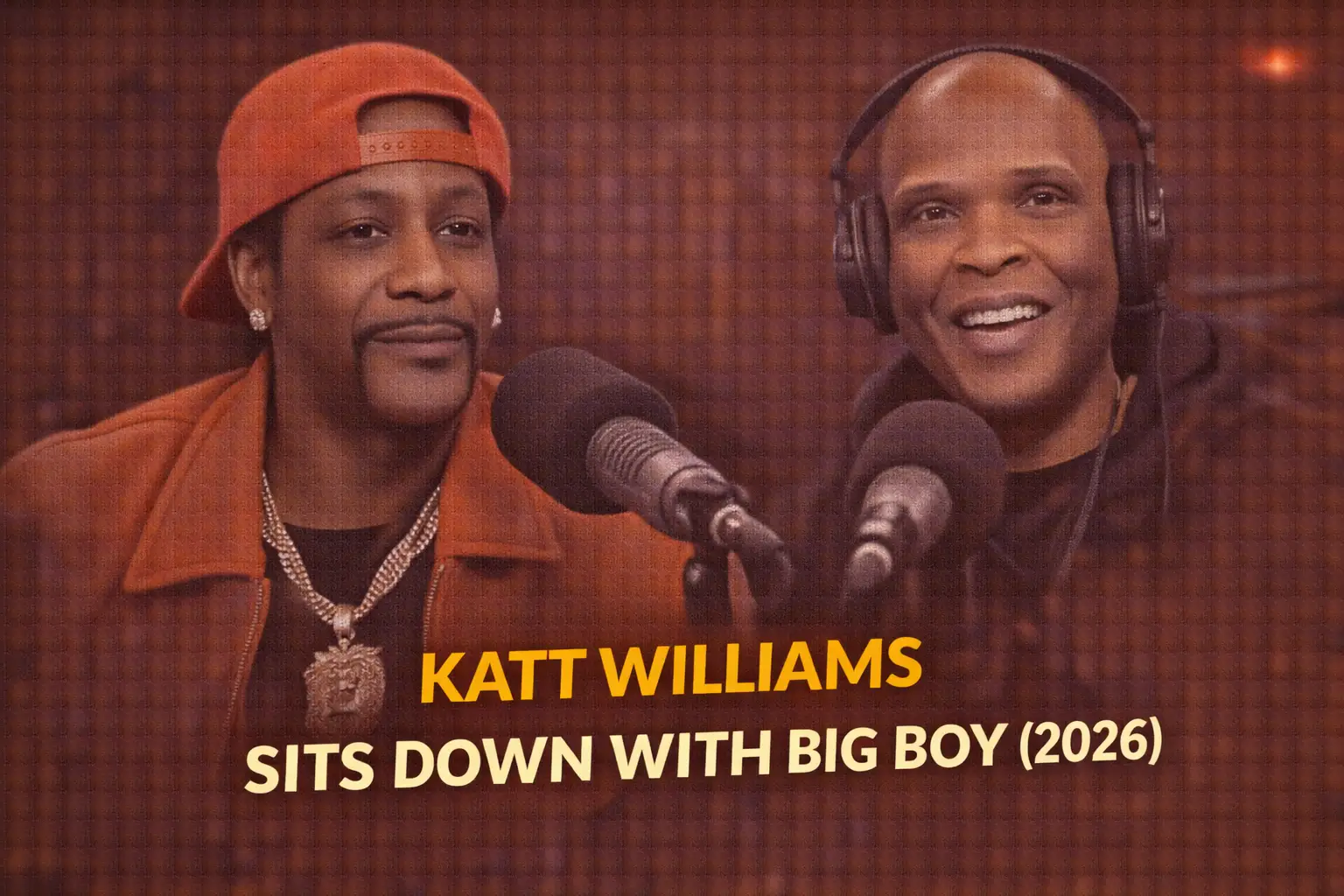
Twenty-plus years into their friendship, Big Boy and Katt Williams don’t talk like two people doing press. They talk like two veterans comparing notes after a long run, equal parts laughter, side-eye, and hard-earned respect.
Katt has always been the guy who can walk into a conversation, flip the lighting, then walk out like nothing happened. In this 2026 sit-down on Big Boy’s Offair, he breaks down how he stays sharp, why he moves the way he moves, and what he was really doing when he “broke the internet” on Club Shay Shay.
A 20-plus-year bond, and why Katt always moves different
By Agent 00-Tea | Cultural Analyst
Big Boy opens with the kind of praise you can’t buy, because it isn’t about hype. It’s about track record. He shouts out Katt’s standup dominance, his cultural commentary, and that rare talent for making a small role feel like the whole movie. The resume gets its flowers: Friday After Next, TV moments like My Wife and Kids, the Roast of Flavor Flav, and the viral aftershocks of Club Shay Shay.
Katt’s energy is calm, but pointed. He drops one of the interview’s central ideas early: he’s not scared to say what he thinks. That’s not him trying to sound tough. It’s him describing how he works.
When Big Boy asks about New Year’s resolutions, Katt flips it into something more useful: he does “weekly” resolutions. Constant adjustment. Constant edits. He even jokes that being “messed up” helps, because it gives you plenty to fix. The point is simple: no finish line, no victory lap, no “perfect” version of yourself that magically arrives one day.
Then comes one of his best metaphors: Katt talks about how he can appear and disappear like a hunter. Not because he’s bored, but because the “disappearance” is where the behind-the-scenes work happens. He frames it as inner work, shadow work, preparation, and staying in the gym, mentally and physically. Big Boy clocks something people don’t always notice: even when Katt disappears from the public eye, he still seems to know what’s happening. Katt basically confirms it. He’s not vanishing, he’s building.
The blueprint: owning his comedy, funding his specials, and betting on himself
Before “independent” became the cool word, Katt treated his standup like a product he owned. Big Boy points out how early Katt was to the business shift: when his shows ended, his name wasn’t only in the credits as talent. He was putting up money and executive producing, long before most comics were thinking that way.
Katt says he did it because he knew his worth. Not in a motivational poster way, in a dollars-and-control way. He believed in the product, the conversation, and what he could deliver. He says he paid for and produced the first 12 specials because it was his best asset. In his mind, that’s an “easy sale” because he’s always trying his best.
It also connects to Big Boy’s point about the media shift. Big Boy has 32 years in radio, and remembers when people talked about podcasts like they were a last resort. Now, podcasting is where money and attention live. Katt’s response fits his whole brand: he doesn’t frame his path as a workaround. He frames it as winning, even when winning requires taking a few hits so people can pretend you’re losing.
Here’s the difference Big Boy is getting at, laid out plainly:
| The old gatekept path | Katt’s approach |
|---|---|
| Wait for the “right” network or marquee deal | Self-produce and keep control |
| Be known only as the performer | Be credited as a producer and owner |
| Let the industry define your value | Decide your value first, then move |
When Big Boy asks whether Katt is trying to prove others wrong, Katt gives a clean philosophy: he cares what people think, but only in the past tense. He’ll consider how people judged what he already did, but he won’t let it steer what he does next.
“I’m a predator”: truth, pressure, and the freedom of not being “tied down”
Katt doesn’t pretend he’s everyone’s comfort comedian. Big Boy asks if he makes people nervous. Katt’s answer is sharp: not dumb people. Anyone nervous around him is “very specific.” Then he says the line that explains a lot of his public persona: he’s a predator.
In Katt’s framing, that doesn’t mean chaos for sport. It means he’s observant, patient, and direct. Big Boy connects it to career freedom. Katt doesn’t come off like someone afraid of losing a deal, a part, or a seat at a table. That kind of independence makes certain conversations easier, especially when the truth makes people squirm.
Katt also takes a shot at the idea that contracts keep people from being honest. In his view, nobody’s contract stops them from telling the truth. The issue is character, not paperwork. He even frames his harshness like officiating: don’t be mad at the ref. Fix what got called out, or keep yelling, your choice.
He also jokes about being selective with interviews, saying he might only do a handful, and then tells Big Boy this is their last one together (with a wink that still lands like a boundary). Big Boy admits the pressure: he had a doctor’s appointment and still moved things around to make this sit-down happen because Katt chooses who he talks to.
And when Big Boy asks about social media, Katt plays it like a trap question. The moment turns into comedy, including a Wi-Fi joke that reminds you he can turn any room into a punchline without breaking a sweat.
Club Shay Shay explained: the algorithm, the “jabs,” and why he didn’t promote it
Big Boy brings up the now-famous Club Shay Shay moment where Shannon Sharpe says “Come on, Katt,” and Katt doubts anyone will want to do the show. Big Boy reminds him what he said back: “They’re all coming.” Then comes the real question: did Katt know it would explode into one of the biggest YouTube podcast episodes ever?
Katt’s answer is technical and intentional. He says he researched what makes the algorithm work and designed the conversation to trigger a specific viewer behavior: people hearing something, thinking “that can’t be true,” pausing to check, then coming back. He even mentions a number, saying it needed to happen repeatedly, consecutively, to maximize impact.
He also claims he scaled it back. In his words, he removed “knockout punches” and left “jabs.” He wanted to pull coattails without completely blowing up everyone’s spot. He compares it to proving power in a single move: if you want people to believe you have that level of influence, you have to walk in, do the impossible, then walk out untouched. Otherwise, they’ll keep doubting.
Big Boy’s funniest observation is also the most telling: after all those views and all that chatter, Katt didn’t do the usual victory tour. No endless clips on his page, no obvious promo push. Katt calls that a flex you can only make when you’re not bought and paid for. He says he thought it was necessary, and that it ended up being beneficial.
For readers tracking how this moment was covered outside the interview, outlets have also recapped Katt’s “truth era” framing, including Yahoo’s summary of Katt’s “age of truth” comments and VIBE’s coverage of his comments tied to Diddy chatter. In Big Boy’s chair, Katt keeps it focused on intent: pressure, precision, and lasting conversation.
The Golden Age tour, Friday talk, Diddy party jokes, and what’s next
Katt says today’s audiences want authenticity. He frames it as a broader cultural shift where people care less about the “best actor” and more about what feels real.
That connects to his new tour, The Golden Age, where he says he’s doing something different: he’s mostly talking about himself. He’s clear that fans shouldn’t expect him to recycle a recent special on the road. When he comes to your city, he’s picking up a new conversation. This time, that conversation is personal. He says he loves himself, is proud of himself, and doesn’t treat failure like a label. He treats it like a step on the way to a win.
When Big Boy asks about longevity, Katt gives the closest thing he offers to business advice: have the best product you can, then be consistent with it. He jokes that he’s been 5’5″ the whole time, the point being that the core has stayed the same. Longevity, to him, is doing your best at the lowest point, then acting like you’ve been there when things get high.
Big Boy also points out something that matters for comedians: you can’t do “greatest hits” the way singers do. Katt agrees, but says the product is better now, which makes new fans fun. He mentions that his comedy conversations have sometimes been “ahead” of public talk, and that current events keep the material fresh.
Then the interview swings into the messier pop culture corners, but Katt keeps it in joke form. On the topic of Diddy parties, he says he wasn’t invited to the parties themselves, but he was around the shuttle parking situation and watched people go up and come back down. He describes it as one of the wilder “both ends” views of Hollywood. He also says he didn’t catch anyone with a “stray,” and implies he’s careful about what he says for legal reasons.
He addresses comedy “fraternities” too, saying it’s more likely they weren’t interested in him first, and that one of his superpowers is no longer wanting what he can’t have. If he can’t have it, he doesn’t want it.
On Friday, Katt says he’s heard names attached to a new movie and thinks it’ll be great. He’d like to be involved, even joking he has a white beard ready if they need him in a different kind of role. Either way, he supports the franchise.
He also drops real updates: he says he has three movies already in the can, and mentions signing deals connected to “Katt Movie Works,” including a large studio property (described as 300 acres). He promises that fans will see him work with people they’ve long wanted him paired with.
Finally, Big Boy brings up Katt’s generosity, including a theater moment where Katt paid and tipped heavily, and how those stories often circulate without Katt ever promoting them. Katt says the rare part is hearing someone else tell the story and realizing, “Yeah, I’m proud of that guy.”
If you want more from Big Boy’s universe beyond this episode, the video description also points to Big Boy’s official site for interviews and clips and Big Boy’s Neighborhood on YouTube.
Conclusion: Katt’s message stays the same, even when the topic changes
This sit-down doesn’t feel like an apology tour or a press run. It feels like Katt Williams doubling down on his identity: disciplined, observant, and comfortable being the person who says the quiet part out loud. Whether he’s talking algorithms, Hollywood access, or personal growth, the through-line is control. He controls his output, his schedule, and his distance. And if The Golden Age tour is really him turning the mic inward, the next chapter might be the most revealing one yet.
Learn more about Pulse of Fame and our editorial team. Want to weigh in? Join the conversation in the Pulse of Fame community forum.
Related: Jaguar Wright’s “End Game” Talk: Epstein Files, Diddy Parallels, and the Jay-Z Q