By Petty Pablo | Lead Social Analyst
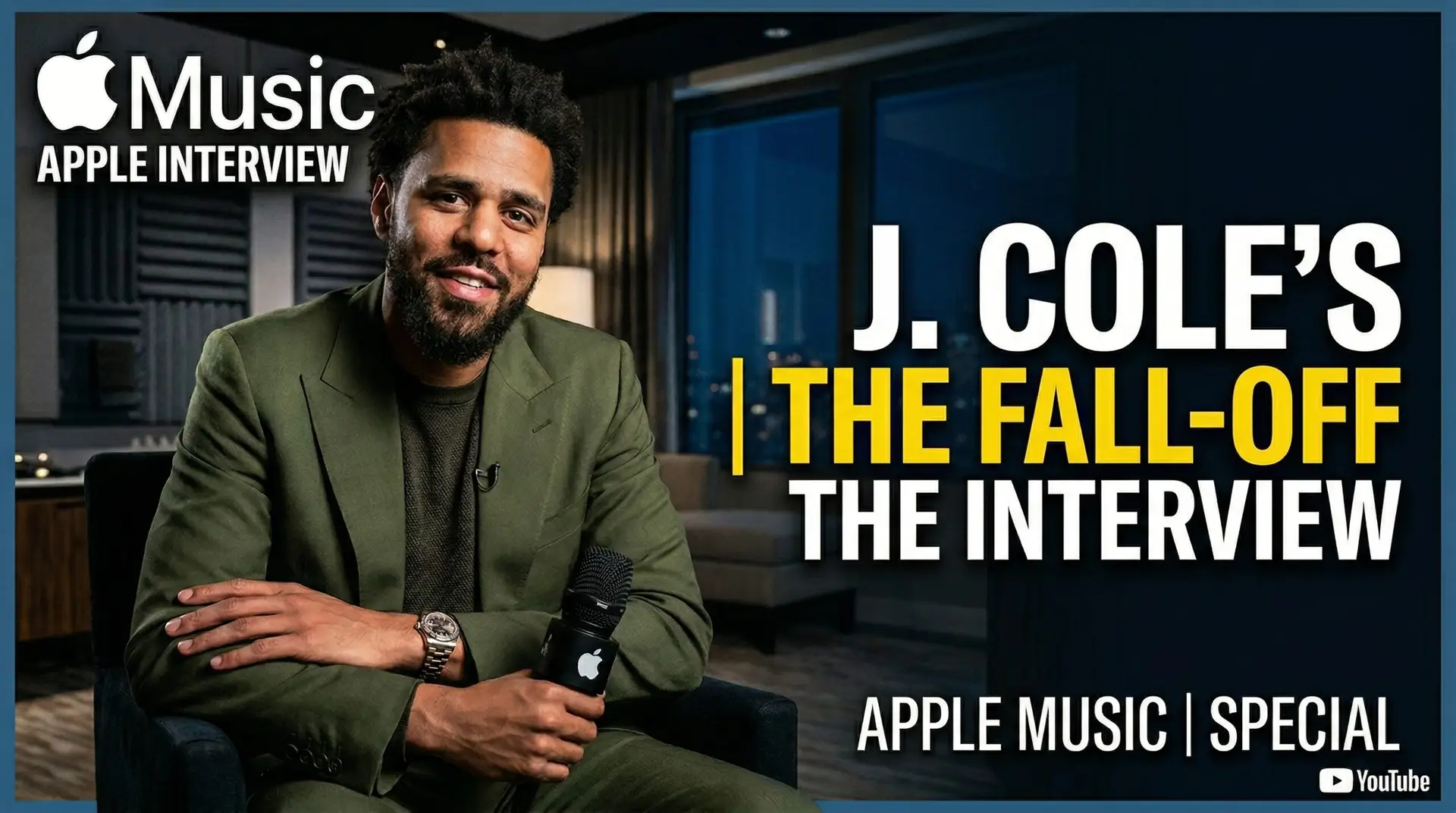
Sitting inside his childhood home at 2014 Forest Hills Drive in Fayetteville, J. Cole used his first post-release interview to explain what The Fall-Off actually means to him. The Apple Music conversation with Nadeska Alexis covered the long road to the album, the emotional logic behind its two-disc structure, the strain of internet-era rap discourse, and why his 2024 Dreamville Fest apology ended up pushing him back toward the music instead of away from it. The bottom line was clear: this wasn’t just an album rollout, it was a reset.
- J. Cole says The Fall-Off took about 10 years because the standard he set for it kept moving, even as other projects like 4 Your Eyez Only, KOD, and The Off-Season came together along the way.
- The interview setting matters. Back at his childhood home in Fayetteville, Cole framed the album as both a return to his roots and a close to one era of his career.
- He described the biggest post-release feeling as relief, but also pride and gratitude, because he says this is the first time in a long time he feels like he became the rapper he personally wanted to hear again.
- The 2024 Dreamville Fest apology to Kendrick Lamar was presented as a turning point, not a side note. According to Cole, the backlash forced him into a hard self-check and reignited his love for the craft.
- The album became a double disc after his creativity came back, with newer songs like “I Love Her Again,” “What If,” “Quick Stop,” and “39 Intro” making it impossible, in his view, to keep the project smaller.
- He also made it plain that online comparison culture drains joy from music, so he stays away from social media when he’s creating and tries to trust his own clarity over outside noise.
Inside 2014 Forest Hills Drive, where the conversation had to happen
The setting did a lot of the work before either of them got deep into the album. Cole and Nadeska Alexis sat inside the Fayetteville house that fans have treated like a landmark for years, the same home tied to 2014 Forest Hills Drive, and in his words, the place where the artist version of J. Cole first took shape.
That hometown pull still shows up in real life. Cole said people driving from New York to Miami sometimes see the Fayetteville exit, get off the highway, and stop by to take pictures. That detail says a lot. For plenty of artists, the old house becomes a photo op. For Cole, it still acts like a living archive.
He pointed out the beat machine his mother bought on layaway, or at least the same model, and treated it less like a trophy than a link back to the beginning. That mattered because the whole interview kept circling one idea: when he needs clarity, he tends to go backward before he can move forward.
The house also became part of the album-making process itself. Cole explained that during a key point in sequencing The Fall-Off, when the track list and opening stretch still weren’t sitting right with him, he came back to Fayetteville and stayed overnight for the first time in years. Even that detail had texture. A king-size bed was bought for the visit, but it didn’t fit in his old room, so he ended up sleeping in his parents’ room. Strange, a little funny, and also exactly the kind of real-world detail that makes this story land.
That trip gave him the breakthrough he needed on the album’s beginning. It also explains why this interview, even after 15 years without sitting down like this, happened here.
A few small details from the house said a lot about the tone of the interview:
- The beat machine on layaway represented the earliest version of his ambition.
- His old bedroom reminded him how narrow the physical space was, even while his goals were getting bigger.
- The overnight stay for track-list clarity turned the home into more than a backdrop, it became part of the album’s final shape.
Cole also admitted he was nervous, which was maybe the least rap-star answer possible and therefore one of the most revealing. The loophole was obvious. He had said he wanted to step outside his comfort zone for conversations, then found a way to do it at home. Still, the nerves were real because the format itself was unfamiliar.
That honesty set the tone. This wasn’t an artist trying to manufacture mystique. It was someone trying to explain how the work actually got made.
Why The Fall-Off took ten years to finish
Cole made one thing clear: the 10-year build was never just about writer’s block or indecision. It was about a moving target.
After 2014 Forest Hills Drive, he says he reached a rare point of comfort. He had come off tour, gotten married, and found himself in a calmer phase of life. The problem was that the calm also changed his relationship to writing. According to Cole, some of the material from that period wasn’t bad in hindsight, but it wasn’t reaching the bar he had in mind for The Fall-Off. In basketball terms, the skill set felt uneven. Some things improved, some things faded, and he believed he had to train his way back.
That’s where the “north star” idea comes in. The Fall-Off stayed in the background as the long-term goal, even when other projects took center stage.
First came 4 Your Eyez Only. Cole said those songs emerged while he was still thinking about The Fall-Off, but once he wrote “For Your Eyez Only,” the material suddenly made sense as its own body of work. The songs were pointing toward a different story, so he followed that instead of forcing everything into one bucket.
Then life shifted again. He became a father, and creativity had to fit around family life instead of the other way around. He described sneaking away for short pockets of time to make music, sometimes only getting an hour here or there. During that period, he also started studying producers like Southside and listening more carefully to the subtleties in sounds some older rap purists might dismiss too quickly. That study period mattered because it led to a burst of songs that became KOD.
Cole said those tracks came fast, almost by accident. What started as scattered moments of beat-making turned into a project with its own internal logic. Once the title meanings started clicking, “Kids on Drugs,” “King Overdose,” “Kill Our Demons,” he felt he had to honor what was coming out naturally.
That pattern kept repeating. The Fall-Off remained the destination, but other albums kept arriving first because they earned their own shape. In that sense, the delay looks less like avoidance and more like discipline. Cole wasn’t interested in calling something The Fall-Off unless it really matched the mission.
That mission, as he explained it, was simple but hard to reach: become the rapper he personally wanted to hear again.
For readers who want to hear the project in full, Apple links directly to J. Cole’s artist page on Apple Music.
What changed once the album finally came out
A month removed from release, Cole said the sharpness of the moment had faded a bit, which makes sense. Album week is chaos. A month later, normal life starts sneaking back in. Even so, he kept returning to three feelings: relief, pride, and gratitude.
Relief came first because, by his telling, The Fall-Off carried years of pressure and endless small decisions. He talked about reviewing old studio footage with collaborators like T-Minus and Diesel and being almost shocked the album ever made it out. There were too many songs, too many versions, too many forks in the road. That kind of process can make an album feel more like a burden than a release.
But the more striking part was what came after. Cole said he now listens to the album the way he used to listen to his favorite rappers. He ran through the phases, 2Pac, Canibus, Eminem, Nas, Jay-Z, and then made a point that framed the whole interview.
“I like this dude right here.”
That wasn’t ego for effect. It was his way of saying he got back to a version of himself he had been chasing for years. He described driving to the interview and rapping along to his own album the way he might rap along to OutKast or Jay-Z. Not because he disliked past albums, he explicitly said he’s proud of them, but because this one was built around a different standard.
That same search for clarity shaped how he deals with outside noise. Cole said one of his rules during album-making is staying off social media. He traced that rule back to the period around Forest Hills Drive, when he first realized that making music for online response was poison. If you’re picking snares or writing lines with a crowd already in your head, you’re not making anything honest.
He extended that thought into a wider critique of internet culture. Comparison, he said, is the thief of joy, and online music discourse is built on comparison. Artist versus artist, album versus album, era versus era. It forces listeners into defense mode, which makes appreciation harder.
That take landed because it wasn’t abstract. He applied it to sports, music, and everyday scrolling. Even YouTube, which he says is his most-used app, now feels risky because it pushes social-style bait right into the feed.
There was also a practical version of this philosophy. When he feels clear and present, he trusts himself. When he feels clouded, too much phone time, too much chatter, too much distraction, he turns to people close to him. He told a small but revealing story about running late to the interview, feeling stressed, and telling his wife he still needed to meditate before the drive. Her advice was simple: you’re already late, so take the extra 20 minutes and arrive clear instead of frantic. He did, and felt better for it.
It’s a small scene, but it explains a lot about the larger album. Cole seems less interested now in being instantly right than in being inwardly aligned.
How disc one turns Fayetteville into the album’s emotional engine
One of the strongest parts of the interview was the way Cole explained the album’s narrative structure. He made a distinction between 2014 Forest Hills Drive and disc one of The Fall-Off, which centers on “29.” In his telling, Forest Hills Drive moves like a broader life story. “29” is tighter, more zoomed-in, more immediate.
He described it as a trip home during a crossroads period. The exact point in the timeline is intentionally loose. He suggested it could be read as after Forest Hills Drive, or around that general rise in fame, but the emotional truth matters more than the literal timestamp.
What matters is the feeling: success on the outside, confusion and weight on the inside.
That’s why the Fayetteville material hits differently here. Cole spoke about a period when coming home stopped feeling easy. Earlier in life, returning to Fville had been joy, routine, identity. Then something shifted. The city felt heavier. News felt darker. Violence seemed more present. Even the local talk around his name started carrying a different energy.
That backdrop feeds songs like “Run Away Train,” where he references feeling the flame change, and it powers the sequence Nadeska Alexis highlighted in the interview. “Safety” sets up the mood with updates from home. “Drum N Bass” brings a flash of movement and nostalgia. Then the atmosphere tightens. By the time “Poor Thing” arrives, the emotional logic is already in motion.
Cole was careful not to reduce “Poor Thing” to one specific real-life target. He said the final verse combines different experiences and emotions. That choice matters because the point of the song, according to him, is not naming names. It’s documenting the triggered feeling that comes when disrespect, real or perceived, lights up an old instinct.
He framed that instinct through hometown pride. In places where reputation and defense can feel tied to survival, disrespect doesn’t land as a simple comment. It lands in the body. He said there’s an immediate part of him that wants to react, but there’s also a more mature voice that steps in and says it isn’t worth creating a whole destructive “movie” over one moment.
That tension gives the first disc its shape. It isn’t just a hometown tribute. It’s a look at how home can hold love, grief, memory, pressure, ego, and forgiveness at the same time.
Cole also suggested the story becomes more literal as the sequence unfolds, with friend updates, a funeral, texts to a woman he’s known for years, time with friends, and the energy of the club building toward a climax. That’s a more cinematic structure than some listeners might catch on first listen.
In other words, disc one isn’t random mood music. It’s plotted.
Why the Dreamville Fest apology became the turning point
Cole’s most important claim in the interview may be the least flashy one: the moment many people treated as a setback became, in his words, a blessing.
He said the idea to apologize at Dreamville Fest came about an hour before he walked onstage. Before that, he had been feeling awful. According to Cole, the issue wasn’t just public reaction to the Kendrick Lamar back-and-forth. It was the private feeling that he had acted out of alignment with himself and had contributed to a negative storyline about someone he actually respected and cared about.
Once the apology idea hit, he said he felt light almost immediately. He told his wife, she cried because she knew how much the situation had been weighing on him, and then he went onstage and did what he believed he needed to do.
The internet, of course, had its own response. Cole acknowledged that the backlash was rough and that people around him were checking in because the online chatter had gotten loud enough to be felt without even actively reading it. He also admitted that some part of him had to sit with the fear that maybe the public thought he was finished.
Then came the real pivot. In the middle of that storm, he says he started asking himself why he ever made music in the first place. Not why he built a career, not why he wanted acclaim, but why he first went downstairs to use the beat machine in that Fayetteville house. The answer was simple: because he loved it.
The next question was harder. Did he still love it right then?
His answer, as he framed it, was basically no, or at least not in an active, alive way. He was exhausted. He had been speaking about The Fall-Off like something to finish and escape. He even said the plan had been to release Might Delete Later and then bring out The Fall-Off around eight weeks later. At that point, he thought he was near the end of the road.
That realization changed everything. Instead of using the album as an exit ramp, he decided he wanted to finish it from a place of inspiration.
What followed was a creative re-ignition. Cole started taking short solitude trips again. He spent more time listening to hip-hop, not just the classics like Reasonable Doubt, Aquemini, and Illmatic, but also records he had previously overlooked. He re-built the habits that once made him feel dangerous on the page. Wake up, open the laptop, make a beat, write, repeat.
That’s also when the second disc took fuller shape.
Songs like “I Love Her Again,” “What If,” “Quick Stop,” and “39 Intro” came from that renewed stretch. He explained that “39 Intro” even helped solve a lingering structural problem, replacing a second half of “Magnus” he never fully liked. That’s the kind of detail only matters if the artist is truly back in the work, and Cole sounded very much back in it.
The same spirit carried into the production and sample approvals. He shouted out James Taylor for clearing the intro, and also mentioned approval from André 3000, Big Boi, and Devin the Dude. Full circle moments mattered to him here, from Erykah Badu appearing on “Villeument” to older sample dreams finally getting cleared.
Then there was the rollout. Cole said going outside for the trunk-sale style activation, riding with his day-ones in the actual kind of car they used to move around in, and seeing people play songs like “Safety” in real time gave him a feeling he would have missed if he had simply dropped the album and stayed home.
That detail is bigger than it looks. For an artist often cast as a hermit, this was a reminder that connection still matters when the work feels honest.
Readers who want more long-form artist sit-downs from the same platform can browse Apple Music’s official interviews collection.
Timeline of Events
- After the success of 2014 Forest Hills Drive, Cole says the idea for The Fall-Off began forming during a period of comfort, success, and personal transition.
- While chasing that album’s standard, he made music that eventually became 4 Your Eyez Only.
- He later became a father, and according to the interview, that changed how and when he could create.
- During that period, short bursts of beat-making and writing led to the material that became KOD.
- Even while releasing other projects, Cole says The Fall-Off remained the long-term goal, with songs sometimes being saved, moved, or repurposed.
- At some point during final album mixing, he returned to his childhood home in Fayetteville for solitude and clarity on the track list and sequencing.
- Before Dreamville Fest in 2024, Might Delete Later was released, and Cole says his plan at the time was to follow it with The Fall-Off roughly two months later.
- He says the idea to apologize to Kendrick Lamar came about an hour before taking the Dreamville stage.
- After the backlash, Cole describes having a personal reckoning about whether he still loved making music.
- That reckoning led to a renewed creative period, new songs, and the expansion of The Fall-Off into a double-disc album.
- After release, he took the album into the world through fan-facing events and now says he feels inspired to produce, contribute verses, and keep working, even if he isn’t promising another album right away.
What We Know vs What’s Speculation
This quick breakdown helps separate what was directly said from what listeners may be tempted to infer.
| Category | Details |
|---|---|
| What’s stated in the video | Cole says The Fall-Off took around 10 years to complete, that he returned to his childhood home for clarity, that fatherhood affected his creative schedule, that the Dreamville Fest apology came to him about an hour before going onstage, and that the backlash helped push him back toward loving music again. |
| What’s alleged | Cole presents his own account of how certain songs were intended, how long release plans were in motion, and how public reaction affected him internally. Those are first-person claims from the interview. |
| What’s speculation | The exact real-life identities behind songs like “Poor Thing,” the precise timeline of every narrative event in “29,” and any broader assumptions about current private relationships with Kendrick Lamar or Drake go beyond what the interview clearly confirms. |
The useful takeaway is simple: the interview gives a strong map of Cole’s thinking, but it does not turn every lyric into a literal fact sheet.
The Final Verdict
J. Cole’s Apple Music interview works because it isn’t chasing viral closure. It’s explaining process, motive, and self-correction. The sharpest takeaway is that The Fall-Off was never just about ending a chapter, it was about refusing to end it from the wrong state of mind.
That makes the Fayetteville setting feel less nostalgic and more strategic. He went back to the house, the beat machine, the old room, and the old questions, because that was the only way to figure out whether the music still meant what it used to. By the end of the conversation, the answer sounded like yes, and for an artist closing one era while leaving the next one open, that’s the part that matters most.