By Petty Pablo | Lead Social Analyst
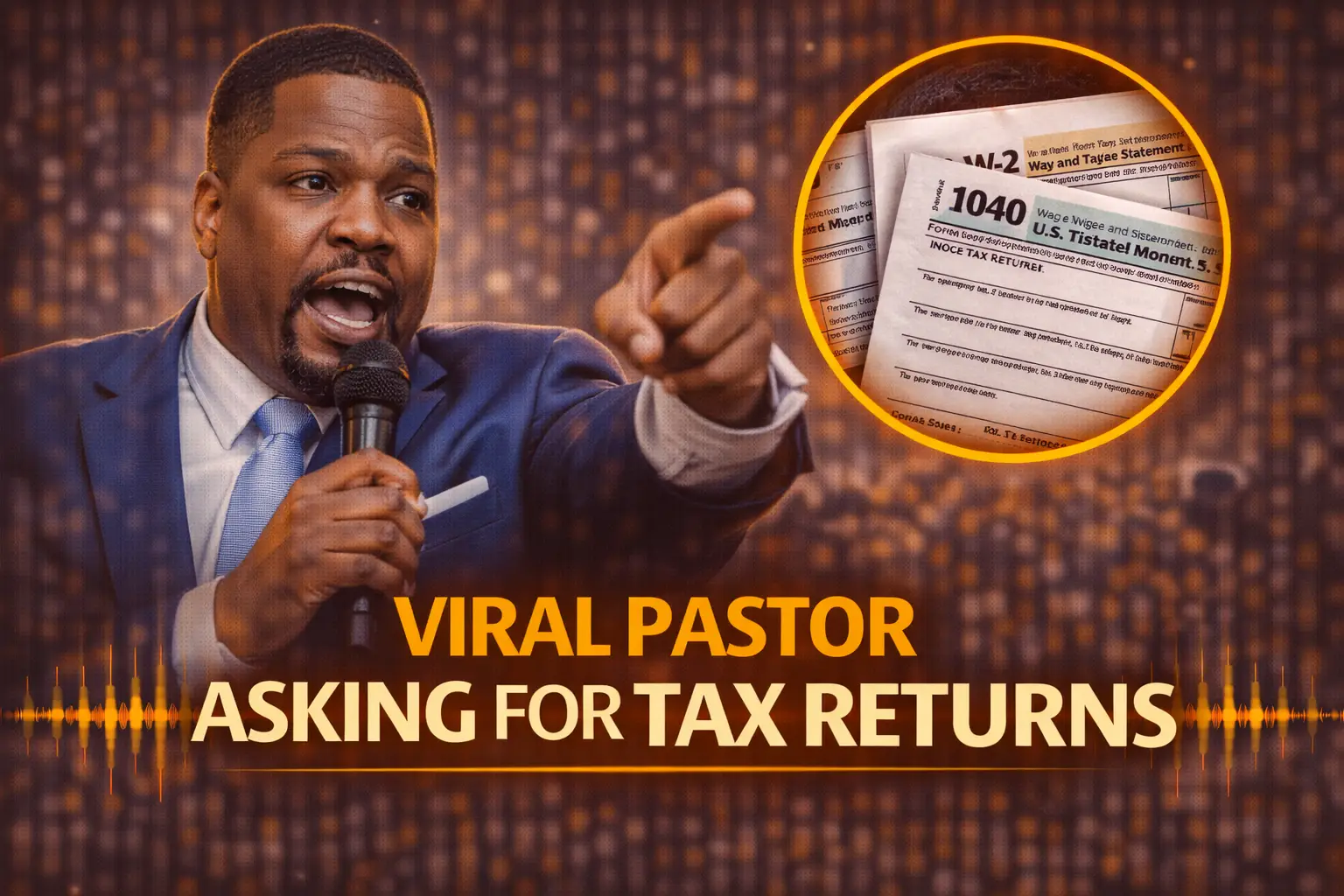
A short church clip recently went viral because it hits two hot buttons at once: money and authority. In the video, a robed man at a pulpit tells congregants to bring their tax returns so he can review them, then frames it as “obedience.” That’s the kind of line that spreads fast because it sounds both unbelievable and weirdly familiar.
But the bigger story isn’t only whether a pastor would ever ask for something so personal. It’s also how quickly the internet can decide a clip is “real,” based on nothing more than a robe, a podium, and a few well-timed amens.
The viral moment, and why it caught fire so fast
The scene is simple, which is part of why it travels well. A man in what looks like a church setting makes a bold announcement: next week, every member should bring a copy of their tax return so he can review it. He adds that he’s putting a stop to people “playing in my face” during tithes and offerings. Then comes the clean little slogan: “It’s tight, but it’s right.”
That’s basically engineered for reposts. It’s short, dramatic, and easy to caption.
The clip also includes the sound of a congregation responding. You hear amens. You hear the rhythm of church call-and-response. So even if a viewer has no clue where this was recorded, the brain fills in the blanks. Church setting plus robe plus amens equals “pastor,” no questions asked.
A key detail from the commentary video is how far the clip traveled. It wasn’t just random internet chatter. It made it to family group texts too, the kind of distribution pattern that turns a niche clip into a mainstream conversation.
“Saints… bring a copy of your tax returns so that I can review them.”
That one line is the whole hook, because it turns giving into supervision.
One reason this moment gets people heated is that it reframes tithing as a compliance check. It’s not “give what you can.” It’s “prove what you make.” That shift changes the emotional tone immediately, and it’s why so many viewers react before they even know if the clip is authentic.
For more context on how the clip is being framed in news coverage, see Black Enterprise’s write-up on the tax return video.
Why the commentary points to AI, not a real church announcement
Denise D. doesn’t treat the viral clip like an open-and-shut scandal. Instead, she treats it like a media literacy test. Her take is that the video looks like church, so people assume it is church. That’s a real shift in how online content gets processed now. Presentation can beat proof.
She also references that she previously talked about AI-generated “pastors” and church videos. The point isn’t that every strange clip is fake. It’s that church aesthetics have become a costume anyone can put on, especially with AI tools in the mix.
A few things, in her view, give the tax-return clip away.
Visual and audio cues that don’t quite match
The video’s voice performance is strong enough that it doesn’t instantly scream “computer.” That matters because early AI clips often had that flat, robotic tone. Here, the audio is convincing.
Still, Denise flags a kind of mismatch in the overall feel: old-school robe energy, modern mic handling, and a delivery that seems built for shock lines more than pastoral cadence. It’s not one detail. It’s the stack of details.
Language that feels “off” for the character being presented
This is where her read gets specific. The clip uses phrases that sound younger than the person portrayed.
A couple lines stand out in her breakdown:
- “You playing in my face”: She frames this as slang more common with younger speakers, not what most people expect from an older pastor in a traditional robe.
- “It’s tight but it’s right”: It lands like a punchline, but the phrasing feels like a meme tagline, not a natural sermon turn.
The deeper point is about character consistency. When a clip asks you to accept a “pastor” identity, the voice, word choice, and setting should line up. When they don’t, viewers start suspecting it’s performance, or outright AI.
For a related example of how quickly AI church clips can spread and confuse people, there’s also coverage of an AI-generated pastor clip that circulated online.
The robe effect: how church visuals can override basic verification
One of the sharpest observations in the video is also the simplest: if the same speaker wore a jogging suit, fewer people would automatically call him “pastor.” Put him behind a podium in street clothes and he could be “some guy,” “a deacon,” or “a visitor with the mic.” Add a robe and a church-like background, and the internet fills in the job title.
That’s not even a church problem. It’s an optics problem.
Online, identity gets assigned through symbols. A robe signals authority. A pulpit signals legitimacy. Congregation sounds signal a real room. Those signals work even when they shouldn’t, because our brains want to categorize fast.
Denise also points out another practical clue: nobody seems to identify the person as “Pastor ___ from ___ Church.” The clip moves around without a clear source attached, which is common for AI content and parody content. It doesn’t prove anything on its own, but it’s part of the pattern.
This is why the debate gets messy. People aren’t only arguing about money and boundaries. They’re arguing about what counts as evidence now. If a clip feels like church, does it deserve to be treated like a real church event?
For broader context on the rise of AI in faith spaces, see News18’s explainer on AI and religion concerns.
A real-life story that makes the clip feel a little too believable
Even while she suspects the viral video is AI, Denise makes a key move: she doesn’t pretend the underlying issue is fictional. She shares a personal story from her mother that mirrors the viral premise almost point for point.
According to Denise, her mom previously attended a church where the pastor asked members to bring in their tax papers. Her mom’s response was a firm no. Denise tells it with some humor, but the boundary is serious. Tax returns aren’t just income numbers. They can include addresses, employer info, and other details many people don’t want floating around any church office.
The mom’s reasoning, as described, isn’t “anti-church.” It’s pro-fairness.
She reportedly questioned the imbalance:
- Members are asked to disclose private finances.
- Meanwhile, congregants don’t know what the pastor makes.
- They also don’t know what the pastor’s wife makes.
- They don’t have clear visibility into where church money goes.
That last line hits the nerve of the whole conversation. Tithes and offerings often get framed as faith and obedience, which is true in many traditions. Still, when the ask becomes invasive, people start thinking less about devotion and more about governance.
In other words, even if the viral clip is AI, the scenario is real enough that it lands. People have seen versions of this power dynamic before, so the internet doesn’t need much convincing.
Tithing, pressure, and what “cheerful giving” is supposed to mean
The video description anchors the debate in a familiar tension: giving as worship versus giving under pressure. Denise’s commentary lines up with that framing. She emphasizes that she wants to give freely, not grudgingly, and not because someone “knows what I make.”
That connects directly to one of the scriptures cited in the description, 2 Corinthians 9:7, which is often summarized as giving should be voluntary, not forced. A readable reference is available at ESV’s passage page for 2 Corinthians 9:7–11.
Giving can be generous and structured, but it can’t be treated like surveillance and still feel like worship.
The other verses listed in the description support the same theme from different angles:
- 1 Peter 5:2–3 warns leaders not to be domineering over people in their care.
- Matthew 6:3–4 frames giving as something not performed for attention.
Denise’s point isn’t that churches should avoid accountability. Her point is that accountability has to run both ways, and it can’t trample basic privacy. Otherwise, the spiritual act starts feeling like a financial audit with a hymn break.
She also raises a practical issue that gets ignored in online shouting matches: a tax return doesn’t explain a person’s life. Bills, dependents, medical costs, and debt don’t show up as a neat “available to tithe” number. So even a well-meaning review can turn into pressure fast, because the reviewer starts making assumptions with incomplete data.
If “accountability” is the goal, the standard has to apply to everyone
Denise makes a fairness argument that’s easy to understand: if members are expected to put their finances on the table, leadership shouldn’t be exempt. That includes the pastor and the pastor’s spouse.
She takes it a step further with a point many congregants quietly feel: the building and the institution stay with leadership. Members can leave, but they don’t walk out with the mortgage, the property, or the brand. So when a church raises money for projects, people often want reassurance that leadership is investing too, not only directing others to give.
To make the tension clearer, here’s what the two models look like side by side.
| Approach | What it signals | Common reaction |
|---|---|---|
| Members submit tax returns for review | Control, compliance, and financial monitoring | “This feels intrusive.” |
| Members give privately without disclosure | Trust, personal conviction, and spiritual autonomy | “This feels like worship.” |
| Church shares full financial reporting while members keep privacy | Institutional transparency without personal exposure | “This feels balanced.” |
| Leaders ask for more giving while withholding their own finances | One-way authority and unclear accountability | “Why is the standard different?” |
The takeaway from Denise’s framing is that “sharing is caring” isn’t a joke, it’s the governance principle. If leadership wants access to personal financial proof, congregants will naturally want access to leadership’s numbers and a clear map of where money goes.
That’s not cynicism. It’s how trust works when money enters the chat.
For another perspective from within Christian media on this exact controversy, see Charisma Magazine’s report on the tax returns request.
Conclusion: the clip is viral, but the real story is the power dynamic
Denise D.’s commentary lands because it holds two truths at once: the viral “pastor” clip looks suspicious, and the underlying ask has happened in real life. That mix is why the internet can’t stop arguing. The content is meme-ready, but the topic is personal.
If there’s a final lesson here, it’s that optics aren’t proof, and money requests test trust faster than almost anything else in a church setting. The comments will stay split, but the boundary question doesn’t go away: when giving turns into monitoring, what exactly is being built, faith or control?
Learn more about Pulse of Fame and our editorial team. Want to weigh in? Join the conversation in the Pulse of Fame community forum.
Related: Dr. Umar Johnson’s Ex-Assistant Claims a Secret Relationship, a Filthy Home, and