By Petty Pablo | Lead Social Analyst
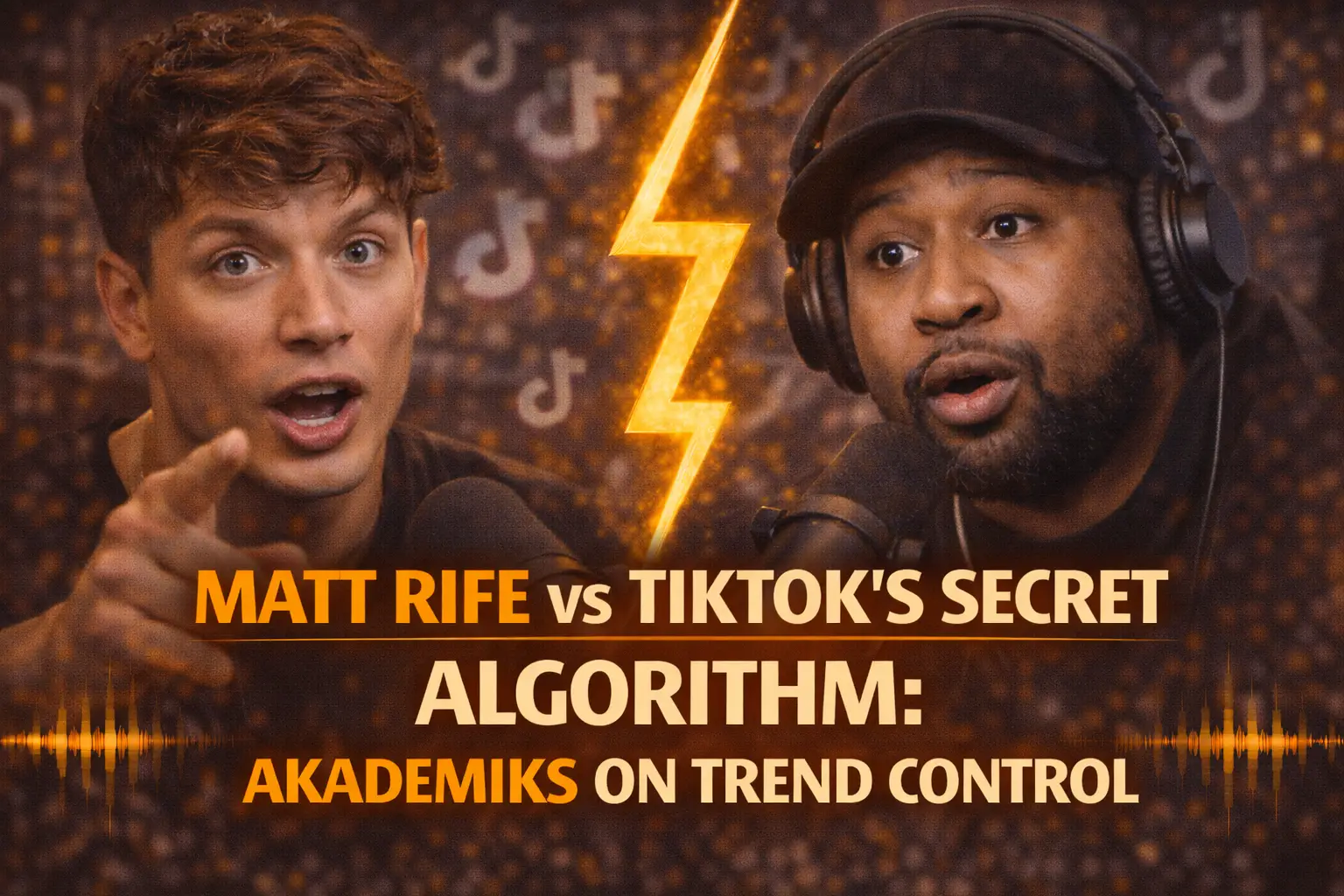
If you’ve ever looked at a creator with millions of followers and thought, “They’re set,” this clip is a reality check. On King Akademiks’ stream, he plays a moment where comedian Matt Rife describes what it feels like when TikTok stops pushing your content, even after you’ve built a massive audience. The big takeaway is simple and kind of brutal: followers don’t equal reach when the platform decides a trend is over.
Matt Rife’s TikTok rise, built on crowd work and fast momentum
Matt Rife is framed here as a comedian who “popped off” on social media, with a style that’s especially friendly to short-form feeds: quick crowd work, tight moments, and punchlines that land even if you’ve never seen a full set. According to the conversation, TikTok wasn’t just a place he posted clips, it was the engine that helped turn those clips into mainstream attention.
He puts a huge number on it: around 20 million followers (he mentions roughly 19.7 million). Even more striking than the follower count is how the distribution felt in the early run. Rife describes an era where posting a video could turn into instant acceleration, to the point where he says he was getting “a million views an hour” once a clip went up. That’s the kind of velocity creators chase for years.
That early phase matters because it sets the emotional baseline. When an app rewards you like that, it trains you to trust it. It feels less like “I got lucky” and more like “I built a channel.” In other words, the relationship starts to feel stable, even if it’s built on a moving algorithm.
Outside of this clip, Rife’s TikTok fame has been widely discussed in entertainment coverage, including pieces like how TikTok helped boost Matt Rife’s career. Still, the point here isn’t his whole biography. It’s the before-and-after of platform distribution, and how quickly “before” can disappear.
The slow drop-off that made the platform feel unreliable
Rife doesn’t describe the change as an instant blackout at first. He says it happened “little by little,” a steady decline that might look normal on a chart, until it doesn’t. He even frames the early dip as understandable. Platforms rotate what’s new; the shine wears off; that’s life.
Then he describes the real shift: after about a year and a half, it completely dropped off.
The pain point isn’t just lower views. It’s the feeling that he can’t even reach a tiny slice of the audience he already earned. In Akademiks’ framing, Rife had 20 million followers but felt like he couldn’t access even 1 percent of them. That’s not just disappointing, it changes the whole meaning of “following.” If the platform decides your posts don’t get shown, the number becomes more like a trophy than a tool.
At that point, Rife says he tried to get clarity directly from TikTok, reaching out through the kind of representative system bigger creators can sometimes access. That detail matters too because it highlights a second layer of the modern creator economy: once you’re big enough, you don’t just talk to your audience, you also end up negotiating with the platform, even if it’s informal.
TikTok’s blunt message: stand-up was a trend, and the trend ended
Here’s where the clip gets spicy, but in a clean, corporate way. Rife says he got on a Zoom call with a TikTok rep, and the rep allegedly told him something direct: “We just don’t push stand-up anymore.”
Not “your last video underperformed.” Not “try posting at a different time.” Not “we’re looking into it.” Just, “We’re not doing that category right now.”
In Rife’s telling, TikTok framed stand-up comedy as a “trend” on the platform, and they suggested it lasted longer than expected. He says they told him most trends only last a month or two, and that stand-up ran longer than it “should have.” They even credited him with helping spearhead the wave, but that praise comes with a catch: the wave moved on.
Akademiks reacts to this part with a kind of impressed disbelief. He says one thing he likes about TikTok is that it “keeps it a bean,” meaning it will tell you the quiet part out loud. In his retelling, TikTok’s stance is basically: if they want to turn your content up, they can; if they don’t, they won’t. That’s not creator-friendly, but it is clear.
Rife then asks the obvious question: what does he do with 20 million followers if he can’t reach them? According to him, TikTok suggested he do current trends, like whatever dance is hot. Rife responds with a dark joke about refusing to do dance trends, and Akademiks clarifies that it was facetious, not a literal statement.
The underlying message isn’t subtle: your “lane” on TikTok exists only as long as TikTok wants that lane to exist.
That’s a hard pill for comedians, because the whole point of stand-up is voice and point of view. Trend-chasing can work for some creators, but it can also flatten the thing that made people care in the first place.
Why this feels like betrayal, even when the platform is “honest” about it
The word “betrayed” hits because the emotional contract creators think they have with platforms is simple: “I’ll make content, you’ll show it to people who opted in.” TikTok’s model, as described here, doesn’t fully work like that. It’s less subscription and more constant audition.
Rife’s anger also isn’t limited to numbers. He calls TikTok “poisonous” and says he was excited when it looked like the app might get banned in the United States. That’s not a small statement from someone who reportedly benefited from TikTok more than most.
Akademiks zooms out and ties it to a bigger pattern: platforms start by positioning themselves as helpful, almost like they’re “for the artists” or “for the audience.” Then, at some point, the incentives shift. Now it’s about the platform’s bottom line and the platform’s control, including how much access creators get without the platform “getting a cut,” as Akademiks puts it.
There’s also an identity issue here. A comedian wants to be rewarded for being funny, not for doing whatever the app picked as the activity of the week. When the rep’s suggestion is “do the dance,” it lands like a category error. It tells the creator, “Your craft is optional, our format is not.”
For more context on how Rife’s rise has been discussed, coverage like Matt Rife getting candid about his TikTok rise shows how central social platforms have been to his public story. This clip adds a twist: the same machine that accelerates you can also quietly shut the faucet off.
Akademiks’ platform contrast: shadowban talk and “we don’t know what that is”
Akademiks uses Rife’s story to make another point: other platforms often won’t admit anything. He describes being on a call with a representative from a different company (he doesn’t name which one), believing he was shadowbanned, and then watching the mood change as soon as he said the word.
In his telling, the rep responded with a denial, along the lines of “What? We don’t know what that is.” Akademiks reads that denial as performative. He compares it to saying a forbidden word in a room and suddenly everyone acts weird, like they’re worried you’re recording.
That contrast is part of why he keeps praising TikTok’s bluntness. TikTok may not be kind, but it’s direct, at least in these stories. It doesn’t pretend the distribution is neutral. It essentially says it has control over the knobs and it’s using them.
Meanwhile, Akademiks also adds his own TikTok history. He says TikTok told him something similar: if you want popularity, don’t try to convince people to follow your unique thing, just follow the trends the algorithm is already rewarding. He also mentions a belief that TikTok is highly loyal to its algorithm, almost treating it like doctrine.
Akademiks briefly throws in a comment about TikTok’s ownership, referencing divestment and saying Oracle “pretty much” owns it. That’s presented as his own commentary in the moment, not as a sourced claim with details:
- Matt Rife says TikTok helped him build an audience of around 20 million followers through stand-up clips and crowd work.
- He claims his reach declined over time, then dropped sharply, even though his follower count stayed huge.
- Rife says a TikTok rep told him the platform doesn’t push stand-up anymore because it was treated like a trend.
- Akademiks contrasts TikTok’s bluntness with other platforms that, in his view, won’t acknowledge things like shadowbans.
- Both frame the bigger issue the same way: platforms can turn distribution up or down whenever they want.
Timeline of events
- Matt Rife builds a large TikTok following with stand-up and crowd work clips, reaching roughly 19.7 to 20 million followers.
- He describes a period where posts got massive exposure, including a claim of “a million views an hour.”
- Over time, he says his reach drops “little by little.”
- After about a year and a half, he claims his reach “completely dropped off,” and he couldn’t reach his own followers.
- Rife says he contacts TikTok and speaks with a representative on Zoom.
- He alleges the rep tells him TikTok doesn’t push stand-up anymore because it was a trend, and trends typically last a month or two.
- Rife says TikTok suggested he participate in current trends (like dances), and he jokes about refusing.
- Akademiks shares his own experience, saying platforms can deny shadowbans, while TikTok is more direct about controlling what gets pushed.
- The conversation ends with a broader point: creators rely on social platforms for promotion and money, even while distrusting them.
What we know vs what’s interpretation
| Category | Details |
|---|---|
| What’s stated in the video | Matt Rife (as played in the clip) says he has around 20 million TikTok followers, saw reach decline, and was told by a TikTok rep that the platform doesn’t push stand-up anymore. Akademiks says TikTok “keeps it a bean” and claims other platforms deny shadowbans. |
| What’s alleged | Rife’s account of what TikTok representatives told him on Zoom, including the framing of stand-up as a trend and the suggestion to do dances. Akademiks’ account of a separate platform rep reacting to the word “shadowbanned.” |
| What’s interpretation | The idea that platforms “don’t want to let you get too big,” or that there’s a direct business motive to limit creator reach unless the platform benefits. It may be true as a theory, but it’s presented here as commentary, not confirmed fact. |
The bigger picture: the “knob” theory and why creators feel stuck
Akademiks sums up the vibe with a simple metaphor: platforms have a knob. They can turn a creator up, turn them down, or do the same to a topic, hashtag, or content type. Whether or not that’s literally how internal tools work, the felt experience matches what many creators complain about: distribution looks like a choice, not a neutral outcome.
This is also where the conversation gets less “comedian story time” and more “how culture moves online.” TikTok doesn’t just host content, it shapes what kinds of content feel worth making. If stand-up stops getting pushed, some comics will adapt and some won’t. When that happens at scale, the whole feed can start to look the same, because everyone is chasing the same set of incentives.
Akademiks also flags the practical trap: people rely on social media to promote shows, sell tickets, and make money. At the same time, those platforms can change the rules without warning. That tension sits under almost every creator economy success story, including this one.
If you want to track Akademiks’ live commentary directly, the video description points to Akademiks’ Twitch stream and his Akademiks channel on Rumble, where his community often follows along in real time.
Official links mentioned in the video description
Conclusion
Rife’s story, as discussed here, isn’t just “the algorithm changed.” It’s the sharper version: a platform can decide your category is over, then keep your follower count like a souvenir. Akademiks’ reaction lands because it’s not shock, it’s recognition, he’s heard the same logic before. Either way, the clip captures a modern truth: platform reach is rented, not owned. If you’ve ever built something online, the question isn’t whether the rules change, it’s when.
Learn more about Pulse of Fame and our editorial team. Want to weigh in? Join the conversation in the Pulse of Fame community forum.
Related: Armon Wiggins Breaks Down Tasha K’s GoFundMe After the Cardi B Judgment