By Petty Pablo | Lead Social Analyst
Online fundraising is usually framed as community support. Still, when a creator’s legal bill is the headline, the internet treats it like a live referendum on accountability.
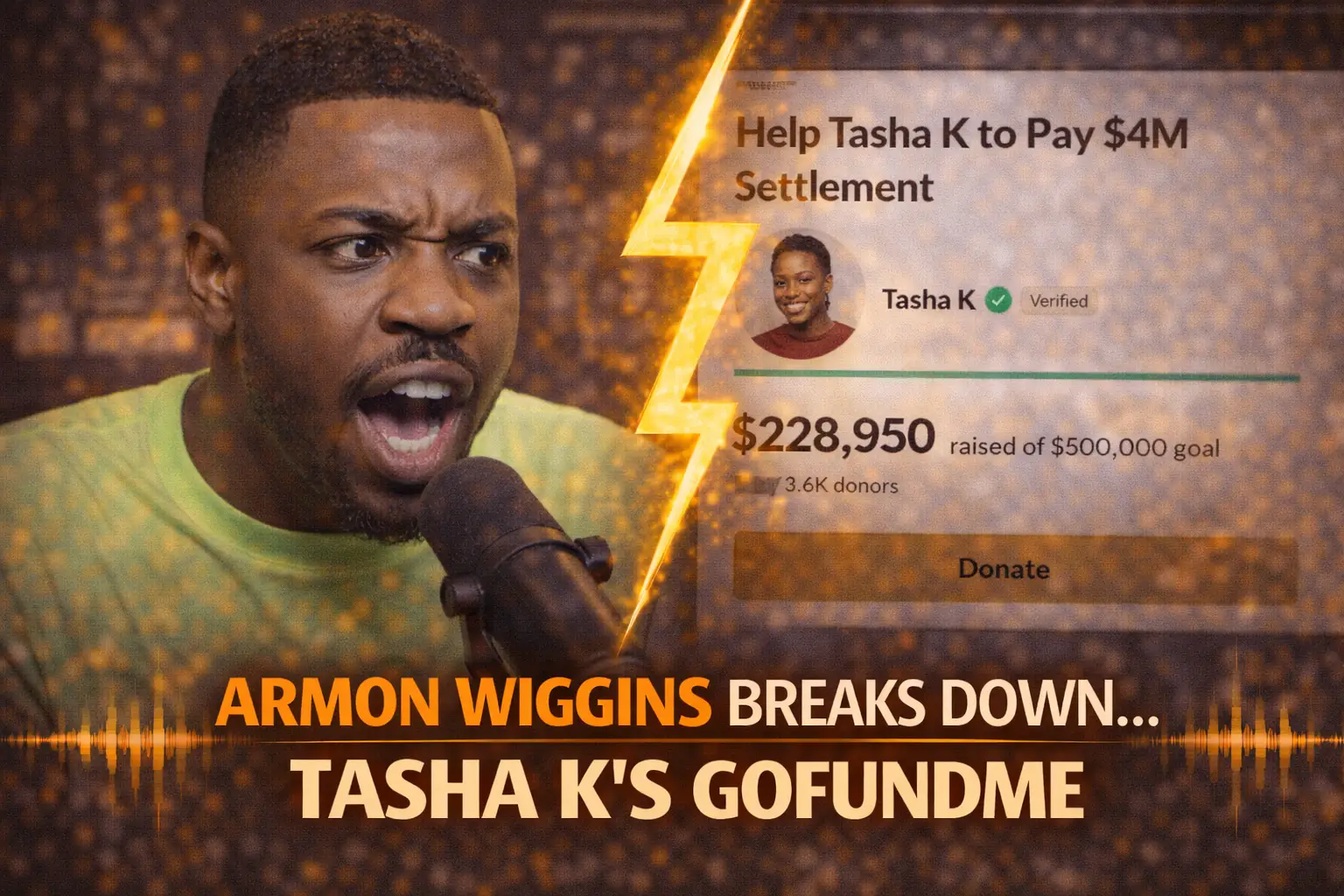
In a recent commentary, Armon Wiggins Tasha K Cardi B became the center of a familiar pop culture storyline: a loud, years-long conflict, a major judgment, and now a public request for donations. Armon’s point is simple, the same energy used to dismiss legal warnings is now being redirected into asking viewers to help cover the cost.
- Armon Wiggins reacts to Tasha K launching a GoFundMe connected to the long-running legal fallout tied to Cardi B.
- In the video, Armon says Tasha K is making $20,000 per month court-ordered payments, yet still wants public donations to speed up the payoff.
- He highlights the GoFundMe goal (shown as $3.5 million) and mocks early progress shown in his recap.
- Armon argues the fundraiser is less about “freedom” and more about reversing consequences from decisions made publicly.
- He also criticizes the broader culture of creators encouraging risky, headline-chasing tactics without planning for legal exposure.
Why Tasha K’s GoFundMe sparked a fresh wave of chatter
Armon opens with high-volume roasting and disbelief that Tasha K, who he says once bragged about ignoring legal warnings, is now publicly asking supporters to help pay down a massive debt.
The core of the segment is Tasha K’s pivot: according to Armon, she’s tired of carrying the monthly burden alone and wants her audience to contribute. He frames it as a sharp contrast in posture, from bold talk to budget reality. In his telling, this isn’t a small personal fundraiser, it’s an attempt to move millions of dollars through public goodwill.
Armon anchors the moment to the long-running Cardi B dispute, describing it as a years-long cycle of legal problems that has finally boxed Tasha K into a corner. He repeatedly returns to one theme: when you build a brand on conflict, you don’t get to act shocked when conflict sends an invoice.
Even while keeping the tone comedic, the video is basically a cautionary tale with sound effects. Armon’s argument is that the fundraiser reads like a public attempt to reframe consequences as persecution, while still wanting the benefits of a controversy-fueled platform.
For readers who want an outside recap of the fundraising angle, this storyline has been covered beyond YouTube commentary, including this report: PrimeTimer’s summary of the GoFundMe tied to the Cardi B judgment.
The “birthday wish” pitch, plus the math that raised eyebrows
Armon spotlights a birthday-themed message he attributes to Tasha K, where she positions fundraising as a symbolic reset: pay off the judgment, restore her ability to speak freely, and move on. He also emphasizes her claim that she’s aiming to raise the money within a year, with transparency.
He then zeroes in on a detail that, in his view, gives the pitch a self-congratulatory edge: Tasha K saying she’ll contribute $200,000 of her own money toward the balance. Armon’s take is that if someone has funds to contribute, they can simply pay down the bill directly. Announcing it, in his framing, is about image management, not just money.
Next comes the part that turns the fundraiser into a viral punchline: the donation math. Armon repeats a breakdown that suggests the goal could be met if supporters donate at scale.
- 175,000 people give $20
- 70,000 people give $50
- 35,000 people give $100
Armon’s critique is less about the arithmetic and more about the assumption behind it. He questions whether Tasha K’s current engagement supports the idea that hundreds of thousands of people will donate real money, rather than simply watch, comment, and move on. In his telling, the fundraiser confuses attention with commitment.
To keep the key figures straight, here’s the way Armon frames the numbers in the video:
| Payment detail mentioned in the video | Amount |
|---|---|
| Monthly court-ordered payments (as claimed) | $20,000 |
| Total judgment referenced | $4 million (approx.) |
| GoFundMe goal shown | $3.5 million |
The takeaway from Armon’s breakdown is clear: it’s not just the size of the goal, it’s the expectation that an audience will treat a creator’s legal aftermath like a shared group project.
Early GoFundMe stats, and why Armon called them “humbling”
Armon then reads out what he describes as early fundraiser performance, treating it as instant reality-check content. In his retelling, the GoFundMe shows a $3.5 million goal, with a small number of donations and a modest amount raised at that point.
He cites figures shown during his recap, including 132 donations and about $3,695 raised. His commentary suggests that the initial totals undercut the confident “we can do this in a year” framing. The moment plays as a cultural mismatch: big speech, small receipts.
Importantly, Armon doesn’t present these numbers as a final verdict on the fundraiser’s future. Instead, he uses them to make a broader point about public perception. When a creator spends years projecting invincibility, the audience expects consistency. A donation drive, especially one framed as a birthday wish, reads to critics like a forced rebrand into vulnerability.
Separately, other outlets have also summarized the GoFundMe move as part of the ongoing legal saga; for example, Sporting News’ recap of the GoFundMe development.
What Tasha K claims the GoFundMe will cover (and how Armon responds)
Armon walks through the fundraiser description and focuses on the stated purpose: donations would go toward reducing the judgment balance. In the language he quotes and paraphrases, the pitch argues that even while making monthly payments, ongoing legal processes can keep pulling her back into court, which costs time and legal fees.
That framing matters because it tries to reposition the fundraiser as practical, not emotional. It’s not “save me,” it’s “help me close this chapter faster.”
Armon, however, doesn’t buy the implied backstory that supporters have been asking for this for years. He openly disputes that claim, calling it revisionist. In his view, the fundraiser appears because pressure has escalated, not because the audience begged for an opportunity to donate.
He also highlights the mention of a separate supporter track: a Kickstarter tied to merchandise, including items like wine glasses and other perks. The split structure, donation page for pure giving plus merch campaign for incentives, is presented as a way to capture both types of supporters.
A key tension in Armon’s commentary is this: a fundraiser can be “transparent” and still be seen as a reset button that the public never agreed to press.
For readers who want another third-party summary of the same development, here’s a similar recap: HotNewHipHop’s report on the GoFundMe tied to the judgment.
Timeline of Events
- Armon reacts to Tasha K launching a GoFundMe tied to paying down a judgment connected to Cardi B.
- He references past moments where Tasha K allegedly brushed off legal warnings and acted unbothered.
- According to Armon, Tasha K says she’s been in court for years and is now making $20,000 monthly payments.
- Armon recounts a birthday message asking fans to help raise money within a year, with quarterly transparency.
- He repeats a donation math breakdown suggesting the goal is reachable if enough people donate small amounts.
- Armon reads early GoFundMe performance numbers shown in his recap and frames them as underwhelming.
- He broadens the critique, saying Tasha K encouraged risky behavior in the creator space and is now facing the consequences.
What We Know vs What’s Speculation
| Category | Details |
|---|---|
| What’s stated in the video | Armon says Tasha K launched a GoFundMe with a $3.5 million goal, tied to paying down a judgment related to Cardi B; he cites monthly payments of $20,000 and describes a promise of quarterly transparency and a related merch Kickstarter. |
| What’s alleged | Armon alleges that supporters did not truly request a fundraiser “for years,” and that the fundraising push is driven by pressure and image repair more than community demand. He also alleges patterns of behavior about how Tasha K treats other creators and critics. |
| What’s speculation | Armon speculates about motives (wanting to “speak freely again,” wanting to regain control of the narrative, wanting to return to attacking critics), and about whether the audience will ever fund the goal at the scale suggested. |
Armon’s bigger argument, consequences, clout, and creator strategy
Once the fundraiser is established, Armon shifts from the specific numbers to the larger lesson. His critique is basically about incentives. If a creator builds a platform by escalating claims, daring people to sue, and treating legal risk like content, then the court outcome becomes part of the brand whether they like it or not.
He also frames Tasha K as a cautionary figure for smaller creators, describing a pattern where newer personalities get encouraged to “go harder” at celebrities for views. In Armon’s telling, that advice ignores the part where legal resources aren’t equal. A celebrity can treat a lawsuit like a long meeting. A mid-tier creator can lose their house, their stability, and their ability to plan.
Armon even references his own back-and-forth with Tasha K (as described in the video), claiming he took the safer route by not chasing certain conflicts. His position is that restraint is not fear, it’s risk management. He argues that no amount of subscribers is worth putting your family’s finances in a pressure cooker.
The sharpest part of his analysis is also the simplest: paying the judgment may reduce the debt, but it doesn’t erase the public memory. Even if the balance hits zero, the story people remember is the loss itself, plus the fundraiser that followed.
Official Links Referenced in the Video Description
- The Armon Wiggins Show on Apple Podcasts
- Back To The Streets on Spotify
- Back To The Streets on Spreaker
Note: This article discusses commentary from a publicly available video. Claims described are attributed to the speaker(s) and are not presented as confirmed facts.
Source: YouTube
Conclusion
Armon’s commentary treats the GoFundMe as a public checkpoint: not just “can she raise the money,” but “does the audience believe the framing.” The video argues that accountability hits differently when it has a monthly due date. In the end, the fundraiser becomes more than a payment plan, it becomes a referendum on how internet fame handles real-world consequences.
Learn more about Pulse of Fame and our editorial team. Want to weigh in? Join the conversation in the Pulse of Fame community forum.
Related: Did The Breakfast Club Get Played by Netflix? Censorship Claims and Fan Fallout