By Petty Pablo | Lead Social Analyst
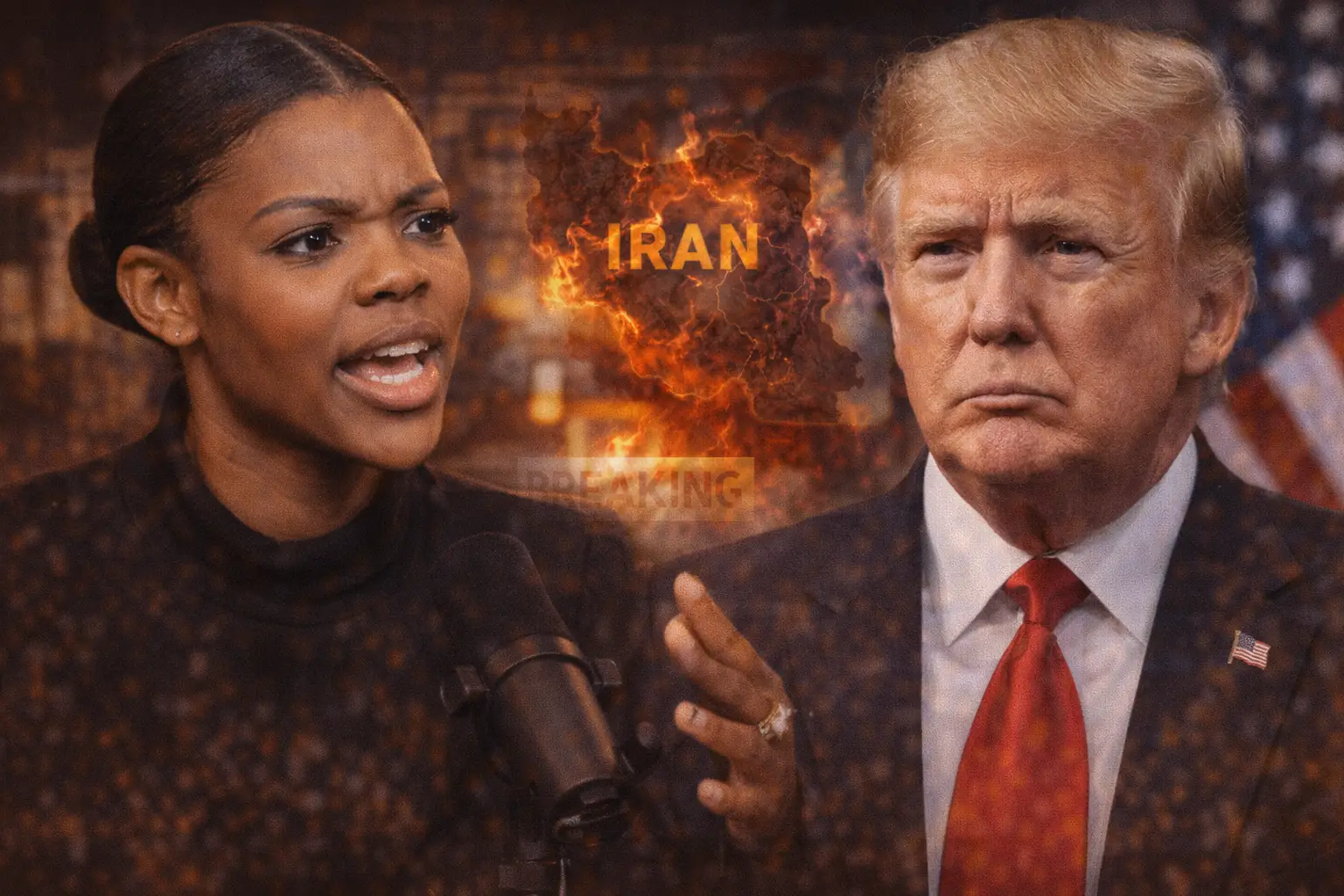
Candace Owens hit pause on her ongoing Bride of Charlie series for one episode, arguing that the current Iran crisis is too big to ignore. In this installment, she frames the news cycle as a persuasion campaign, one that uses fear, emotion, and nonstop messaging to move the public toward another major conflict.
Her core message stays consistent with what she has pushed across the Bride of Charlie episodes: public power invites public questions, and storytelling (no matter how polished) is not a substitute for verification. This time, though, she widens the lens, linking foreign policy, media framing, and internal conservative politics into one argument about who actually steers the agenda.
Tucker Carlson’s “spell” tweet, and why Owens says it set people off
Owens opens by pointing to Tucker Carlson trending after a short post: “Pray that the spell breaks and the world is saved.” She argues the backlash was not about prayer, but about the word “spell,” because it implies a spell implies some sort of witchcraft or unseen manipulation.
From there, she treats the moment as a tell. In her view, certain online gatekeepers can tolerate almost any political argument, but they panic when language hints at hidden spiritual or psychological influence. She praises Carlson’s willingness to challenge “allowed” narratives, then uses his phrasing as a bridge into her broader thesis: the public is being steered, and the steering is not subtle.
Owens’ framing is not a narrow policy critique. It’s a commentary on how arguments get packaged: what words trigger coordinated pushback, what topics get waved off as unserious, and why the “don’t ask that” tone shows up right when stakes get high.
Owens’ occult framing: Hollywood, symbolism, and “trust the experts” messaging
Owens argues that modern culture trains people to treat occult references as either fantasy or comedy. She mentions family-friendly pop culture examples to make the point: if it’s magic, it belongs in a kids’ franchise or a joke, not in a serious conversation about power.
She then stacks a series of examples she says are “in plain sight,” including provocative art and elite-facing performances that use ritual-like imagery. In that same thread, she references viral moments that people tend to dismiss as “just art” or “just science,” including a clip she describes involving scientists in ceremonial clothing near religious iconography.
Her larger claim is about conditioning. Owens argues that institutions spent decades teaching the public to override instinct and defer to official authority, in her words, to trust the experts instead. As an example, she recalls COVID-era moral scolding, where ordinary human impulses (like wanting to see a dying relative) were treated as suspect if they conflicted with official guidance.
This is also where her Bride of Charlie theme reappears: when a narrative is emotionally loaded, it can be used to shut down basic questions. Across the earlier episodes, she repeatedly frames that as the central conflict, verification versus vibes.
“I knew something was wrong”: Owens’ intuition claims about Charlie Kirk
Owens describes a personal moment from the day she learned Charlie Kirk had been shot, saying her immediate reaction was that he had been “betrayed.” She admits that’s not an empirical claim, but she emphasizes what she sees as a pattern of foreknowledge and dread.
She also says that, in the week before the attack, she felt unusually strong warnings tied to:
- a sense of danger connected to a school setting
- an association she describes as related to bees
- a level of fear that led her to increase security, pause her show, and pull her children from school
Owens adds a second layer: she claims Charlie himself expressed that he expected to die young, and that it would be connected to Turning Point USA. For her, that kind of certainty is not easily explained by conventional “expert” reasoning.
At this point, she connects her current Iran framing to her Bride of Charlie argument from Episode 4, where she described a behind-the-scenes struggle over escalation and portrayed Charlie as an internal obstacle to a larger war push. In this episode, she goes further, calling him the “first casualty” of the Iran conflict, in the sense that she believes political pressure and messaging battles around war preceded his killing.
Freemasonry, symbolism, and the “Pentagon” association she draws
Owens pivots into Freemasonry, explaining that she’s been reading on the topic through her book club research. She describes receiving a “Freemason Bible” tied, according to the story she relays, to a deceased 33rd-degree Mason whose belongings were cleared from a home.
She says an early page in the book shows a pentagram diagram with a marked center that she interprets as a “place of sacrifice or worship.” From there, she draws a symbolic association to the Pentagon, emphasizing the five-sided geometry and claiming the visuals line up with what she believes is a ritual logic.
She also reads from the book’s section on symbolism, saying it describes Freemasonry as a “science of symbolism.” Owens highlights examples she says the book lists, including a square representing morality, a plumb line representing uprightness, and a beehive representing industry. She connects that to her earlier instinct about “bees,” and to public messaging moments she views as coded, including a public figure repeatedly emphasizing the number 33.
Next, she references the “Seal of Solomon” discussion and argues that symbols often presented as purely religious can also operate, in her framing, as occult signifiers in other traditions. She then name-checks Aleister Crowley as a figure she believes helped mainstream ritual ideas inside elite circles.
Owens also includes a clip from a priest discussing a concept he calls “revealing the method,” which she interprets as an impulse among certain groups to display symbolism openly while expecting the public to dismiss it.
TPUSA and the post-assassination storyline: grief, branding, and “future president” chatter
Owens returns to the internal conservative fight she has been mapping in Bride of Charlie. Her argument is that the public was pushed to treat questions as taboo because a grieving widow was involved, even though the role she stepped into is executive and public-facing.
In this episode, Owens claims the organization’s behavior after Charlie’s killing felt off to many viewers: a public tragedy followed by what she calls a fast “coronation” of Erika Kirk, plus a shift in who gets welcomed into the orbit.
She plays clips from people in Charlie’s circle discussing political futures for Erika. One voice (Tyler Boyer) says Charlie believed Erika could be president one day. Owens treats that as clashing with Charlie’s public messaging about family life and traditional priorities.
She also cites other friendly-media conversation that floated “Vance-Kirk” ticket talk, then pivoted to excitement about Erika as a future leader. Another moment she flags is commentary about “blueprints” allegedly left behind for Erika and younger staff.
Owens’ harshest critique centers on Erika’s demeanor and choices in the aftermath. She suggests a psychological explanation for what she views as emotional mismatch, and she points to examples like:
- praising or rewarding security after the incident
- giving major interviews shortly after the killing
- describing herself publicly as unafraid
- presenting forgiveness and faith-forward messaging early, even while details remained contested
Separately, she plays a clip from comedian Tim Dillon, who jokes about the oddness of the situation and riffs on the idea of “handlers” and institutional control. Owens treats the joke as cultural confirmation that more people are noticing the same gaps and contradictions.
Trump, Iran, and “preemptive” logic: Owens’ betrayal argument
Owens doesn’t try to hide her disgust with Trump here. She argues he offered minimal public attention after Charlie Kirk’s assassination, and she claims Trump showed more energy for smaller media disputes than for demanding a full investigation.
Her broader accusation is that Trump’s “no new wars” branding has collapsed under Israel-linked pressure. She cites several examples and storylines from the episode:
- her criticism of speech and campus policy shifts she frames as narrowing First Amendment protections
- her frustration with how the Epstein files were handled and dismissed
- her claim that foreign interventions continue to spiral, including a Venezuela storyline she says benefited Israel
- her focus on a glyphosate-related executive order, plus her claim that the policy connects to munitions supply chains
- her anger at “preemptive” strike logic presented by officials, including a clip of Marco Rubio describing the reasoning
Owens also argues public messaging is laying groundwork for escalation. She points to comments about keeping “options on the table,” and she interprets that as leaving room for ground troops or even a draft.
Finally, she discusses backlash she says she received after encouraging Americans not to volunteer for a war she believes serves foreign interests. Her stated position is blunt: Americans should not be asked to fight and suffer for another nation’s agenda, and service members swear an oath to the US Constitution, not to political donors or allied governments.
Timeline of Events
- Owens pauses Bride of Charlie for a day due to the Iran news cycle.
- She highlights Tucker Carlson trending after tweeting, “Pray that the spell breaks and the world is saved.”
- Owens argues occult symbolism is normalized through entertainment, art, and elite institutions.
- She recounts her intuition claims leading up to Charlie Kirk’s assassination and her belief he was “betrayed.”
- Owens describes receiving a “Freemason Bible” and connects its symbolism to her theories.
- She criticizes TPUSA’s post-assassination messaging and plays clips discussing Erika Kirk as a future political figure.
- Owens condemns Donald Trump’s record on investigations, Israel, and Iran, and calls him a traitor and coward.
- She reads viewer comments and says public opinion is shifting because “the illusion” is breaking.
What We Know vs What’s Speculation
| Category | Details |
|---|---|
| What’s stated in the video | Owens says she paused her series, reacted to Tucker Carlson’s “spell” tweet, described receiving a Freemason-related book, replayed clips from TPUSA-adjacent figures discussing Erika’s political future, and criticized Trump’s Iran posture and messaging. |
| What’s alleged | Owens alleges outside pressure for war escalation, claims coordinated manipulation tactics, and implies hidden control over Trump’s decisions by pro-Israel forces. |
| What’s speculation | Owens speculates about occult ritual motives, symbolic “spell-casting,” and deeper spiritual explanations for political events and public tragedies. |
Official links referenced in the video description
Conclusion: the episode’s real through-line is power, persuasion, and verification
This episode isn’t structured like a traditional news analysis. Owens mixes geopolitics, spirituality, and institutional suspicion into one argument about narrative control. Still, the consistent through-line matches what she’s been building across Bride of Charlie: big money, big power, and public leadership should come with basic answers, not emotional shutdown tactics.
If her audience takes anything from Ep 308, it’s her insistence that the fight isn’t “left versus right,” it’s whether the public accepts packaged stories without receipts.
Source: YouTube
Learn more about Pulse of Fame and our editorial team. Want to weigh in? Join the conversation in the Pulse of Fame community forum.
Related: Bride of Charlie Episode 7 Recap: Candace Owens Calls Out Erika Kirk’s “Mom-CEO”