By Petty Pablo | Lead Social Analyst
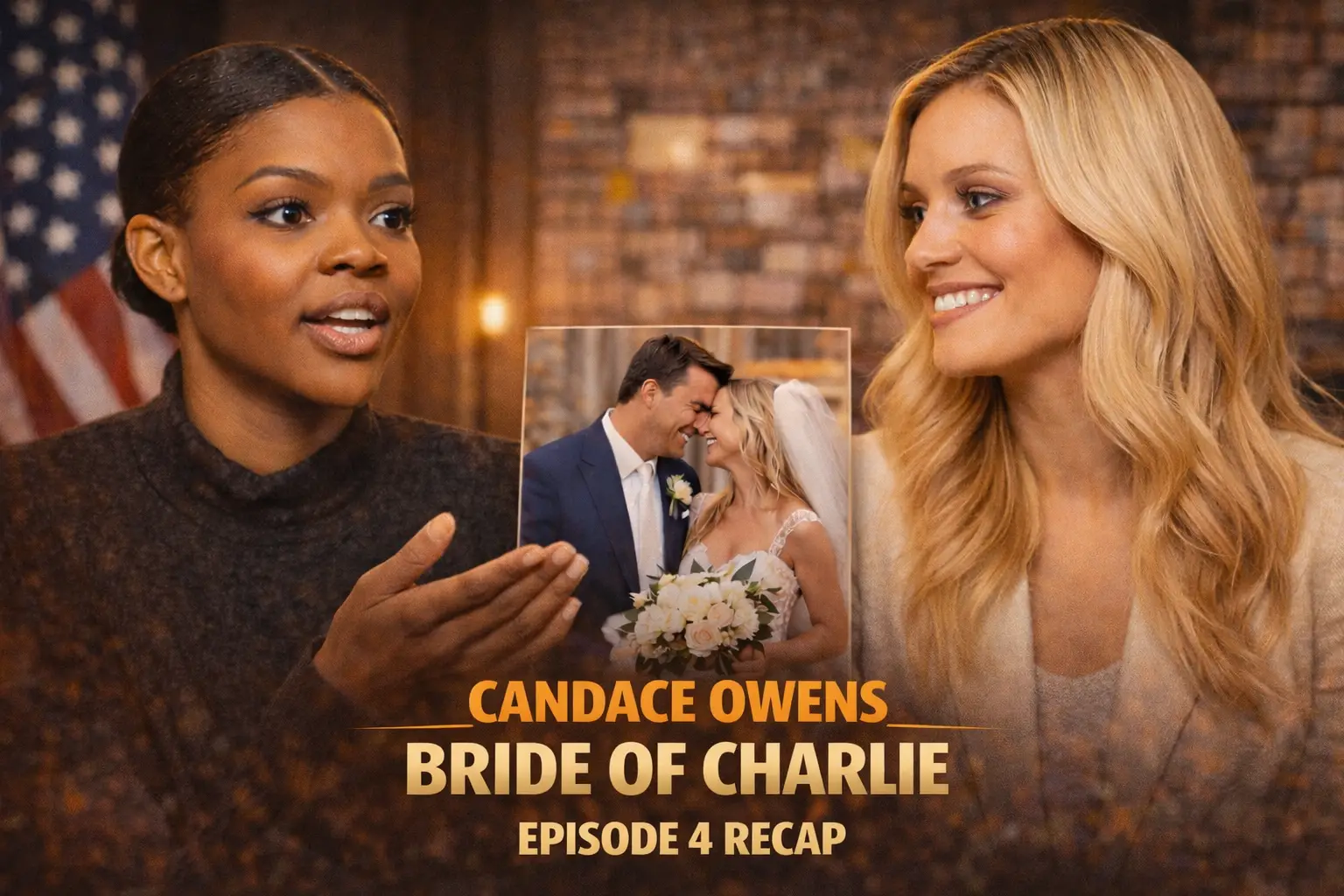
Candace Owens opens Episode 4 of Bride of Charlie in full alarm-bell mode about war with Iran, arguing that the public got “gaslit” about where things were headed. From there, she pivots back to her core theme for the series: if someone is going to sit at the top of a major political fundraising operation, their story should be easy to verify, not weirdly slippery.
War with Iran framing, and why she says Charlie Kirk mattered
Owens frames the moment as a return to a fight she says happened behind the scenes during what she calls “Operation Midnight Hammer,” describing it as a limited strike that could have turned into something much bigger. In her telling, the pressure campaign for escalation came from pro-war voices around Trump, with Benjamin Netanyahu (referred to as “BB” in the episode) cast as the figure who wanted the US to go all-in.
Her central claim is that Charlie Kirk was the key internal obstacle. She says he personally pushed Trump away from a full-scale conflict because it would wreck support and damage Trump’s legacy. Owens then extends that into a darker theory, suggesting that the fallout from that disagreement put Charlie in the crosshairs.
To make the case that Charlie’s public posture on Iran was not “regime change now,” Owens plays an older clip of him criticizing neoconservative calls for overthrow. In that clip, Charlie argues that Iran’s size, population, and internal complexity make “whiteboard” war planning fantasy. He also cites past failures, naming Iraq, Afghanistan, and Libya as examples of outcomes that didn’t match the sales pitch.
Owens’ “through line” matches what she has argued across earlier episodes: public power invites public questions, and emotional messaging should not be treated like a substitute for clarity. That theme appeared in her earlier focus on bio details, money-adjacent rumors, and why she believes leaders of large nonprofit-style operations should expect scrutiny instead of scolding.
“The ghost of Charlie” and her claim that TPUSA’s posture changed
Owens’ next move is rhetorical, and pretty sharp. She argues that after Charlie’s killing, people who now represent Turning Point USA began using Charlie’s image and old clips as a shield, selectively positioning him as aligned with Trump’s current posture even when Owens believes Charlie’s own words cut the other way.
She points to commentary from voices she identifies as Charlie’s “best friends,” who argue that Charlie would have trusted the president once conflict began, and that people sharing older clips are stoking fear or chaos. Owens hears it differently. In her view, this is posthumous message management: keep Charlie branded as loyal, keep the base calm, and avoid any suggestion that he had turned against the war lobby she thinks surrounded him.
Owens’ argument is less “I know every motive,” and more “watch how the framing works when questions get inconvenient.”
She also jabs at what she portrays as a new lineup around TPUSA, suggesting the organization is drifting toward the very neoconservative politics Charlie criticized. In earlier episodes, she made a similar point with a simpler demand: if leadership changes hands at a massive fundraising operation, the public should not be told to stop asking basic questions just because grief is involved.
For broader context on the online blowback around Owens’ series, see AOL’s report on Owens defending the project and NewsBreak’s summary of the debate.
The cast list she’s building: Dr. Jerri, “Uncle Jack,” and Lori France
Episode 4 spends a chunk of time re-centering the characters Owens has been stacking from week to week. If you have not watched Episodes 1 through 3, the recap still makes the intent clear: Owens is building a map of relationships, institutions, and paperwork, then arguing that the map itself raises questions.
She revisits Dr. Jerri France Fay (whom she describes as the first wife of Erika Kirk’s father), repeating details she says connect Jerri to psychology work, corporate roles, and “tesseract” modeling. Owens also claims a marriage tied to the Baha’i Temple in Chicago, and makes a point of highlighting symbolism she finds too on-the-nose (including a school seal and other “pattern” clues). In earlier episodes, Owens used Jerri’s background to support her larger suspicion of institutional influence and image-building.
Next up is “Uncle Jack” Solomon, whom Owens describes as connected to Utah Valley University and BYU, and as the founder of a casino-tech business (which she frames as relevant to her broader gambling and money theme). She also repeats her claim that a dedication associated with Zion Gate belongs to Solomon’s family, not Erika’s.
Finally, Owens returns to the center of Episode 3: Lori France, Erika’s mother. Owens re-states her contention that Lori is the consistent influence behind Erika, and she re-emphasizes a pattern she claims shows up in Lori’s paperwork, including many corporate filings that feel hard to track cleanly. It’s the same “small stuff” drumbeat Owens has used all series: dates, signatures, and boring records should be the easiest part.
The Urbanbeck connection, and why she highlights “Uncle Rick” at Universal
Owens then digs into the Urbanbeck name again, arguing it appears repeatedly in Lori’s paperwork history. She repeats the story she referenced earlier about an Urbanbeck family member linked to a well-known fraud case (and stresses in this episode that “Rick” did not serve prison time, in her telling). Still, she argues that being closely tied to a family with that kind of headline history is, at minimum, a choice worth noticing.
Her “new” piece for Episode 4 is what she presents as social proof: she shows Erika’s old Instagram story highlights from a 2018 Universal Studios trip, where Owens says Rick works, and frames Rick as being treated like an “uncle” figure.
From there, Owens offers a speculative sidebar. She wonders whether Rick’s position at Universal could have been a pathway into pageant opportunities, because (as she notes) NBCUniversal and Trump had split ownership of the Miss Universe Organization around that era. She clearly labels the idea as unproven, but she keeps it in the episode anyway because it fits her broader “relationships create outcomes” frame.
This matches the series’ broader posture: Owens is not only arguing about what is true, she’s arguing about what is odd, what is too convenient, and what she thinks doesn’t survive basic common-sense questions.
For background on when Owens first teased the series, see Sportskeeda’s write-up on the project launch.
The divorce filings and the “clerical error” that won’t go away
One of the most concrete portions of Episode 4 is Owens walking through document screenshots tied to Lori and Kent France’s divorce and child support filings. Her focus is narrow: Erika’s birthdate.
Owens says critics claim a single “clerical error” explains why documents list November 22 instead of November 20. Her response is that it’s not one typo. She presents multiple documents across multiple years, describing repeated use of November 22, 1988 as the date. She emphasizes that child support paperwork should, at minimum, correctly identify the child.
In her narration, the filings include items like a shared parenting plan, a child support amendment she describes as irregular, a final decree, medical support paperwork (she says Aetna is listed), later enforcement documents for defaulted payments, and an emancipation filing when Erika turned 18. She also points out that Erika’s name appears with different spellings in at least one early school reference she displays.
Owens’ takeaway is not subtle: if the “beginning” is messy, she thinks it matters, because early biography is where she believes later persona-building starts. That argument echoes her earlier emphasis on verification over vibes, and her criticism of treating sympathy as a blanket shield when a person steps into executive authority.
The history detour: Khazars, revolutions, Hollywood, and “how narratives work”
Episode 4 also contains a long historical monologue that shifts away from documents and into big-picture ideology. Owens references claims about Khazar history and identity, then moves into talk about European revolutions, immigration waves, early American labor violence, and organized crime.
A key point for readers is that this segment is presented as worldview framing, not as a sourced history lecture. Owens uses it to argue that power networks influence institutions through persuasion and storytelling, including entertainment and public myths. She also portrays sports as distraction, and Hollywood as image-making on an industrial scale.
Because this section touches sensitive territory, the most accurate way to capture it is simple: Owens is explaining how she thinks influence works, and why she distrusts official narratives when they collide with messy records, elite protection, or “trust the experts” messaging.
She then uses that lens to return to the series’ interpersonal focus, arguing that the people around Erika, and the story told about Erika, deserve extra scrutiny because of the size and reach of the organization she now leads.
The Vince Lombardi claim, and the “missing year” contradictions
Owens’ biggest pop-culture shock in Episode 4 is a clip she plays of Charlie Kirk saying his wife Erika is “from the Lombardi family,” and that her mom is a Lombardi. Owens treats that as significant because Vince Lombardi is iconic in American football culture, with the Super Bowl trophy named after him.
Owens then describes her own attempt to reconcile the “Lombardi” claim with an obituary reference she found that uses “Lombardo,” and she floats further speculation about possible organized-crime ties. She does not present confirmation, and she openly asks other online researchers to look deeper.
From there, she swings back to a storyline she’s been building since earlier episodes: Erika’s timeline gaps. Owens says she can now confirm Erika attended St. Ursula Villa in Cincinnati for kindergarten, but says the years she previously suspected are still not confirmed by yearbooks. She also repeats her claim that Erika did not play in a specific basketball season at Regis University, despite later statements Erika made about playing two years.
Finally, Owens highlights what she sees as the cleanest contradiction: Erika describing a six-to-eight-month period of isolating to read the Bible and only seeing a pastor’s wife, then later saying she first read the Bible cover-to-cover in 2016 with a friend as an accountability partner. Owens uses that mismatch to argue that Erika’s stories shift based on the room, the audience, and the goal.
She closes by reading viewer comments and teasing future episodes, including more about “Tesseract” and military-adjacent claims that, in her telling, connect back to Erika’s early life.
Conclusion: what Episode 4 is really trying to prove
Episode 4 isn’t just a pile of clips, it’s an argument about credibility. Owens keeps returning to the same test: if someone becomes the face of a major political operation, should their biography get clearer, or more confusing? Whatever a viewer thinks of her tone, the episode is built to leave one impression, that the “small stuff” is where the story breaks.
If you want to follow the series as it evolves, watch how Owens prioritizes paperwork, timelines, and relationship maps, then asks whether the public is being sold a legend instead of a verifiable life.
Learn more about Pulse of Fame and our editorial team. Want to weigh in? Join the conversation in the Pulse of Fame community forum.
Related: Bride of Charlie Episode 3 Recap: “Have No Fear, Lori Is Here” and the Paperwork