By Petty Pablo | Lead Social Analyst
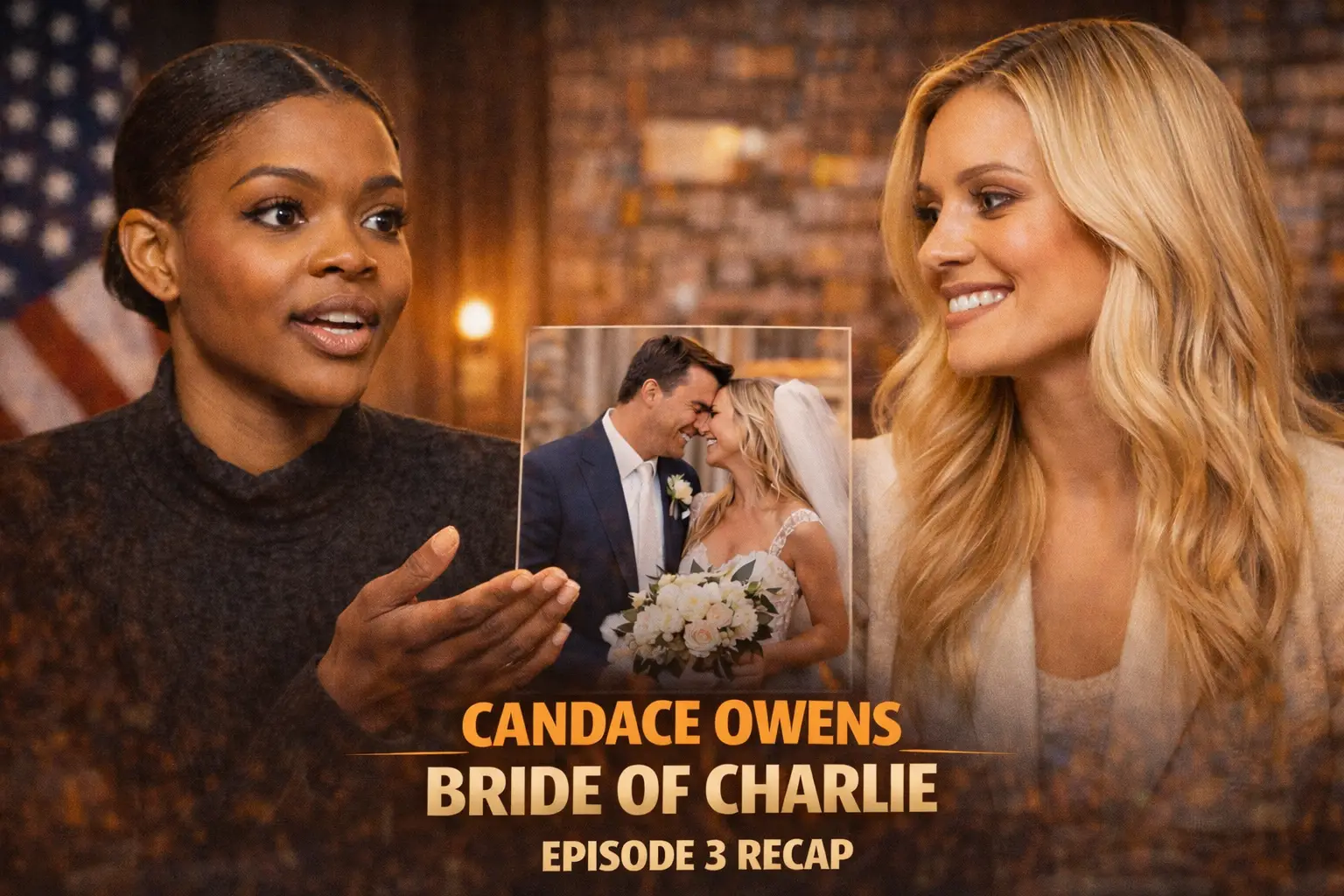
Episode 3 of Candace Owens’ Bride of Charlie series keeps the same core argument from earlier installments: if someone is stepping into public power, basic facts should be easy to verify. This time, Owens shifts the spotlight to Erika Kirk’s mother, Lori, and to a name that pops up in both divorce paperwork and business filings.
What follows is less a single accusation and more a pattern Owens wants viewers to notice: recurring “messy records,” overlapping relationships, and money-adjacent controversy that, in her telling, shows up too often to ignore.
Lori France, the “voice in Erika’s ear,” and a board seat that raises eyebrows
Owens opens with a blunt premise: by her account, the steady influence behind Erika Kirk is her mother, Lori France. She describes a parallel media push, with Erika posting content that highlights Lori’s illness. Owens says she doesn’t dispute that Lori is sick, but she questions a specific detail about Erika being present for a treatment on September 10 (she flags it, then sets it aside for later).
The bigger point in this episode is about business alignment. Owens claims Lori recently landed on the board of Superfeed Technologies alongside Tyler Boyer, whom she identifies as Turning Point Action’s COO. In Owens’ framing, that makes them more than just political acquaintances, it makes them business-adjacent partners.
She also repeats a rumor she says is circulating online: that Turning Point Action money may have been routed into Superfeed. Owens explicitly says she cannot verify that and notes she isn’t a forensic accountant. Still, she uses the rumor as context for why she thinks the relationship matters.
Owens also ties this to what she says she has reported earlier: Turning Point Action, via Boyer, allegedly moving toward real estate as a new line of activity. The episode treats that as one more reason to scrutinize who is connected to whom, and what roles they hold.
For readers who want background on the Superfeed controversy Owens references, see coverage framing Superfeed as part of an Arizona political dispute, including reporting that describes a Kari Lake related bribery flap tied to Superfeed Technologies.
The divorce documents update, and the witness named Richard Urbanbeck
Owens returns to a theme from earlier episodes in the series: the “boring” details, dates, signatures, and filings, because those are the parts that should not be dramatic.
She recaps what she says she saw in earlier document pulls tied to Lori and Kent France’s divorce: multiple dates for an alleged wedding, an odd-looking childcare agreement, and a birthday mismatch (she previously contrasted Nov. 20 vs. Nov. 22 depending on which record was cited). In this episode, she says viewers sent additional documents that weren’t previously available.
Her update is straightforward:
- She claims the later set of documents consistently shows Erika’s birthdate as November 22.
- She adds that Erika’s name spelling varies across paperwork (including “Erica” with a “C”), and says she’ll address that later.
Instead of staying on the date issue, Owens pivots to a name on the paperwork: Richard Urbanbeck, whom she identifies as a witness. She says she blurred his address when showing the document, but that it helped her confirm which Richard Urbanbeck it was.
Owens then makes a broader claim that becomes the spine of the episode: Urbanbeck is not a random one-off witness. In her telling, the Urbanbeck family appears repeatedly across Lori France’s business ecosystem, as notaries, incorporators, and signers tied to Lori’s many LLC filings.
Owens’ recurring point across the series is simple: the “small stuff” (dates, records, signatures) shouldn’t be the hardest part to lock down.
That logic matches earlier beats in the series, including the “why is everything messy?” framing, and the idea that public narratives can be strengthened by repetition even when the paperwork stays fuzzy.
Lori’s long list of LLCs, and why Owens finds the “tech” story hard to follow
From there, Owens lays out what she frames as Lori France’s unusually long trail of companies. She sketches Lori’s background as shifting from modeling to secretarial work, then (in Owens’ telling) abruptly into building tech-focused entities. Owens presents that as a credibility question: she says she can’t find evidence that explains the jump, while the filings keep coming.
She repeatedly emphasizes that she isn’t claiming a proven crime. What she is saying is that a large number of LLCs with unclear public footprints triggers her skepticism, especially when “technology” is the label.
Owens lists examples she says span roughly 25 years and repeatedly include Richard or Donna Urbanbeck as signers:
- Euroch (filed June 1993)
- Euroch International UK (1995)
- Techmetrics International (filed 1993, with later documents naming Richard Urbanbeck as secretary)
- Techmetrics Ltd UK (1995)
- Virtual Registration (filed December 1999, with both Donna and Richard Urbanbeck connected in filings)
- An Arizona tech entity filed in 1997, later renamed E3 Tech in 2017 (as Owens describes it)
Her tone here is half investigative, half social commentary: when companies multiply but their purpose stays hard to summarize, she treats that as a signal to look closer, not a reason to look away.
The Erpenbeck family scandal Owens connects to the Urbanbeck name
The episode’s biggest detour is also its biggest “aha” moment, at least in Owens’ presentation. She connects the Urbanbeck name in the divorce paperwork to a widely covered Northern Kentucky and Ohio homebuilding fraud case involving the Erpenbeck family (Owens pronounces it in a way that sounds close to “Urbanbeck” at points, but she is clearly pointing to that real-world scandal).
Owens summarizes it as a missing-money disaster for homeowners: homes not built as promised, mortgages not paid as expected, and buyers left holding the damage. She describes it as a case that involved courtroom chaos, document issues, and a family split that turned explosive.
For mainstream reporting on that case and its long aftermath, see WCPO’s coverage of Bill Erpenbeck’s release after serving decades for fraud and WLWT’s report on the same release.
Owens’ reason for camping out here is rhetorical: she argues it adds context to why she distrusts irregular notarizations or paperwork that looks “off.” She even notes that she’s a notary herself, and says the notary-related allegations in the Erpenbeck coverage mirrored the kinds of red flags she felt when reviewing Lori’s divorce documents.
Outcomes Owens lists from the case (as described in the episode)
Here’s the family outcome snapshot Owens gives, condensed into a quick table for clarity:
| Person (as Owens describes) | Outcome (as stated in the episode) |
|---|---|
| Bill Erpenbeck | Served about 21 years after a fraud conviction |
| Tony Erpenbeck (father) | Separate sentences, plus additional time tied to an alleged plot to harm officials |
| Lori Anne (sister) | Served time on a bank-fraud count (Owens says one year) |
| Gary and Jeff (brothers) | Owens says they avoided charges |
| Rick Urbanbeck (connected name in docs) | Owens says he testified and gave up a Kentucky law license, but avoided charges |
Owens also revisits a later headline detail about buried cash being found years later, using it to argue the scandal never really stopped echoing.
A timeline jump: schools, pageants, and the “missing” year Owens focuses on
After the Erpenbeck segment, Owens returns to a mapped timeline of Erika’s early life, framed through schools and activities she says are easier to track than the paperwork disputes.
She revisits the Arizona “Tesseract” school thread from earlier episodes and repeats the idea that it ended amid financial trouble. (This matches the series’ broader motif: institutions close, money gets questioned, and the record becomes hard to reconstruct.)
Owens then suggests Erika may have spent time back in Ohio from roughly 2000 to 2002, possibly attending St. Ursula Villa. She asks viewers for yearbooks or confirmation and stresses she cannot fully document that stretch yet.
From 2003 onward, Owens says the trail becomes easier. She places Erika at Notre Dame Prep, and points to sports participation and yearbook-level documentation.
Pageantry becomes Owens’ next pressure point. She replays Erika describing pageants as something she was not “groomed” for and says she received a mailer invitation. Owens disputes the vibe of that story by saying she found Erika competing regularly from 2005 through 2012. She adds that some pageant participants contacted her to argue that minors are not typically invited at random, because a parent or guardian usually submits materials.
Owens also mixes in family context as she goes: Lori’s LLC activity continues, and Kent France appears in government-adjacent contractor language in the telling (risk assessment and DHS-related references).
The “pastor’s wife” period, and Owens’ claim Erika’s public story doesn’t match receipts
Owens zeroes in on what she calls a “missing” school year around 2008. She says she found limited sports records for Erika at Regis University, despite Erika later describing two years of college basketball. Owens floats a few possibilities (stopping sports but staying enrolled), then returns to a clip she frames as the clincher: Erika describing an eight-month period where she became a hermit, saw only family, and spent time with her pastor’s wife while reading scripture repeatedly.
Owens treats this as a turning-point moment. She speculates that this could explain Erika’s later hyper-scriptural public style, then asks: who was the pastor’s wife?
Owens and her team propose a possible connection to City of Grace in Scottsdale, based on social media posts that mention Pastor Terry and Judith Christ years later. She then flags that Terry Christ is connected socially to Brian Houston of Hillsong, and references the Hillsong scandal involving accusations that Houston mishandled abuse claims inside his family circle. Owens brings on a co-host to summarize that connection and repeats that some of this sits in allegation territory.
From there, Owens returns to a later pageant milestone: she says Erika competed in Miss USA Colorado 2009 and placed third runner-up, despite the earlier “I locked myself away” narrative.
Finally, Owens goes after a different kind of inconsistency: Erika’s claim that she did not date during five years in New York City before meeting Charlie Kirk. Owens says her own research indicates Erika had multiple relationships during the 2013 to 2018 window, and that this makes the “I never dated” line feel like purposeful image-shaping.
She lands on the series’ main thesis again, consistent with earlier episodes that also questioned “mundane” record conflicts and emotionally charged messaging: sympathy is not the same as verification, especially when leadership roles and major fundraising operations are involved.
Conclusion
Episode 3 is Owens tightening her focus on Lori France, and using one witness name on paperwork to open a much larger story about business filings, document practices, and a notorious fraud case she says rhymes with what she’s seeing now. Whether viewers accept Owens’ conclusions or not, the episode’s consistent demand stays the same: public authority should survive basic questions.
If the rest of the series follows this track, the next fights will not be about vibes, they’ll be about receipts.
Learn more about Pulse of Fame and our editorial team. Want to weigh in? Join the conversation in the Pulse of Fame community forum.
Related: Bride of Charlie Episode 2 Recap: Dr. Jerri, Tesseract School, and the “Morfar”