By Petty Pablo | Lead Social Analyst
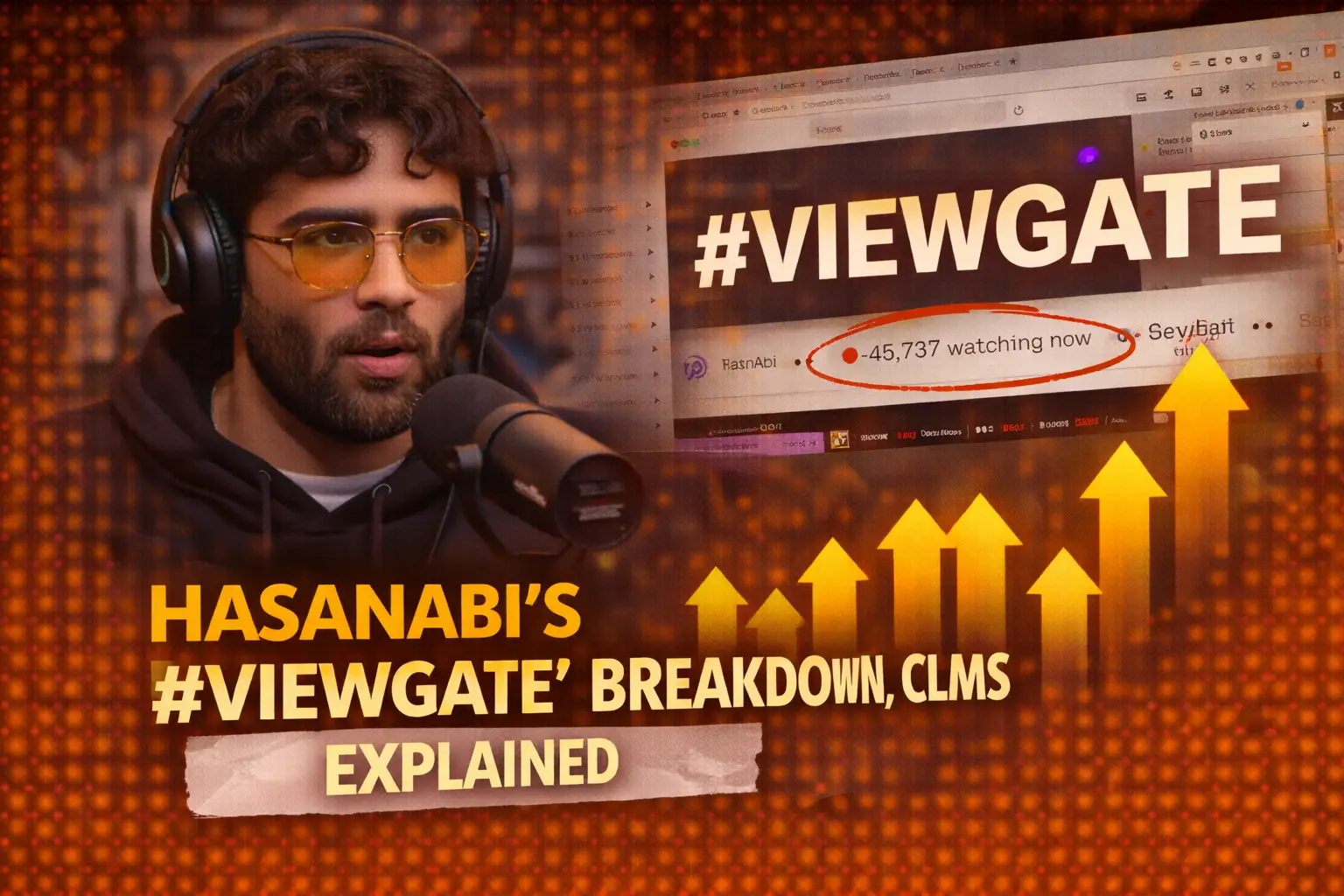
Viewer numbers are supposed to be the simplest flex on Twitch, a clean scoreboard anyone can read. In this episode of #Viewgate, HasanAbi argues that those numbers can also be the easiest thing to fake, and the hardest thing to prove in real time.
When “he has more viewers” becomes the whole argument
The clip opens with a familiar Twitch scene: chatters arriving not to discuss the topic at hand, but to post scoreboard-style taunts. Hasan describes people subscribing just to say Asmongold has more viewers, then getting shut down and leaving. He also reads a chatter’s claim that they were banned by Hasan’s moderators for saying they were Jewish, and he frames it as bait without clear proof, noting the chatter “hid the receipts.”
The bigger point is simple: Hasan treats the viewer-count flex as a substitute argument. If someone can’t win on substance, they pivot to popularity. He shrugs off the premise even while addressing it head-on, saying that whether someone has 100,000 real viewers or botted viewers, it doesn’t automatically make their position correct.
Still, once chat tries to “win” on numbers, Hasan decides to talk numbers.
Hasan’s framing is that viewership is not a truth meter, but it often gets used like one.
The two-day Twitch “bot purge” storyline Hasan keeps pointing to
Hasan’s core claim is tied to a specific moment he calls a purge: he says Twitch removed bots and artificial viewership for a short window, and Asmongold’s stream performance dropped sharply during that period.
He calls out August 20 and 21 as the days where the alleged purge “cooked the bots,” and says those dates were Asmongold’s worst-performing streams of the year (as Hasan describes it). He also claims this was the only time Asmongold’s viewership fell suspiciously under Hasan’s own numbers, which he presents as a tell.
Then comes the detail he leans on for narrative punch: Hasan says Asmongold stopped streaming for a couple days, and after the break, the inflated-looking metrics returned. In Hasan’s telling, that sequence is too convenient to ignore.
To be clear, Hasan frames this as observable behavior and inference, not a verified internal Twitch action report. If you want a broader sense of how this storyline has circulated, several outlets have covered versions of the debate, including GameRant’s summary of the view-botting discourse and Several’s write-up about a Twitch viewbot crackdown. Those pieces don’t replace proof, but they show how mainstream the conversation has become.
The analytics Hasan focuses on, and why he says they matter
The most concrete part of Hasan’s argument is his use of streamer analytics concepts, especially ratios. He compares what he describes as his own chat activity to his current viewership, then contrasts it with what he claims to see on Asmongold’s side.
Hasan says that at the moment of his explanation, he has around 43,000 viewers with 39,000 active chatters, and he characterizes that as a high engagement ratio. He also compares sub counts, claiming he has far more subs than the other channel while showing fewer total viewers, which he presents as another “does this look normal?” moment.
On the other side, Hasan claims Asmongold has around 61,000 viewers with 7,000 subs, and that the channel’s “users-to-viewer” ratio looked worse before the alleged purge. He cites a past figure of 40% during what he calls “peak botting,” then says it improved later, while still looking suspicious to him.
Here’s the side-by-side based on the figures Hasan states in the video:
| Metric (as Hasan states it) | HasanAbi | Asmongold |
|---|---|---|
| Viewers at the moment discussed | 43,000 | 61,000 |
| Active chatters at the moment discussed | 39,000 | (not stated) |
| Subs at the moment discussed | 49,000 | 7,000 |
| Users-to-viewer ratio mentioned | 89% | 68% (and “40%” pre-purge, per Hasan) |
Hasan also adds an important caveat: he says ratios aren’t a perfect detector because newer bots can mimic engagement better than older ones. In other words, he’s using the numbers as smoke, not a fingerprint.
“Is it him?” Hasan’s take on responsibility, plus the follower-botting angle
Hasan repeatedly says he doesn’t believe Asmongold is personally buying bots, but thinks someone may be doing it for him. He argues that a creator might not push back hard if inflated metrics make them look bigger, even if the boost is unwanted.
He also contrasts view-botting claims with follower-botting, pulling up a clip where Asmongold appears to react to sudden follower changes. In that segment, Asmongold says he gets follower-botted regularly, and describes purging bots often. Hasan’s response is nuanced on one point and sharp on another: he says he’s not blaming Asmongold for follower-botting, but he criticizes the idea of delegitimizing Hasan’s channel while acknowledging bot activity exists on the platform.
This is where the argument becomes less about one creator and more about Twitch’s ambient chaos. If bot activity is common, then public accusations turn into a credibility war, and everyone becomes a part-time forensic accountant.
For more context on how this back-and-forth has been framed elsewhere, Win.gg’s recap of the Hasan and Asmongold viewbotting claims captures the “two sides, two narratives” energy around the dispute.
The personality subplot: insecurity, rage-quitting, and the “second account” glow-up
Hasan doesn’t keep the discussion purely technical. He mixes the numbers with a character read.
He calls Asmongold insecure, and brings up a clip of Asmongold quitting a difficult game (Hasan references a FromSoftware title, and the clip includes Asmongold saying the game stresses him out and he’s done). Hasan contrasts that with his own style of getting mad and moving on, using it to argue that Asmongold cares deeply about how he’s perceived.
Then Hasan mentions Asmongold building up a second channel after stepping back from his main account. The transcript refers to it as “the Zack Roar one” (commonly known online as a secondary account), and Hasan treats that as part of the broader “image management” arc.
None of that proves bots. It does explain why, in Hasan’s view, the idea of inflated metrics would be tempting to ignore. The numbers become less a stat and more a confidence accessory.
Why Hasan keeps talking about Asmongold anyway
A recurring complaint Hasan responds to is: “You’re the only one keeping him relevant.” Hasan rejects that framing. He argues that ignoring a large creator doesn’t make them disappear, and he says someone has to challenge the talking points and contest the perceived legitimacy.
He also claims the “more viewers” chant is used as social proof by people who don’t care about policy or substance. Hasan’s tactic, as he describes it, is to poke the one pillar those chatters treat like gospel. If the viewer numbers are questionable, then the aura of inevitability gets weaker.
He extends that into a broader critique of online political identity. Hasan says many people don’t engage politics through ideology or policy, they engage through what feels cool, dominant, or popular. If a platform’s vibe shifts rightward, he argues, it can pressure others to copy the tone just to fit in.
That’s also why he calls Twitch “his backyard.” He’s not only reacting for content, he’s describing it as defending the space where he works.
If you want to follow Hasan’s own output beyond this clip, the video description points to his main livestream home on HasanAbi’s Twitch channel and his updates on Hasan’s Twitter account.
The bigger accusation: platform enforcement, politics, and “permission structures”
The most serious part of the video isn’t the bot math, it’s Hasan’s claim that Twitch applies rules unevenly.
Hasan compares the tolerance for heated rhetoric across creators, and he brings up Destiny as an example of someone who faced major consequences for comments Hasan describes as milder than what he’s criticizing here. He also claims Asmongold’s audience can mobilize harassment toward smaller creators, and says he absorbs a lot of it himself so others don’t have to.
Then the conversation expands into politics: Hasan argues that certain online spaces have shifted because cultural gatekeeping weakened. He describes an earlier era where right-leaning creators self-censored more to avoid consequences, then says the “floodgates” opened. He also claims Twitch is hesitant to act against big creators because of the backlash narrative, especially if powerful outside figures amplify it.
In that same lane, Hasan references outside groups and narratives about Twitch being “hyper-woke,” saying those claims created cover for inconsistent enforcement. His conclusion is blunt: he believes Twitch knows about botting and rule-violating behavior, but won’t act because it fears the public reaction.
Conclusion: what #Viewgate is really about
Hasan’s case rests on pattern recognition: a two-day performance dip during an alleged purge, engagement ratios he says don’t add up, and a platform culture that rewards “bigger number wins.” None of it is presented as confirmed proof from Twitch, but it explains why the storyline keeps catching fire.
In the end, #Viewgate isn’t only a debate about inflated viewers. It’s a fight over who gets to look legitimate on a platform where perception often becomes reality. If Twitch wants fewer of these public trust spirals, the cleanest fix is consistency, both in metrics integrity and in enforcement.
Learn more about Pulse of Fame and our editorial team. Want to weigh in? Join the conversation in the Pulse of Fame community forum.
Related: Jim Jones’ Landlord Is “Lying,” According to Wayno, and the Viral Video Left Out