By Agent 00-Tea | Cultural Analyst
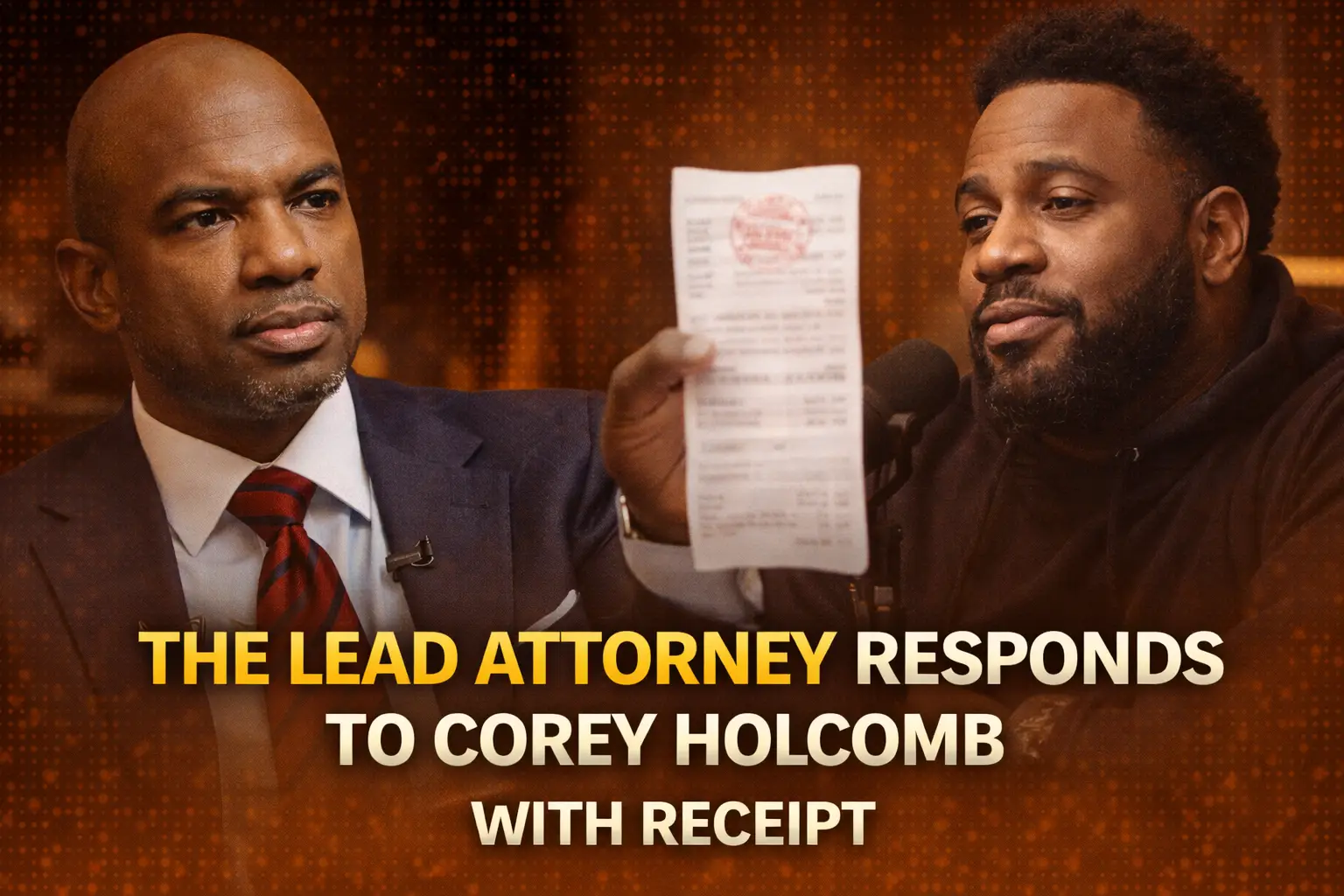
When a comedian says, “I’m going to make an example out of this,” you already know the internet is about to clock in. This time, Corey Holcomb aimed that energy at The Lead Attorney, accusing him of lying about one key detail: whether Corey approved an interview with Corey’s own lawyer.
The claim that kicked off the back-and-forth
Corey’s complaint is simple, and he repeats it with confidence: he says he never gave permission for The Lead Attorney to speak with his attorney. In Corey’s version, that’s the whole story, and the fact that The Lead Attorney stayed quiet afterward is treated like a silent confession.
The Lead Attorney frames Corey’s comments as more than jokes. To him, it crosses into a direct hit on credibility, especially because the claim is about something easy to verify: whether Corey’s attorney said the interview was approved.
Still, The Lead Attorney’s point is narrow. He says he didn’t respond at first because he didn’t want to embarrass Corey by showing private messages. That decision changes the moment Corey calls him a liar again in front of a big audience.
Two ways to interpret it, and why silence didn’t mean surrender
The Lead Attorney says there are only two ways to read the situation:
- Corey is lying about never giving permission, or
- Corey’s lawyer acted without properly looping Corey in, which would be a problem on the lawyer’s side
In other words, somebody’s story has to bend, because both can’t be true at the same time.
He also pushes back on the idea that staying quiet means he knew he was wrong. His explanation is more personal: Corey had previously invited him to Corey’s show, covered transportation, provided great accommodations, and even took him out to eat with Craig and Darlene. So he chose not to turn a messy private issue into content.
That’s the emotional layer of this “Corey Holcomb Lead Attorney Receipt” moment. It’s not just about messages. It’s about respect, gratitude, and what happens when public shade forces private proof into the light.
Why client permission matters when lawyers do interviews
The Lead Attorney shifts into attorney-mode and explains the ethical framework. If a lawyer is representing a client, the lawyer can’t just pop onto someone’s YouTube channel and talk shop because it sounds fun. A careful attorney has to get approval and make sure the client understands the tradeoffs.
He describes it like this:
- Check with the client first before agreeing to speak publicly
- Explain pros and cons of doing the interview
- Get informed consent, meaning the client understands and still agrees
He also contrasts experience levels mentioned in the video: Corey’s attorney “Derek” says he’s been practicing 14 to 15 years, while The Lead Attorney says he’s been an attorney for close to 25 years. That comparison isn’t just ego, it’s used to underline standards of professional responsibility.
Another key detail: Derek represents Corey, not Corey’s co-hosts. So neither Craig nor Darlene can “clear” an interview on Corey’s behalf. Only Corey can.
The receipts: DMs, scheduling, and the “cleared to speak” line
The Lead Attorney shows screenshots and email threads (with sensitive details redacted) to demonstrate what happened.
First, he reaches out to Derek after Derek appears on Corey’s show discussing the Christina Payne situation. The Lead Attorney says he felt Corey was getting a “raw deal” in how people were characterizing that incident, and he wanted Derek to share Corey’s perspective.
Derek’s initial reply, according to the messages shown, is basically: he’ll check with Corey first.
Then comes the line The Lead Attorney says changes everything: “I am cleared to speak with you.”
From there, the conversation moves into logistics. Derek suggests a time window (Friday after 7 p.m. Central, or weekend evenings). He also provides professional contact details to coordinate. The Lead Attorney follows up by email with “Interview” as the subject line, thanks Derek for being willing to do it, and asks for any publicly available filings (not privileged info).
By Friday afternoon, The Lead Attorney emails again asking for a confirmed time, noting he needs to announce it on his channel and get basic show prep done.
The cancellation, the gag order explanation, and the awkward contradiction
Derek ultimately cancels. The reason given: a gag order connected to the court matter, and the need to be careful.
The Lead Attorney doesn’t claim Derek scammed him or took money. His issue is the logic. If a gag order prevents talking about the case, why did Derek already discuss it on Corey’s show while that same gag order was supposedly in effect?
That contradiction is the whole point of “dropping receipts” here. The Lead Attorney says Corey went public calling him a liar, even though the messages show Derek presenting the interview as approved. If Corey truly never cleared it, then Derek’s “cleared to speak” line raises uncomfortable questions about how Derek handled client permission.
The central dispute isn’t whether the interview happened. It’s whether the approval was real, and who’s responsible for the mixed signals.
Reputation, respect, and why he says he’s still not rooting against Corey
The Lead Attorney closes the loop with a broader point about reputation. He notes Corey has talked about losing gigs and money due to reputational damage. Therefore, publicly labeling someone a liar, especially a lawyer who cares about professional standing, is a serious move.
At the same time, he insists he’s not part of a “cancel Corey” crowd. He even draws a line between topics where he disagreed with Corey (the “Anton” situation) and topics where he supported Corey (Christina Payne). His ideal is simple: support people when they’re right, and say they’re wrong when they’re wrong, without name-calling.
For viewers who want to follow The Lead Attorney’s work beyond this clip, the video description includes official resources like a private 1-on-1 consultation, the Divorce Domination newsletter, and the private community group.
Conclusion
This dispute lands where most online feuds land, on receipts and pride. Corey says no permission was given, while The Lead Attorney shows messages that appear to say the opposite, at least from Corey’s attorney. Whether the real problem is miscommunication, bad lawyering, or public ego, the lesson is the same: once “liar” enters the chat, screenshots aren’t far behind. In the end, reputation is the only currency both sides can’t afford to waste.
Learn more about Pulse of Fame and our editorial team. Want to weigh in? Join the conversation in the Pulse of Fame community forum.
Related: Jay Morrison Bankruptcy Social Proof: Inside the Tulsa Real Estate Fund Intervie