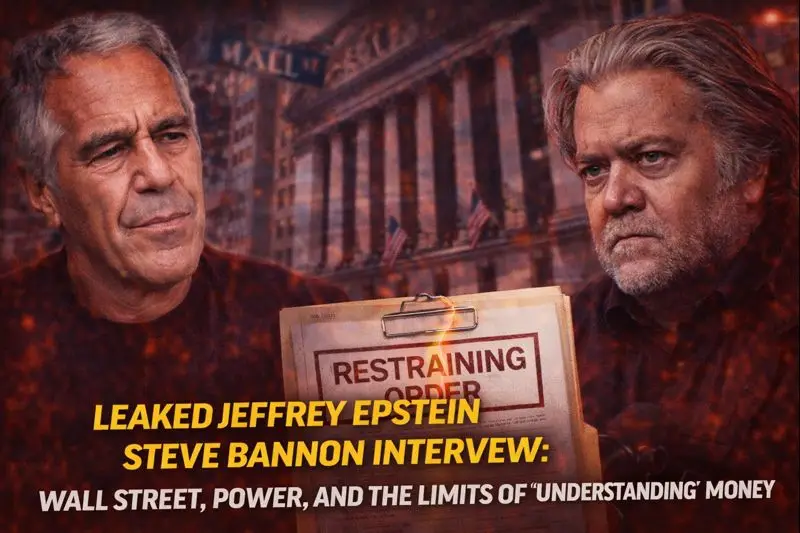
A two-hour clip billed as the Leaked Jeffrey Epstein Steve Bannon interview is making the rounds.
What lands hardest is the core tension: people assume the folks closest to power understand the system, yet the conversation keeps circling one claim, that the system is too complex for anyone to fully control.
How Epstein frames his path from Bear Stearns to elite rooms
By The Legal Eye
Epstein presents his rise as a byproduct of an older world colliding with a newer one. He says he was invited onto Rockefeller University’s board around the late 1980s or early 1990s because the institution needed more financial expertise as investing, budgeting, and portfolio thinking got more technical.
In his telling, prestige used to run on “name and reputation,” then business culture shifted toward what could be calculated. He uses a very period detail, the Texas Instruments calculator, as a symbol of finance moving from handshakes to math. He argues that once numbers became the language, institutions like Rockefeller wanted people comfortable with that language.
A key character in his story is David Rockefeller, who Epstein describes as unusually respectful and curious. He recounts Rockefeller introducing his driver as a “colleague,” and he shares an anecdote about Rockefeller growing up with the expectation he’d always pick up the check because of the family name, even though Rockefeller told him he would not inherit money.
This segment also threads into the Trilateral Commission, which Epstein describes as Rockefeller’s attempt to create stability by bringing together political leaders and business leaders from North America, Europe, and Asia. Epstein says he was invited in his early 30s and jokes that when asked to submit a bio alongside major figures, he wrote: “Jeffrey Epstein, just a good kid.” Bannon wants starstruck awe; Epstein insists he’s impressed by ideas, not titles.
For broader reporting on Bannon’s recordings and how they’ve been discussed publicly, see The Hollywood Reporter’s coverage of Bannon’s Epstein videos.
“Most leaders are financially illiterate,” and Epstein’s favorite proof points
Epstein’s most consistent theme is that money basics aren’t widely understood, even by powerful people. He claims many political leaders come from careers built on popularity rather than finance, and he tosses out examples ranging from military leaders to entertainers. In his view, their “financial knowledge” often stops at personal banking, not system design.
He then goes straight for the concept that reliably confuses people: bank balance sheets. Epstein says ordinary language breaks down because a bank’s “assets” are not cash in a vault, they’re money owed to the bank. So when a bank’s assets grow, that can mean it’s extended more loans, not that it’s “richer” in the everyday sense.
His bigger teaching moment is fractional reserve banking (he uses the phrase “fractionalized” reserves). Epstein claims the average person would assume that if they deposit $1, the bank can lend less than $1 because it should keep some on hand. He says the modern system allows banks to lend multiples of that deposit, which he frames as both normal and deeply unintuitive. Whether or not his exact numbers match today’s rules, the point he’s making is cultural: people picture banks like safes, not like credit-creation machines.
Inflation becomes another showcase for disagreement. Epstein tells Bannon he still “doesn’t understand” inflation as a concept, then explains it in everyday terms anyway: your dollar buys less over time, prices rise, and the value of money shrinks. Bannon pushes the historical fear angle, central banks haunted by the 1970s, Weimar Germany, and the link between inflation panic and political collapse.
Epstein’s scariest illustration is hyperinflation. He references Zimbabwe and describes a headline-grabbing image, a massive denomination bill worth roughly a cent in US terms. He uses it as a warning for how systems can break when trust in money breaks.
Why the first Trilateral Commission meeting sounded “boring” to him
Bannon tries to stage the Trilateral Commission as an elite summit where geniuses map the future. Epstein replies with a shrug and calls it boring. That answer is doing a lot of work, and it reveals how Epstein wants to be seen: not as a fanboy, but as an analyst.
He says he flew privately to Tokyo for an early meeting (he notes it wasn’t his plane), but claims the room didn’t impress him because many leaders were skilled politicians, not deep thinkers. His status bar is “great ideas,” and he says those can come from anyone, including a bus driver or a student.
The meeting topic he remembers is inflation and how to control it, which he uses to underline his broader theme: even “big” conversations can turn into debates built on shaky shared definitions. Bannon frames inflation as the specter that haunts central bankers; Epstein keeps redirecting to the idea that the entire system rests on structures most people never intuitively grasp.
This is also where the interview starts to sound like a warning about modern expertise. Epstein compares the financial system to the human body: lots of specialists understand parts, but no one fully understands the whole. In his analogy, you can find a great knee doctor or heart doctor, but you won’t find a single person who truly “gets” everything at once.
That framing, elites as partial specialists inside a massive organism, is a recurring motif in later sections, including the 2008 crisis.
Santa Fe Institute, complexity theory, and the AI comparison he can’t stop using
Epstein links his interest in the Santa Fe Institute to a desire for interdisciplinary work and to what he calls “complex systems.” He places the funding or support in the early 1990s, and ties it geographically to New Mexico, Los Alamos, and the post-Cold War moment when high-energy physics funding shifted and scientists remained in the region.
He describes Santa Fe as an attempt to make complexity legible with math: to “mathematize” systems where outcomes don’t track cleanly from inputs. It’s the same instinct behind the “butterfly effect” story he later tells from trading days, where a small currency shock ripples across global markets.
Then he jumps to artificial intelligence, and this is where his point gets sharper. Epstein argues that modern neural nets can produce answers, and even outperform humans at tasks like learning video games, but the people who build them often can’t fully explain how the system arrived at its decision. To him, that’s proof we’ve entered an era where humans create powerful systems that become partially opaque, even to their creators.
His verdict on the Santa Fe ambition is harsh. He calls the effort a “total failure,” not because it produced nothing, but because the central dream, predicting the unpredictable, keeps collapsing. He says people build models, believe they’ve cracked the code, try to profit from it, then go broke and start over.
If you want another window into public reporting around the Epstein-Bannon connection beyond the clip itself, see BBC reporting on emails highlighting the relationship.
The 2008 financial crisis, told from solitary confinement
The most surreal segment is Epstein’s claim that he was in jail during the Lehman Brothers weekend in September 2008. He describes solitary confinement conditions: a small cell, minimal items, no library access, and food passed through a slot. He says he learned about the crash when a guard mentioned it and worried aloud about his pension.
Epstein claims the guard brought up Bear Stearns as a front-page name, which landed personally because Epstein says he had been a partner there and still had significant money tied to it. He describes using limited early-morning collect calls to reach Jimmy Cayne (he identifies him as Bear Stearns’ president), and then calling a contact at JPMorgan, whom he says was trying to buy Bear Stearns.
The interview lingers on the irony, Bannon tries hard to get a “what have I done with my life” moment, and Epstein refuses to give it. He calls it strange, even incredible, but not emotionally shattering. The exchange turns into a character test: Bannon wants regret, Epstein gives detachment.
The financial content returns when Epstein explains what he says he told Treasury contacts. His message: stop thinking of finance as a machine with replaceable parts. Think of it as a body in an emergency room. He uses one repeated analogy, liquidity is the blood of the system. When it dries up, everything fails fast. He says you pump “blood” into the system first, then worry about secondary injuries later.
On the Bear versus Lehman decision, he frames it as triage, like saving kidneys over a gallbladder. He also argues that blaming derivatives for 2008 is simplistic. He compares it to blaming hair for a heart attack: present in the picture, not the root cause.
For a sense of how the “lost tapes” storyline has circulated in politics coverage, see a House member’s site referencing Daily Beast reporting on Bannon’s Epstein tapes.
Subprime, politics, and the accounting change he says accelerated panic
When the conversation turns to causes, Epstein makes a provocative claim: he blames Bill Clinton, not because ordinary borrowers wanted homes, but because he says politics pushed banks into risk they would not normally take.
In Epstein’s telling, “subprime” is basically a rebrand of bad credit that sounds less judgmental. He describes pressure on banks to lend to borrowers who would previously be denied, plus government-linked guarantees that made the loans feel safer to the lenders. He also alleges banks faced threats of discrimination charges if they refused to lend under these new expectations.
That setup, he claims, let banks originate large volumes of riskier mortgages, bundle them, and sell them onward, spreading exposure throughout the system. He frames it as politics inserting itself into markets, turning a risk question into a vote-counting exercise.
Then he points to an accounting shift as an accelerant. He describes a move away from valuing assets at what you paid yesterday toward valuing them at what you could sell them for today (a stress case). In his simplified example, something bought for $1,000 becomes marked at $990, then $980, creating cascading write-downs that tighten balance sheets and worsen fear. He treats it less like a single trigger and more like a pressure multiplier during a fragile moment.
This segment is also where Epstein insists again that nobody can truly “see it coming.” He compares 2008 to a heart attack or stroke: in hindsight you can list warning signs, but prediction in real time is shaky, even for people inside the system.
From Newton to “the soul,” and why he thinks measuring has limits
The final stretch pivots into big-think territory: Newton, calculus, quantum physics, and the limits of measurement.
Epstein frames Newton as the turning point because physics became predictive. If you can measure motion, you can forecast outcomes. Yet he notes Newton could name gravity and measure it, without explaining what it “is.” To Epstein, that’s the recurring human pattern: we label mysteries and mistake labels for understanding.
Calculus enters through Zeno’s paradox, the idea that you can halve distance endlessly and “never” reach the wall. He presents calculus as a tool for approaching limits, even if you never touch the absolute point. He also uses the taboo example of dividing by zero as a border zone where normal math breaks.
Quantum physics, in his summary, is what happens when you zoom in and the old physical intuitions stop working. He describes the electron not as a tiny ball but as a cloud of energy, another case where common sense collapses under the microscope.
Then he makes his most personal claim: he believes in the soul. He calls it the “dark matter of the brain,” something you can’t see directly, but you infer from what it seems to do. He insists life is a miracle, not something easily described by equations. He riffs on bananas “breathing” and seeds as liminal objects to argue that “alive” and “dead” don’t fit neatly into boxes.
He also draws a gendered contrast, saying men tend to want measurement and women tend to trust intuition more. Whether you buy that framing or not, it matches his broader point: some of the most important forces in human behavior, fear, attraction, gut sense, don’t submit cleanly to math.
He even brings it back to trading. Epstein claims great traders often can’t fully explain why they know what they know. They feel it, then act. The market, in that sense, behaves like another living system, with signals that resist tidy formulas.
Conclusion
This clip is messy, self-mythologizing, and oddly revealing, sometimes all at once. It sells a worldview where power circles are full of status, but not much certainty, and where complexity beats confidence more often than people admit. If there’s a throughline, it’s this: the interview treats “understanding” as the thing everyone wants credit for, yet almost nobody actually has.
Learn more about Pulse of Fame and our editorial team. Want to weigh in? Join the conversation in the Pulse of Fame community forum.