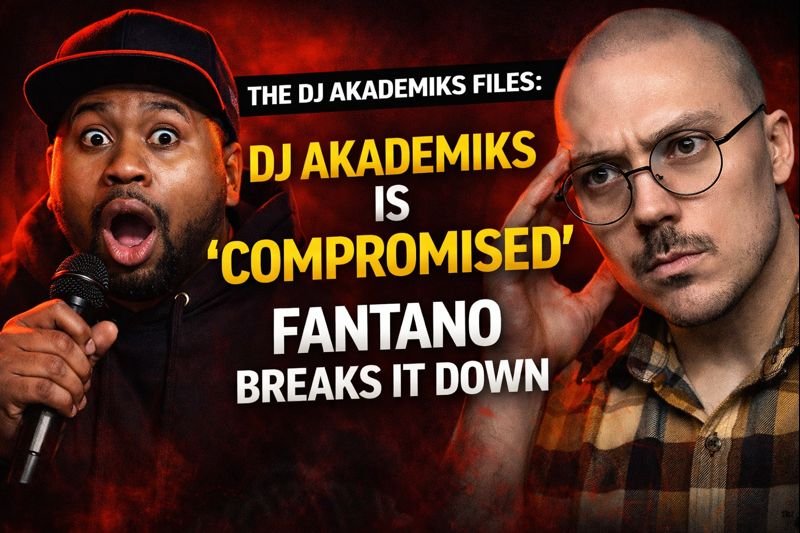
What do you even say when the headline is always the same person, again? Every time I end up talking about DJ Akademiks, it’s because he’s found a new way to turn rap commentary into a mess, then act surprised when people side-eye the whole operation.
In this case, the loudest part is not even the clip where he’s complimenting Nick Fuentes. The bigger moment is Akademiks repeatedly saying, on camera, that he took money for favorable coverage, then treating that confession like it’s some kind of power move.
The Akademiks cycle: loud takes, louder consequences
By Agent 00-Tea
There’s a pattern with Akademiks that’s hard to ignore. The energy is always turned up to maximum, the framing is always personal, and the “journalism” label starts to feel like a costume you put on right before a livestream.
Fantano’s tone here is basically: how many times do we have to do this? Not because one creator is “mean,” but because the constant drama starts to tell you something about incentives. If the goal is attention at any cost, then context is optional, fairness is negotiable, and credibility becomes a prop.
A quick recap of what gets brought up in the video as part of that broader frustration:
- Perceived bias toward certain artists, with Drake named as a go-to example.
- Aggressive narrative-spinning, especially when a story is already heated.
- A habit of escalating conflicts, then acting like the escalation was forced.
That’s what makes the “compromised” label sting. It’s not just about one claim. It’s about a long-running vibe that the commentary has a price tag, even if nobody can prove the exact number in every case.
For a wider look at how Akademiks built his reputation as a controversy magnet, this older profile helps frame the persona: how DJ Akademiks became hip-hop’s one-man TMZ.
The Nick Fuentes shoutout that raised eyebrows
Before the money claim even takes center stage, the video flags another clip that’s hard to watch casually: Akademiks giving a friendly shoutout to Nick Fuentes, calling him “a cool dude,” while adding a partial disclaimer that he doesn’t like it “when he go off on some little racist” stuff.
That kind of “I don’t like the worst part, but I like the logic” defense lands like a half-wash. Fantano’s point is not complicated here. It’s surprise, mixed with disbelief, that Fuentes is showing up as a casual-friendly mention at all, let alone more than once in a short span of time.
Even if someone thinks they’re complimenting “debate style,” the clip still normalizes the person attached to those ideas. That’s the issue. The bar for who gets treated as “cool” starts looking way too low, and it feeds the bigger theme of the video: judgment that seems guided by convenience, not principle.
The real bombshell: Akademiks says he got paid for silence on Lil Baby
The main story is Akademiks claiming, repeatedly and emphatically, that he can prove money moved. He says he’ll show receipts. He says he’ll show his bank account. He says he’ll give the money back.
He also name-drops major industry entities while doing it, including Universal Music Group, Capitol Records, and Motown, as part of the “I’ll return every dollar” rant. The way it’s presented is not calm or careful. It’s emotional, chaotic, and built for maximum spectacle.
Then comes the line that turns the whole thing into a credibility crisis. Akademiks claims Lil Baby’s team paid him $30,000 to stay quiet about Baby’s most recent album, described in the video as his last full-length LP. The wording matters because it’s not framed as paying for promotion. It’s framed as paying for the absence of criticism.
If you want to see how this claim has been recapped elsewhere, here’s one write-up centered on the same allegation: DJ Akademiks accuses Lil Baby’s team of a $30K payment.
The alleged incident that set him off
Fantano adds context, with careful language, because not every detail is confirmed. According to what’s described, there was some kind of confrontation involving an associate of Lil Baby and Akademiks, possibly a press or a slap. The facts are presented as incomplete, but the result is clear: Akademiks links the situation directly to Lil Baby, and he spirals into challenge-mode.
That’s when the “I’ll fight you anywhere” energy starts, along with personal insults aimed at Baby. The specifics of the insults aren’t the important part. The shift is. Akademiks goes from “industry media guy” to “street fight narrator” in seconds, which is exactly why so many people don’t take the journalism label seriously when it comes to him.
Why admitting “pay for play” doesn’t win, it stains everything after it
Fantano’s central argument is simple: if you admit you got paid to shape coverage, you don’t corner the artist, you corner yourself.
From that point forward, every future opinion becomes suspect in one of two ways:
If Akademiks criticizes Lil Baby later, people can say it’s personal, because the relationship is clearly hostile now. If he praises Lil Baby later, people can say it’s purchased, because he already told the public a payment happened before.
It’s like trying to play referee after telling the crowd you took a check from one team. Even if you make a correct call later, nobody trusts it.
Fantano also points out a second-order effect that’s almost funny in how self-defeating it is. Akademiks talks as if this confession gives him leverage for bigger payouts later, tossing out a larger number as a hypothetical. But once you’ve publicly exposed the first deal, why would any future deal be “worth it” for an artist? The audience would assume the coverage was bought. The whole point of paying would be gone.
To put it bluntly, the confession doesn’t make Akademiks look fearless. It makes him look like someone who traded his most valuable asset, trust, for a short-term flex.
For another angle on the payola conversation around Akademiks, this Billboard report captures how often these accusations follow him: DJ Akademiks denies taking payola from Drake.
The “bias” receipts fans bring up: Drake, Tory Lanez, and selective smoke
Part of why this moment hits so hard is that it plugs into years of audience suspicion. People have watched Akademiks go unusually hard for some artists, then unusually gentle on others, and they’ve asked the obvious question: why?
Fantano frames it as a pattern of irrational defense and selective outrage, with two examples named directly:
Drake: the idea that Akademiks plays the role of loyal defender, to the point where it looks less like analysis and more like being on payroll, even if no payment is proven in any specific instance.
Tory Lanez: Fantano references Akademiks defending Tory during the period when Tory’s situation with Megan Thee Stallion was a major story, and emotions were already high across the culture.
The video’s point is not “every opinion is bought.” It’s that Akademiks has created a context where people assume money or personal relationships are steering the wheel, because he benefits from that ambiguity until it backfires.
Fantano also lists other controversies and judgment calls as part of the larger “how is he still doing this?” question, including:
- A willingness to collaborate with someone associated with a “weird” case.
- Ongoing issues involving his own allegations with a woman (mentioned without detail).
- A past interaction with a 15-year-old that Fantano describes as inappropriate for an adult to be having.
Those aren’t presented as court findings or verified fact in the video. They’re presented as part of the public cloud that already follows him, which makes the new “I got paid” moment feel like gasoline, not a spark.
ASAP Rocky’s old accusation hits different after this
One of the sharpest parts of Fantano’s breakdown is the reminder that A$AP Rocky previously accused Akademiks of being paid to post certain content.
Rocky’s quote, as referenced in the video, paints a before-and-after picture: Akademiks used to post things he genuinely liked, now it’s “nothing but drama,” and Rocky claims “we know they gave you five bands to post that” video. It’s an accusation of bought attention, said to his face.
Akademiks, in that older moment, denies it with a pretty clean slogan: you can’t buy his opinion, and if you could, he “doesn’t matter.”
That denial is exactly why the Lil Baby claim is so damaging. Fantano treats it like the mask slipping. If you tell the public you don’t do pay for play, then later brag that you took $30,000 to keep quiet, you don’t just contradict yourself. You validate years of skepticism from viewers, artists, and other media people.
If you want a recap of the broader Lil Baby back-and-forth that’s been circulating, this report is one example (again, it’s still based on online claims, not confirmed documentation): DJ Akademiks reacts to Lil Baby allegations.
My takeaway: “compromised” isn’t an insult, it’s a warning label
Fantano ends up in a blunt place: don’t treat Akademiks like a serious critic or a trustworthy journalist, because his own words suggest the output is driven by money, grudges, and attention.
And once a commentator publicly frames their coverage like that, the work starts reading like a product, not an opinion. That’s the real damage. It doesn’t just hit one story, or one artist. It trains the audience to distrust the whole format.
If you want to keep up with Fantano’s work beyond this video, the official channels are here: The Needledrop Patreon, The Needledrop on X, and Fantano on Instagram.
In the end, compromised is the cleanest word for it. When the creator tells you the coverage can be bought, you don’t need a conspiracy. You just need ears.
Learn more about Pulse of Fame and our editorial team. Want to weigh in? Join the conversation in the Pulse of Fame community forum.
Related: The Tasha K Files: Teyana Taylor dragged; Tasha K blamed.